
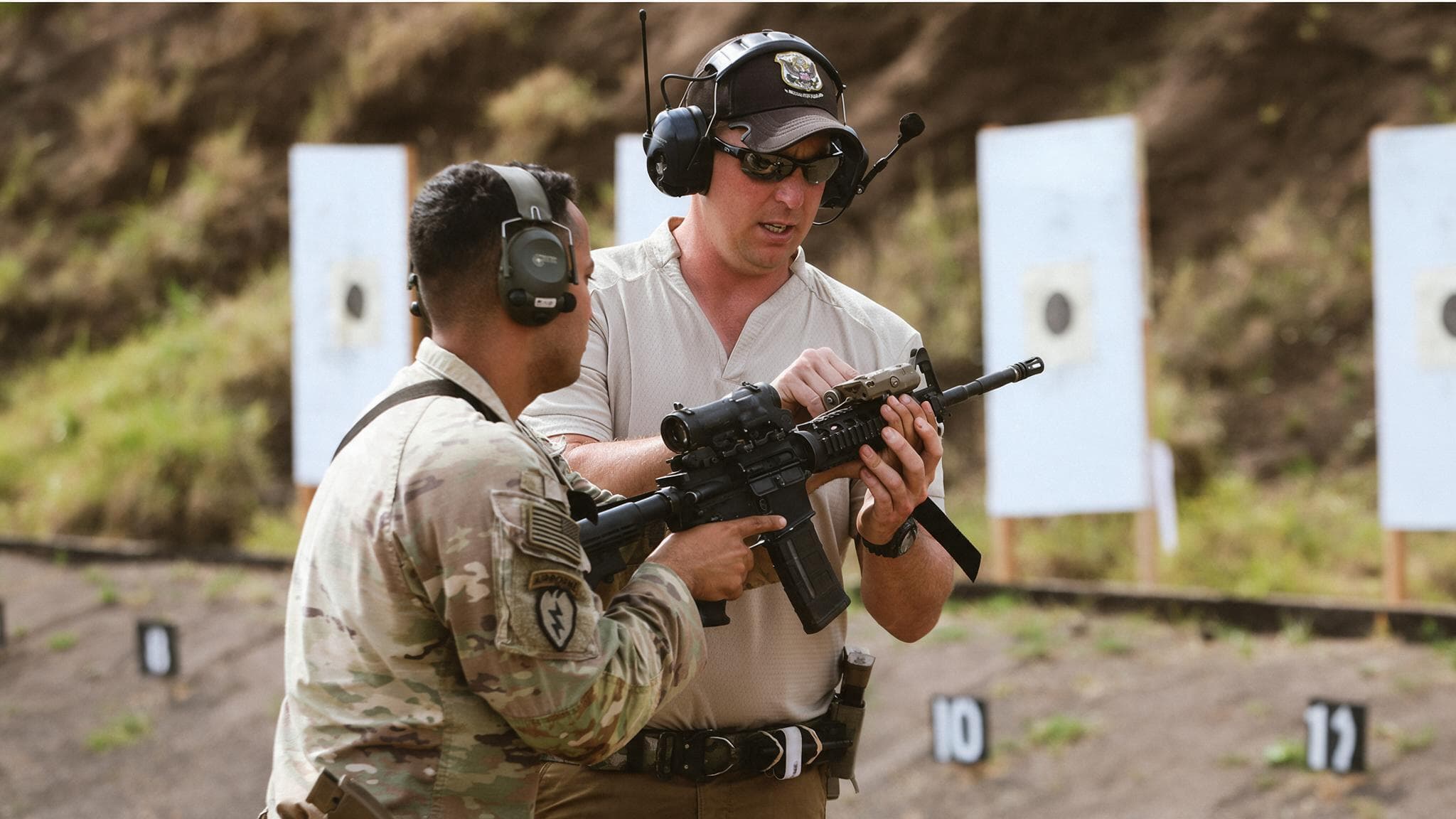
I was living in New Mexico, working out at Los Alamos National Lab, when some friends from Badlands Tactical in Oklahoma called and asked if I wanted to drive out and help on the range for an upcoming carbine class. Nine hours each way. I said yes before I had finished thinking about it.
Day one I ran roving diagnostics, checked manipulations, fixed the odd mechanical hiccup. Day two the lead instructor told me, “they’re all yours,” and walked off to let me run the class myself. At lunch he pulled me aside for a walk. I thought I was in trouble. Instead he asked if I wanted to teach more, then handed me a small box: my own Badlands business cards. I stayed on staff there until I relocated in 2022, and I still teach their armorer classes most years.
None of that prepared me for how much of this job is diagnosis and not instruction. A student tells you what is wrong with their shooting. Half the time they are wrong about what is wrong, and figuring out which half is the actual work. I learned that lesson on other people’s rifles long before I learned it on my own range.
THE BOLT THAT WASN'T THE STUDENT'S FAULT
I spent years as an armorer and worked in firearms manufacturing before I taught full time, so mechanical failure is the first thing I check on a gun that won’t run, not the last. A student in one of my Badlands carbine classes had a name brand rifle that simply would not cycle. I ran the bolt on an empty chamber myself and felt it stick.
Headspace came back excessive. The bolt lugs were sharp too, like the machining had never been finished. I swapped in a spare GI bolt head I carry in my kit, rechecked headspace, and the rifle ran clean for the rest of class.
A concealed carry student in Los Alamos gave me the same lesson from the other direction. She was using every inch of her target, and her technique looked solid enough that I could not explain the spread. I figured I would deal with it when it became an actual problem instead of chasing a theory. When we stretched the distance out, her group tightened into a fist sized knot. I stopped the drill and asked her what happened to the earlier shots. A previous instructor had told her he could not count her holes when she grouped tight, so she should scatter them across the paper. She had never believed that made sense. Neither did I.
We talked about the difference between an instructor and someone who just counts holes on a target. She came back for several more classes over the next few years, and every one of them started the same way I now start every class: find out what is actually broken before you touch anything.
Neither one had a shooting problem. One had a rifle problem. The other had a bad instructor.
STARTING AT TWENTY FIVE YARDS INSTEAD OF ARGUING AT ONE HUNDRED
A precision rifle student in Ohio kept fighting her bolt on a Remington 700 SPS Tactical, chassis stock, factory Accuracy International magazines. Every instructor on the line kept telling her to run the bolt like she meant it. The rifle kept jamming anyway, round after round, in front of a class that was starting to wonder if she just could not run a bolt gun. Summer heat had softened the feed lips on her magazines just enough to let rounds tip up early, before the bolt could pick them up clean. She switched to single feeding for the rest of the class and never fought that rifle again. She had not done a single thing wrong. Her gear had quit cooperating in ninety degree heat, and no amount of aggression on the bolt handle was ever going to fix a magazine.
My first precision rifle class in Los Alamos taught me the bigger version of that lesson. Ten rifles on the line, and not one of them sighted in. We spent an hour lead farming at one hundred yards with dismal results before I called time.
I moved every target to twenty five yards and stacked two dot stickers, blue over yellow, about an inch and a half apart. Aim at the top dot, hit the bottom dot. The drill doubles as a mechanical offset lesson. Two strings later, everyone in that class was stacking rounds on the bottom sticker.
A shooter who does not trust the rifle in his hands cannot learn anything else at the same time.
Confidence in the gear came back before confidence in the shooter did, and the second one does not show up without the first. Once those rifles proved themselves at twenty five yards, moving out to one hundred stopped being a fight.
I call it dot torture now, and it changed how I open every scoped rifle course I teach. Most of those rifles that first day were pie plate accurate at some distance between twenty five and three hundred yards, but none of those ten shooters could tell me which distance, and that gap was what was breaking their confidence before the class had even started. If a rifle will not hold at twenty five yards, that is a rifle problem, not a shooter problem, and I can talk the student into a loaner gun before the class burns a day chasing a flinch that was never there. Sight in trouble at the start of a class usually comes from every variable stacking at once: nerves, unfamiliar gear, technique, adrenaline. Instructors do not know which one they are chasing, and students get frustrated fast. I stopped opening carbine classes with a fifty yard zero for the same reason.
Fix what is close first. The far target will still be there once the near one stops lying.
None of this works if I am trying to be the smartest person on the range. I tell new instructors the same thing every time: don’t be a rock star or a stand up comic, the class isn’t your personal stage. Gun ranges have a habit of measuring an instructor by the size of his ego, and I have watched good instructors talk themselves into believing there is only one right way to shoot. That belief does not build better shooters. It chases off the kind of new shooter this sport claims it wants to keep. That is not a training problem. That is a choice instructors keep making, one class at a time.