
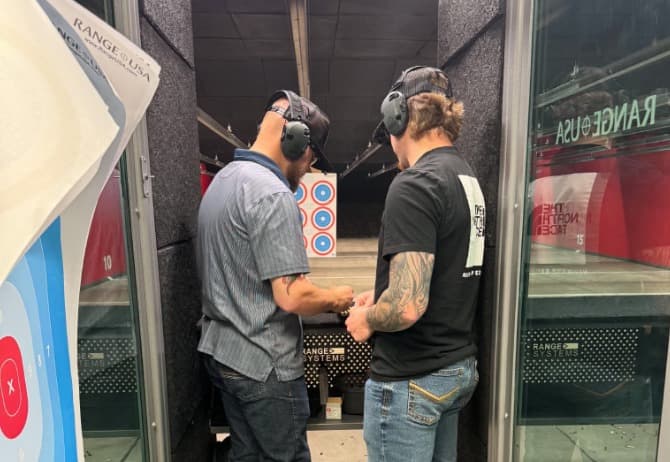
I don't have one range moment that sticks with me more than the rest. I have dozens. The ones that stay are the sessions where a newer shooter is getting tighter and more frustrated with every string, and we stop sending rounds downrange. We go back to grip, stance, trigger control, and what the sights are actually telling them. The group on the target isn't what I remember afterward. What I remember is the change in the person, the moment everything clicks and the frustration drains out of their shoulders. That's the part of this job that keeps me in it, not showing anyone how well I can shoot.
One of the biggest things I've learned to watch isn't the shot itself. It's what happens right before it.
WHAT THE HOLE IN THE PAPER DOESN'T TELL YOU
A student can have a solid stance, a decent grip, and what looks like clean trigger control, and something still changes in the fraction of a second before the gun fires. A slight tightening of the fingers. A shift in grip pressure. A dip of the muzzle. The whole body starting to brace for recoil before the shot even breaks. If you're only reading where the round landed, all of that is invisible. The target is showing you the result of something that already happened. It isn't showing you the cause.
The typical student shooting consistently low and left brings the easy answer with him: “you're flinching.” That's probably one of the most common diagnoses we hear on the range. But “flinch” describes what we think we're seeing. It doesn't necessarily tell us what the shooter is actually doing.
Watching this student closely, the problem wasn't the trigger finger at all. As the press finished, the lower fingers of the firing hand were adding pressure, a sympathetic squeeze that showed up at precisely the wrong instant and pulled the muzzle off line. I recognized it partly because I'd fought a version of the same thing myself after elbow surgery on my strong side. So we stopped chasing “the flinch” and worked on keeping grip pressure constant while letting the trigger finger move on its own.
A perfect example is social media. Post a photo of your target and a hundred people will confidently tell you what you did wrong, without having watched you shoot a single round. Two shooters can produce nearly identical groups for completely different reasons. A chart that maps shot placement to a cause can point toward something worth investigating, not hand you a diagnosis. Treating it like one usually means fixing a problem the shooter doesn't have while the real one stays untouched. The target is evidence, not the diagnosis.
THE DRILL THAT MAKES THEM SEE IT THEMSELVES
The standard advice for that student would have been “slow down and press the trigger.” It sounds right. With this particular shooter it made things worse, because the slower and more deliberate the press became, the more time they had to sit there anticipating the recoil. So we dropped “press slowly” and replaced it with something narrower: press the trigger without disturbing the sights. Keep the grip pressure where it is. Let the finger move independently. Accept that the gun is going to recoil, because it is, every time. Sometimes changing one word in an instruction changes how a shooter processes the entire shot.
The target is evidence. It isn't the diagnosis.
The tool that actually closed the gap is one I hand almost every new student. I balance a snap cap on top of the muzzle during dry fire and have them work through the press without letting it fall. It gives immediate feedback. Instead of me telling them they're moving the gun during the press, they can actually see it happen. If the lower fingers tighten, if the gun gets pushed, if anything disturbs it as the trigger breaks, the cap drops. They aren't relying on a hole in the target or an instructor to tell them what happened. They can see it in real time.
Dry fire strips out the noise and the expectation of the shot firing, so the student can focus on the movement itself instead of bracing for what comes next. Repeat it enough and the correct process stops requiring conscious thought. Myelination. Then live fire isn't a test of willpower against flinching. It's a shooter falling back on something they've already practiced successfully.
What changed in that student first wasn't a tighter group. Consistency showed up first, and the frustration between strings started dropping. The shots that had been drifting low and left started coming back toward point of aim, and the group began tightening naturally. More importantly, the shooter started catching the mistake before we ever looked at the target, feeling the extra pressure in those lower fingers and self-correcting mid-drill. That's the moment I'm actually working toward with every student. Training isn't the same thing as practice, and a drill that leaves the range with them is worth more than any correction I could give in the moment.
They aren't relying on a hole in the target to tell them what happened. They can see it in real time.
I see some version of this constantly. The specifics shift. Too much pressure from the lower fingers. The whole firing hand tightening. Pushing the gun. Anticipating recoil before it arrives. Change the grip size, the trigger, the recoil impulse, or the shooter's confidence level, and the symptom on paper changes even when the underlying issue is nearly identical. It isn't limited to new shooters, either. Add speed, distance, or pressure to an experienced shooter and the same fundamentals can resurface. Difficulty just exposes them faster.
None of that works if I'm only teaching the material. Every student who walks onto my range shows up with a different background, a different confidence level, and a different reason for being there. What lands with one shooter completely misses the next. Sometimes the fix is a different word. Sometimes it's slowing down and listening for a few minutes before saying anything at all. I don't think being a good instructor is mostly about how much you know. It's about how well you can read the person standing in front of you and figure out what they actually need from you, not what worked with the last student.
Never get so comfortable with the title instructor that you stop being a student. We're human too, and I see a lot of us run into the same problems our own students have. Techniques evolve. Equipment changes. Our understanding of performance changes. Sometimes something I've taught or believed for years deserves to be challenged. That means continuing to train, seeking out other instructors, listening to different perspectives, and being willing to say, “I don't know, but I'll find out.” There isn't one universally correct way to do all of this. Fundamentals matter, but bodies are different, abilities are different, equipment is different, and the reasons people walk onto a range are different too. Good instruction has to leave room for that.
Never get so comfortable with the title instructor that you stop being a student.
And lastly, don't get so focused on demonstrating what you know that you forget why the student is standing in front of you. The class isn't about the instructor. Keep learning. Stay humble. Be willing to evolve. Earning the title of instructor doesn't mean you've reached the end of your education. It means you've taken on a responsibility to continue it.
Don't just learn how to teach the material. Learn how to teach the person.