
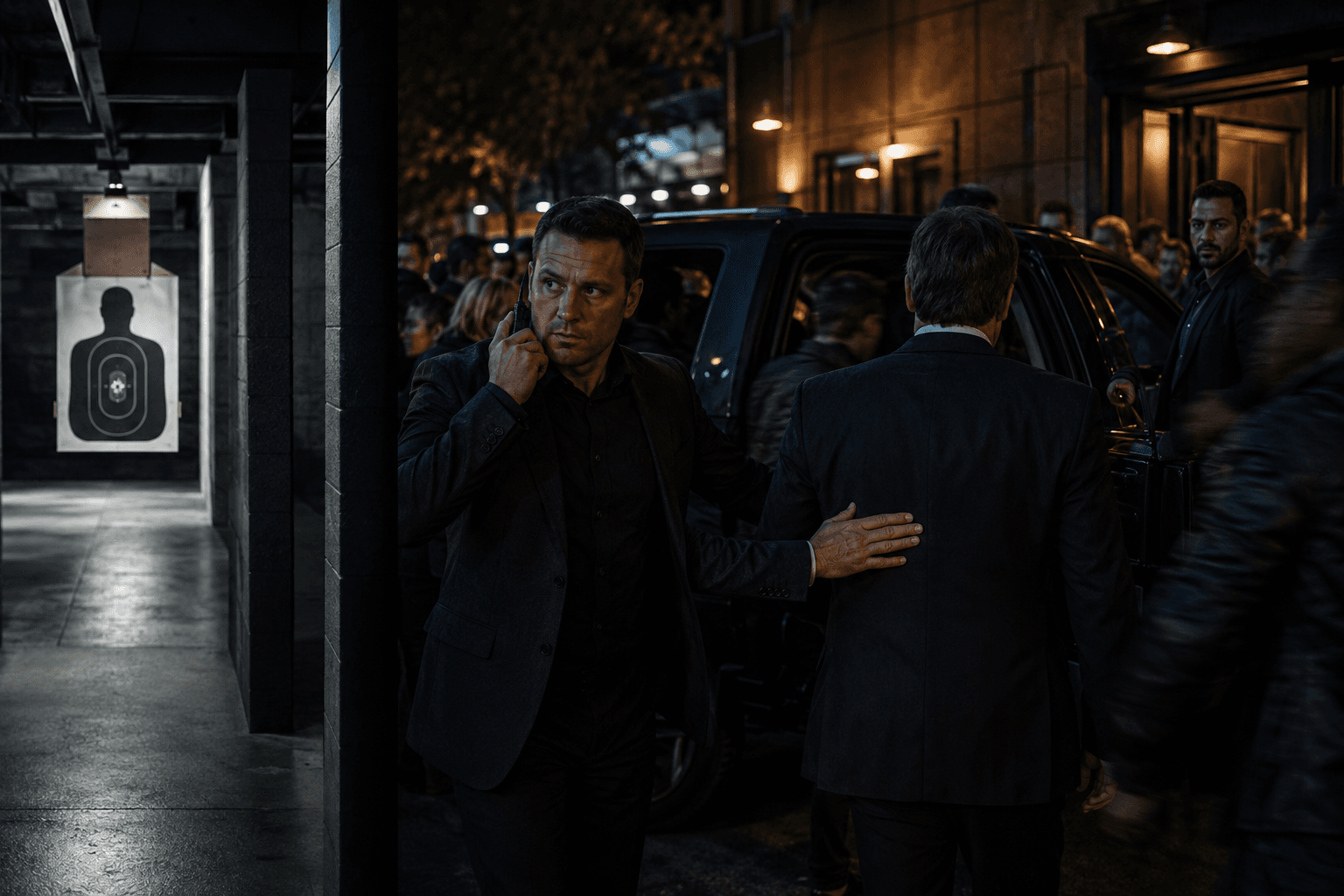
Picture a vehicle pickup outside a crowded venue. The door opens a half second early. Someone near the entrance is watching the principal instead of watching the car, and that detail either registers in under two seconds or it doesn't. There is no second window built into the sequence.
That is the entire argument behind protection training. A protection assignment does not go well because someone fought their way through a threat. It goes well because the threat never got the chance to develop.
I have spent eight years building training around that gap, working with a network of roughly fifty people across security and protection roles in Austin. The lessons did not come from a manual. They came from watching where technically skilled people still fail.
The Mission Is Prevention, Not Confrontation
The mission is not to win a gunfight. The mission is to identify risk and prevent escalation, protect the principal, and make sound decisions under pressure.
Most training programs measure the wrong thing. They track how often an operator engages a threat, when the real skill is keeping a situation from becoming one. An operator who finishes a career without ever drawing a weapon has not failed. The job was done correctly, and few programs have built a serious way to measure that: early recognition, route changes, communication timing, crowd control, and whether the principal ever entered the problem in the first place.
Reading the Environment Before It Reads You
Threat assessment starts with observation. A student has to learn what normal looks like in a given space before they can notice what is changing in it. Skip that step and every alert becomes a guess.
Pattern recognition comes next. Behavior carries information on its own. Context does too. A driver who circles the same block twice is telling you something. A crowd that goes quiet is telling you something else.
The final piece is prioritization. Information during an incident is almost never complete. Time is almost never generous. Knowing what matters, and what does not, in that order, is the actual skill. A paper target does not require prioritization. It only requires accuracy, which is why most range-based programs never touch this piece at all.
A driver who circles the same block twice is telling you something.
The Static Range Does Not Prepare Anyone
Protection work happens around people, vehicles, and structures that keep changing. Threats do not wait for perfect positioning, so training that only rewards a stable stance and a clean sight picture is training for a situation that will not occur.
Movement changes how a threat has to be read and answered. Crowds change it again, because awareness and decision-making get harder the moment innocent people are inside the picture. Vehicles bring a different problem entirely: access and mobility do not behave like a square range, and neither does evacuation. Transitions matter most of all, because real incidents do not happen in a controlled sequence. They happen in the gap between two plans.
This is what it looks like on the ground. A principal steps toward an open door, the crowd tightens by two feet, and a technically excellent shooter gets half a second to solve a problem the range never gave him. The marksmanship was never in question. The environment was.
Most programs still stop at firearms. Environmental training gets a token mention, and physical training gets close to nothing. That gap shows up the first time a scenario asks someone to do more than stand and shoot.
One Scene From the Training Floor
I ran a scenario last year with a student who was, by every square-range measure, excellent. Flat groups, fast splits, clean reloads. I put him on a simulated principal pickup: a crowd around the vehicle, two role players moving unpredictably near the door, and a radio call telling him the route had changed thirty seconds before extraction.
He froze on the radio call. His eyes stayed on the door, his hand went to the radio, and his feet stopped moving. Not for long, maybe two seconds, but two seconds is the whole margin in that kind of exit. He was still solving the door when the crowd had already told him the route needed to change. His hands were fine. His decision-making under a stacked task was not. That gap does not show up on a paper target. It only shows up when you build the pressure that exposes it.
Pressure Is the Only Honest Test
I apply real pressure in training, on purpose. A student has to move through the actual emotions of a bad moment to find out whether they can adapt inside it. Adding physical strain while forcing a decision exposes something a calm range session never will: the gap between technical skill and decision-making. That gap is not only mental. It is physiological.
Time pressure teaches a student to prioritize information instead of freezing. Environmental complexity adds movement and shifting positions, then stacks a competing task on top to make the uncertainty feel closer to real. Communication demands force clear information sharing instead of a solo performance. Physical stress shows a student how fatigue and an elevated heart rate degrade focus and judgment. Scenario-based problems make someone process, prioritize, and decide, instead of waiting to react to a command.
Physical stress is the variable that exposes the deepest layer. Bruce Siddle and Dave Grossman helped popularize the discussion around sympathetic nervous system arousal in tactical training, and whatever framework an instructor prefers, the field observation holds up: students start losing fine motor control first, then timing, coordination, and peripheral awareness as heart rate climbs under stress. A static range never pushes a student into that territory. It never tests the zone where real incidents happen.
In my scenarios, I build in one primary skill, one environmental complication, and one communication problem. If all three are present, marksmanship cannot cover for the student.
None of this is designed to create chaos. It is designed to expose what breaks. The real benchmark is recovery: whether someone can make a mistake, regain control, and keep the problem from spreading.
The real benchmark is recovery: whether someone can make a mistake and keep the problem from spreading.
Leadership Is Not the Loudest Voice in the Room
A skilled operator has to make a specific transition, from asking how to perform the task to asking how to make the team succeed. That shift does not happen by accident. I build it by handing people responsibility: the chance to plan, brief, decide, take feedback, and lead under pressure that is controlled on my end but does not feel controlled on theirs.
Leadership in protection work is not motivational language. It is the ability to brief a plan, change it midstream, and keep the team moving without creating panic. Technical skill makes someone capable. Leadership is what makes that capability worth something when the plan changes mid-event.
Communicating with purpose means delivering clear information and priorities when time is short. Command presence means projecting control without creating unnecessary escalation. Ownership means taking responsibility for a decision, its outcome, and the team's performance, including the parts that did not go well.
Leadership is what makes that capability worth something when the plan changes mid-event.
The Failures That Don't Look Like Failures
The job is not only reacting to an incident. It is staying aware, managing uncertainty, deciding with incomplete information, and holding that standard over long stretches of time where nothing happens. The biggest risks in this work rarely look dramatic.
Complacency sets in after enough exposure to normal conditions. Decision fatigue builds from sustained vigilance nobody talks about. An operator starts missing small changes because attention has narrowed without anyone noticing it happen. Stress quietly degrades judgment, communication, and performance long before it shows up as a visible mistake.
I still see programs built around equipment and procedure, with technical performance sitting on top. The harder problems are human: decision-making under uncertainty, communication under pressure, leadership when the picture is incomplete. The harder question is whether someone can recognize when the skill is needed, then adapt out loud when the plan stops working.
I do not come from a military or law enforcement background. I trained alongside people who did, and the biggest difference I found was not access to equipment. It was mindset. Civilians can access much of the same gear outside a narrow list of restricted tools. What most civilians lack is training, mental and physical, built for the moment the plan breaks.
An untrained person is a target of opportunity before anything else ever happens. Awareness is not about becoming paranoid. It is about deciding in advance that you will not be the easiest person in the room to surprise.
Don't be loot.