
Sometimes an instructor can make a student better almost immediately.
We see the problem. We correct the grip. Adjust the stance. Move the trigger finger. Slow the student down. Remind them to breathe.
The next few shots improve. We look at the target and think the correction worked.
But did it?
There is a difference between correcting a student's performance and teaching a student to recognize what needs correcting.
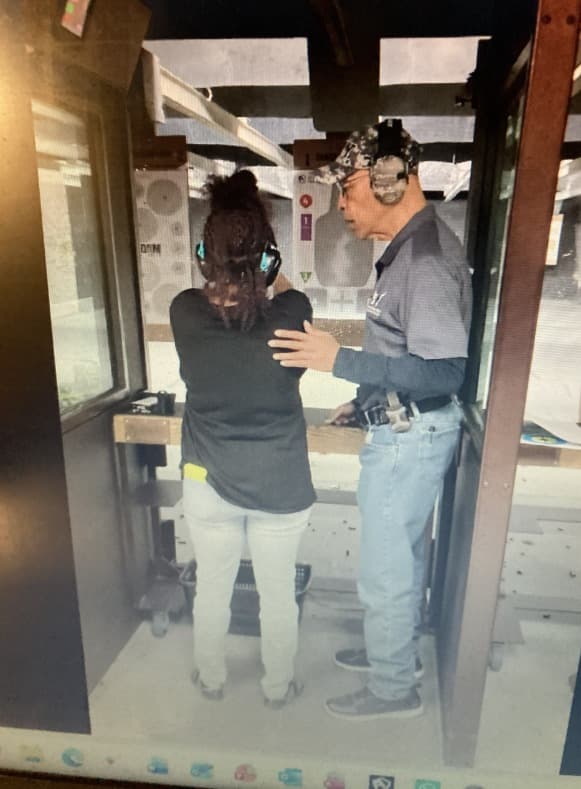
Bowen works with Quashia during an early range session in Firearms Safety First's six-week training program.
There is a difference between correcting a student's performance and teaching a student to recognize what needs correcting.
I was reminded of that through one of my former six-week program students, Quashia. During her first range trip with our group, I was right there with her. I could watch what she was doing, make corrections, reinforce the fundamentals, and help her work through what was still unfamiliar. That is what instructors are supposed to do. But we cannot remain beside the student forever.
When the Instructor Isn't There
A week or so after completing the six-week program, Quashia purchased her first firearm. She asked me to accompany her when she made that purchase, and I did.Not long afterward, she went to the range by herself. I didn't send her. I didn't know she was going. There was no instructor standing beside her watching her grip, stance, trigger control, breathing, or target.
When she finished, she sent me videos. She later told me she had been a little nervous going to the range alone. Then she told me what she did about it. She remembered to breathe and relax.That mattered to me more than the target, because something we had practiced together had followed her to the range when I wasn't there.
For Quashia, part of that process was BRASS: Breathe, Relax, Aim, Slack, Shoot. BRASS can help organize the physical shooting process, but I also use those first two words, breathe and relax, in a much broader context. They interrupt the rush. They give the student an opportunity to regain control before continuing. And that is where self-regulation begins to matter.
One of the things I teach repeatedly is to ask: what if? What if something changes? What if the firearm doesn't respond as expected? What if I become nervous? What if I lose my place in the process? What if the situation I expected isn't the situation I now have?
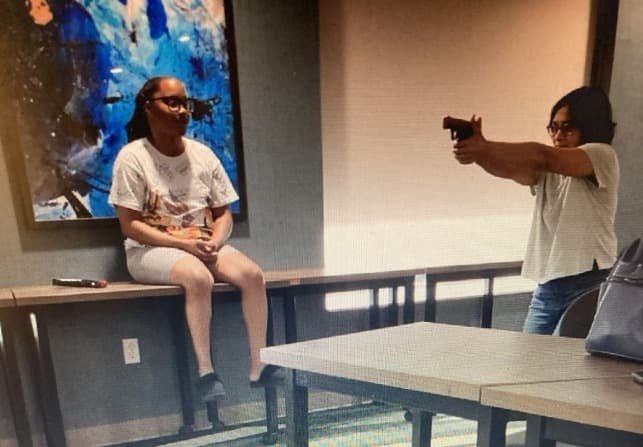
We shouldn't wait until something goes wrong to begin thinking about what we will do when it does. That applies to far more than shooting.
If I have to recognize every problem for the student, the student is still dependent on me. Eventually, they must begin recognizing change for themselves. That is why I believe a correction has not fully become a skill simply because the next shot improved. The student should eventually be able to recognize that something changed, then ask what changed, why, and what they need to do about it. That is a different level of learning.
If I have to recognize every problem for the student, the student is still dependent on me.
When Students Start Seeing What You See
I sometimes give selected graduates and more advanced students in my programs the title Student Mentor. That title is intentional. They are not instructors, and they do not assume responsibility for instruction or range supervision. They are still my students, just a little farther down the road than the newer student standing beside them.
I select them because they have demonstrated that they can consistently apply the fundamentals without requiring constant correction, and because they can share their experiences with newer students. A newer student may hear me explain something and understand it intellectually. Then a Student Mentor who stood in that same classroom not long ago tells them, in effect: I struggled with that too. Here's what Doc was trying to get me to understand. The instructor's words are still there. They're just being translated through another student's experience. I've seen this be particularly helpful when a female Student Mentor works with another woman. There can be an immediate sense of camaraderie: someone beside her who understands some of those concerns from personal experience.
But I don't leave the room. I'm observing. I'm listening. And occasionally something happens that means more to me than the Student Mentor probably realizes. I'll notice a newer student's grip is wrong, or their stance needs adjustment, or their trigger finger isn't where it should be. I'm about to say something. And the Student Mentor sees it too. Before I can get the words out, they speak up.
So I remain quiet and listen. I listen to how they explain it. I listen for whether they understand why it matters. And sometimes I'm smiling pretty brightly on the inside, because they got it.
We spend a lot of time evaluating what happened on the target, and targets matter. But a target only tells us the result. It doesn't tell us whether the student actually learned anything, or just got it right this once with me standing there.
Can they recognize when something is changing? Can they diagnose a problem? Can they recall the fundamentals without being prompted? Can they regulate themselves when nervousness or frustration appears? Can they make an appropriate correction without immediately looking toward the instructor for the answer? Those questions tell me much more about whether a lesson is becoming durable.
As instructors, we should certainly correct errors. Safety demands it. But if our only measure of success is whether the student performed correctly while we were standing beside them, we may be measuring the quality of our supervision rather than the quality of their learning.
The larger goal is not to create students who perform well because the instructor is watching. It is to develop students who can recognize, think, adjust, and make good decisions when the instructor isn't there. Because eventually, every student leaves the instructor. The lesson has to be able to leave with them.
Because eventually, every student leaves the instructor. The lesson has to be able to leave with them.