
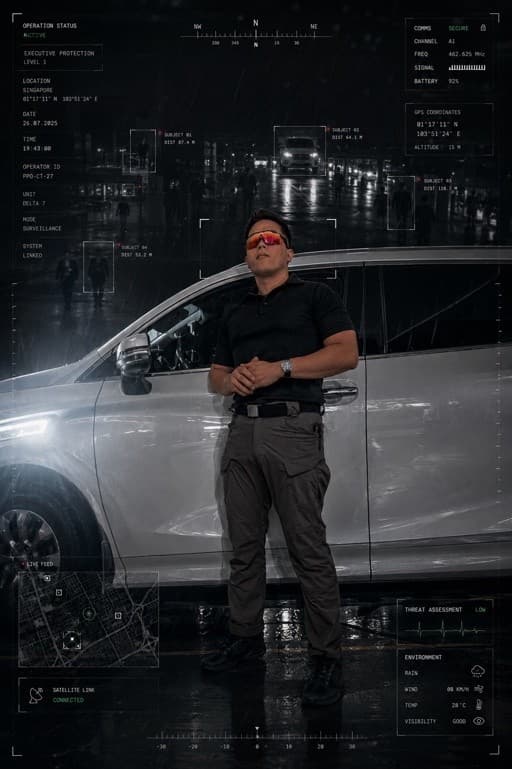
People ask what effective firearms training looks like for a protection role, and they expect an answer about grip, stance, trigger press. That is not where I start. The first question on any range is whether the firearm needs to come out at all. My job is not to win a gunfight. It is to bring the principal to safety and away from immediate danger.
Standard civilian training builds accuracy for its own sake. Law enforcement training builds engagement, closing distance on a threat to stop it. Protection work asks a different question in every moment: does this call for a draw, or for moving the principal out of the room instead?
Decision Making Over Firepower
I built this habit by forcing that question early, before there was any reason to be running on adrenaline instead of judgment. I would rather freeze for half a second and ask the question out loud than reach for the weapon on instinct once a situation turns real.
Instinct is not free. What a body defaults to under stress is whatever it rehearsed most, and if the reps are all about drawing and firing, that is what shows up when it matters. A protection detail that ends in an exchange of gunfire has usually already failed at earlier stages: the advance work, the read on the room, the positioning. The firearm sits at the end of that chain, and I put weight on every link before it. My answer, far more often than drawing, is moving the principal.
My answer, far more often than drawing, is moving the principal.
Decision-making under pressure is not something I overcomplicate in training. Breathe. That is the whole instruction, and it is also the hardest one to follow when time is short and the stakes are real. Nobody is running through a checklist in the moment. What a person can actually control is his own breathing, and that single control point buys the half second needed to think instead of just react.
My own accuracy on a calm afternoon is not the accuracy I have under real stress, and the difference is not that my hands forget how to shoot. My attention narrows to a single point and stops taking in the rest of the room, and a protection officer whose attention has narrowed that far is no longer protecting anyone but himself.
Most people train for the static range, and protection work is not static. I build my own practice around a specific choice: center mass instead of the head. Our job is not to kill someone. It is to deter them from continuing and give law enforcement the chance to follow up.
The reasoning is simple once separated from instinct. A lot of civilian and even military training conditions people toward the fastest stop, and that instinct points at the head. A head shot asks for a level of precision that, in my experience, is the first thing to go when a heart rate climbs, and a miss at that height carries consequences well past the intended target. Center mass gives a more realistic target under real stress and still accomplishes the goal: stop the threat, create room for the principal to move.
I am careful with that distinction, because no shot placement guarantees an outcome, and treating center mass as a promise of a clean result would misstate what a firearm actually does.
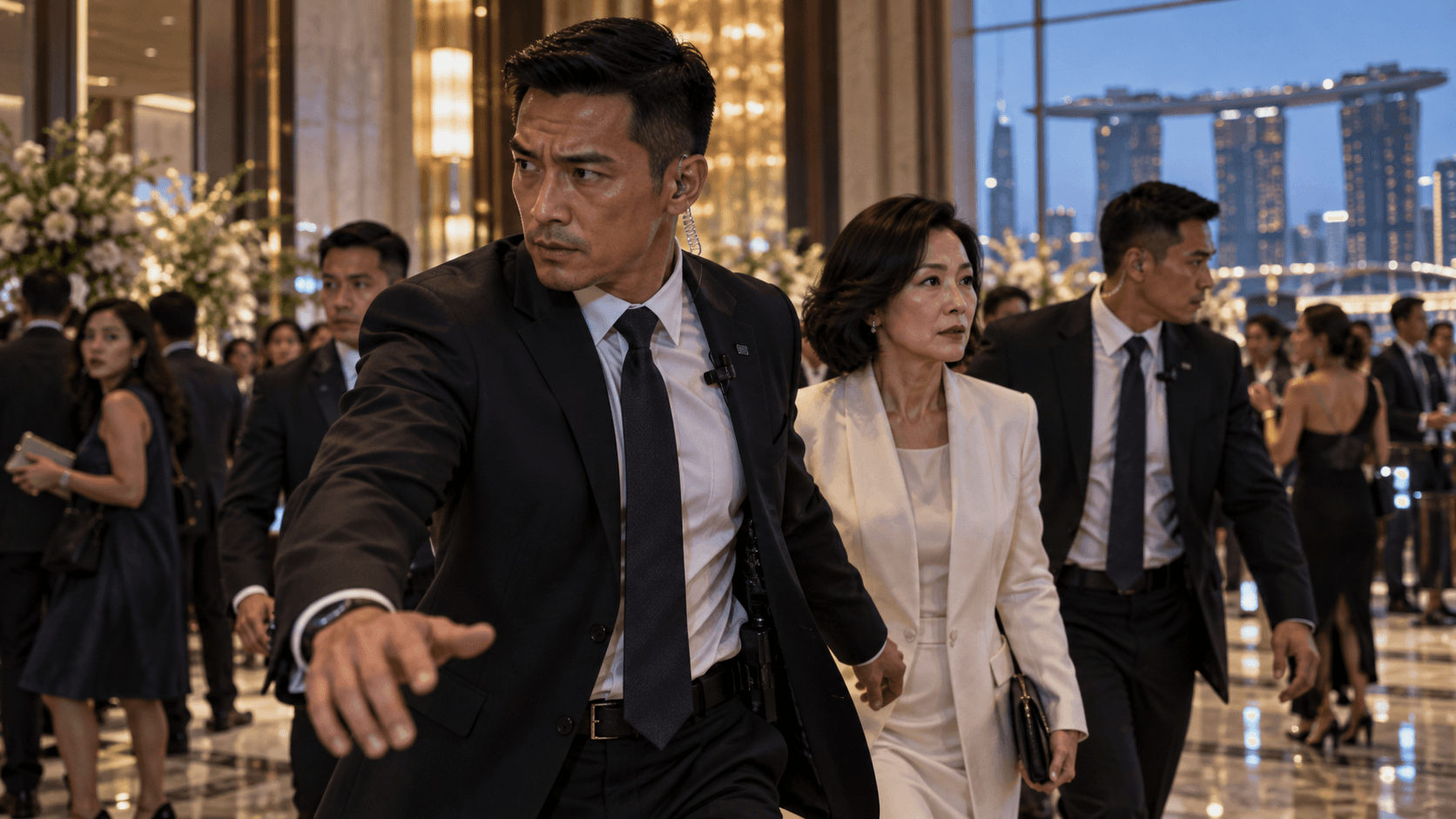
My military background shaped this more than anything else, mainly through trigger discipline: finger off the trigger until the sights are on a target I intend to engage. That single habit outweighs most of what I picked up about tactics, because tactics change with the job and discipline does not.
Military training conditions a person to close distance on a threat as the objective. Protection work aims at the same outcome measured differently: principal safe, threat engaged only if there is no other option. Carrying the soldier's instinct into a protection role without adjusting the framework around it is how an officer ends up moving toward danger when the job needed him moving away from it.
Planning Over Muscle
Building a training program around threat assessment starts with a simple habit: people watching. I take a day or two and sit near a crowded place with no other job than to watch, tracking where people's eyes go and trying to predict their next movement before it happens. That is the skill I am developing, and how I measure whether someone else is developing it.
This is not a skill anyone picks up from a manual. It takes repetition, the same way marksmanship does. Sitting somewhere with real foot traffic and guessing where a stranger is walking to, before he actually gets there, is how I built it in myself. Most guesses are wrong at first. Where someone looks right before they move is rarely random, and noticing that pattern consistently is how the skill actually forms. You can prevent what you might predict.
You can prevent what you might predict.
The biggest gap I see between how protection professionals are trained today and what the job actually demands is formation work. Formations get taught heavily because they are easy to drill, but they are also predictable, and predictable is not a compliment in this line of work. What actually works is chemistry between operators: knowing where to fill the gaps, knowing the guy at your back has you covered. That kind of trust is not something a diagram can teach.
A formation can look impressive on a training ground, everyone in position, clean spacing, textbook lines. None of that tells you whether the operators inside it actually trust each other. I have watched formations come apart the moment something unscripted happens, not because anyone forgot the choreography, but because nobody adjusted for what a teammate was doing without being told to. That kind of adjustment only comes from operators who have worked together long enough to read each other.
What the protection and security training community gets wrong most often is simple. Having muscles doesn't mean you're a strong protection officer. Planning is the first thing I would fix in how this field trains its people, if I could only fix one.
Newer people entering the field arrive assuming fitness and firearms proficiency are the foundation of the job. Those things matter, but they are not the foundation. The foundation is the thinking that happens before anything physical is required at all, reading a threat early enough that the physical part never becomes necessary. An officer who puts all his effort into the gym and the range, and none of it into planning, is preparing for the wrong stage of the job. It's about the brain. Planning is number one in protection.
It's about the brain. Planning is number one in protection.