
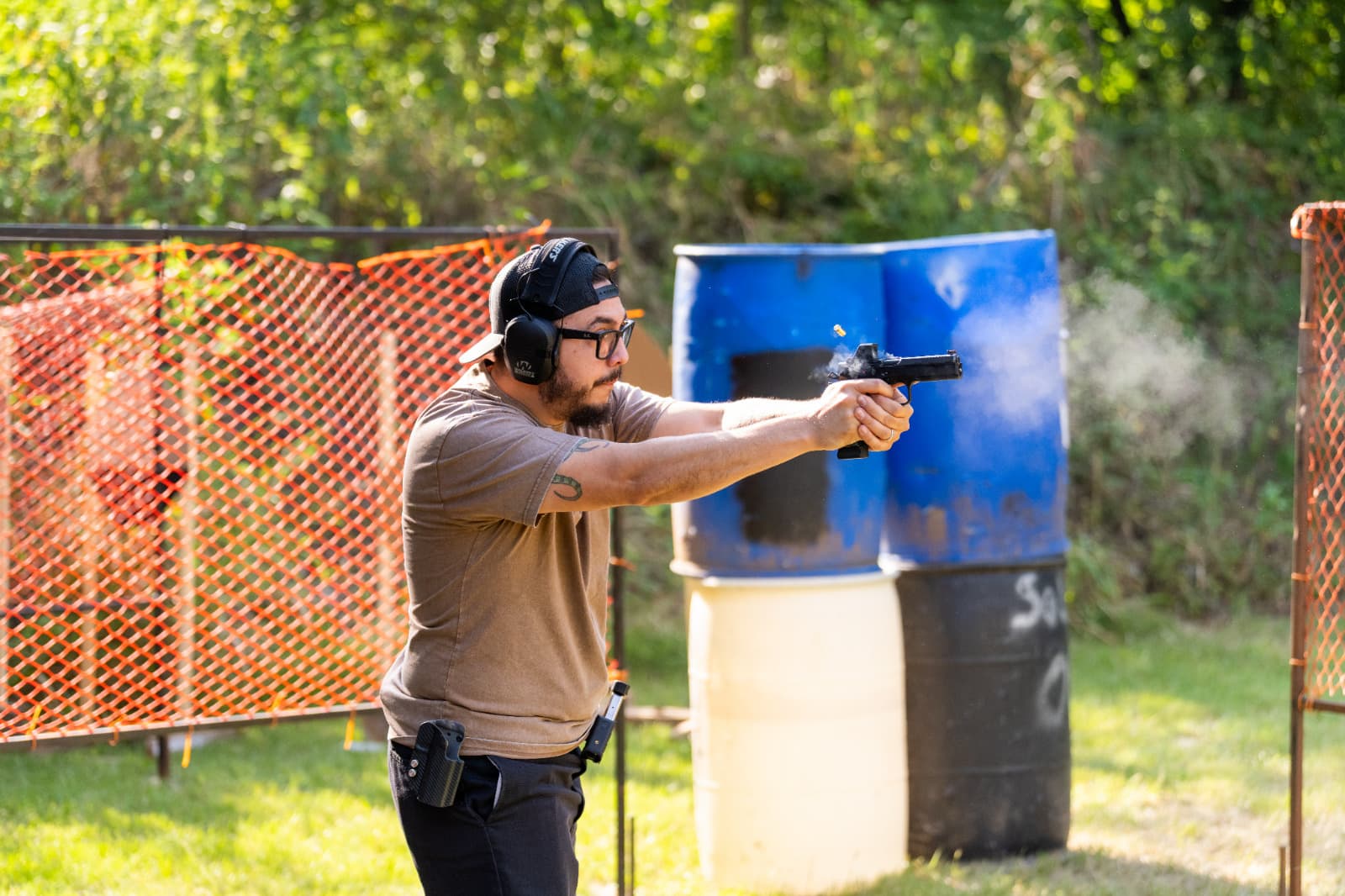
The match that changed how I compete wasn't one I won. I talked my buddy Emilio into an outdoor USPSA match with me. We hadn't seen each other in months, and it had been a couple of years since he'd competed at all, but we landed on the same squad. The whole day felt like going to the range with my brother instead of walking into a test. The nerves I usually carried into a match weren't there, and I had the mental bandwidth to actually shoot instead of getting intimidated by the better shooters around me.
Most of my early matches had the same shape: watch a regular run a stage clean and fast, feel my own plan shrink before I stepped up to the line. That day with Emilio, none of that showed up, even against the same stages and the same shooters. The only thing different was what was happening in my head, and that's what I've been chasing since.
I'm four months into this sport, and most of what I know so far, I learned by getting something wrong first and finding out why later. A few of those wrong turns looked like equipment problems. They weren't.
Chasing the Wrong Fix
I shoot carry optics, and running a dot on a pistol is still new to me. Every time I transitioned from target to target, especially moving more than a couple of steps, I'd lose the dot and struggle to present the pistol fast enough. My first explanation was the equipment: everyone else on my squad seemed to be running bigger windows than mine.
It wasn't the window. I started watching POV footage from shooters who'd been doing this far longer than I have, and the pattern showed up fast. I had a habit of breaking my grip when I didn't need to, and every time I broke it, I had to reestablish my whole presentation from scratch, mid-transition, on the clock. The dot wasn't hiding from me. My hands kept losing it.
The dot wasn't hiding from me. My hands kept losing it.
The same instinct showed up with a gun. My first match was IDPA, run with a Glock 43X MOS and an EPS Carry. When my friends found out I already owned a Shadow 2 Compact, their reaction was to ask why I wasn't using it. So I switched. I do love the Shadow 2, but I'm still not convinced it made me a better shooter. I've watched a guy use a Glock and recently reach M class. Swapping the gun never touched my mechanics, and the mechanics were the actual problem all along.
The Pressure I Didn't Need
I can't shoot as often as the other guys at my local matches, and early on that made every match feel like it had to count. I'd walk in thinking I'd better not waste it, and that pressure had nothing to do with my actual skill level, which still has a long way to go.
The loop that hurt me most was watching someone crush a stage, then watching myself follow it up badly. That comparison eats a shooter alive if you let it sit there. I've had to swap the response on purpose: instead of that's not something I can do, I try to land on that was awesome, let me try that. Most of the shooters I compete against want to see me improve. Once I stopped treating their skill as a measure of my own worth, I had room to actually watch what they were doing.
Once I stopped treating their skill as a measure of my own worth, I had room to actually watch what they were doing.
Dropping the pressure didn't drop the work. I still dry fire and put in live-fire and movement work between matches. What changed is what happens once I'm on the clock: I'm more accurate, and I take risks I wouldn't have taken before, because I'm not burning mental bandwidth trying not to embarrass myself. Some shooters perform better under pressure, and a lot of what I used to carry into a stage wasn't necessary. The ones at my matches who consistently do well are the calm ones, the ones who can take a hit on a no-shoot and laugh about it before the buzzer sounds again.
I'm not an expert, but I'd probably tell a plateaued shooter to push the pace and see where things start to fall apart. They may be shooting too comfortably.
None of this shows up without the data. I shot a match with the second-best hits in the A zone on the range, and still finished near the bottom of the field. The winner's combined time across the stages was almost twice as fast as mine, with more of his hits landing in the C zone instead of the A. Before that match I'd have called myself an accurate shooter and left it there. The scoresheet said something closer to slow, not careful. I'm running an experiment now: pushing my pace and watching where my accuracy starts to slip. Dry fire is where most of that work happens, and reading the data after a match tells me if it worked.
I’m happy to be shooting the Shadow 2, but I know now that a nice pistol doesn’t solve all of your problems in a match. The grip and the pressure were never equipment problems. If you can handle your firearm safely, enter a match and test what you can actually do.
None of this stays inside pistol matches for me either. I run pump shotguns for fun and have never competed with one, but chasing a USPSA or IDPA stage taught me something a home defense mindset alone never did: you can become proficient with your preferred platform, but you do not know whether that proficiency holds up until you test it.
You can become proficient with your preferred platform, but you do not know whether that proficiency holds up until you test it.