
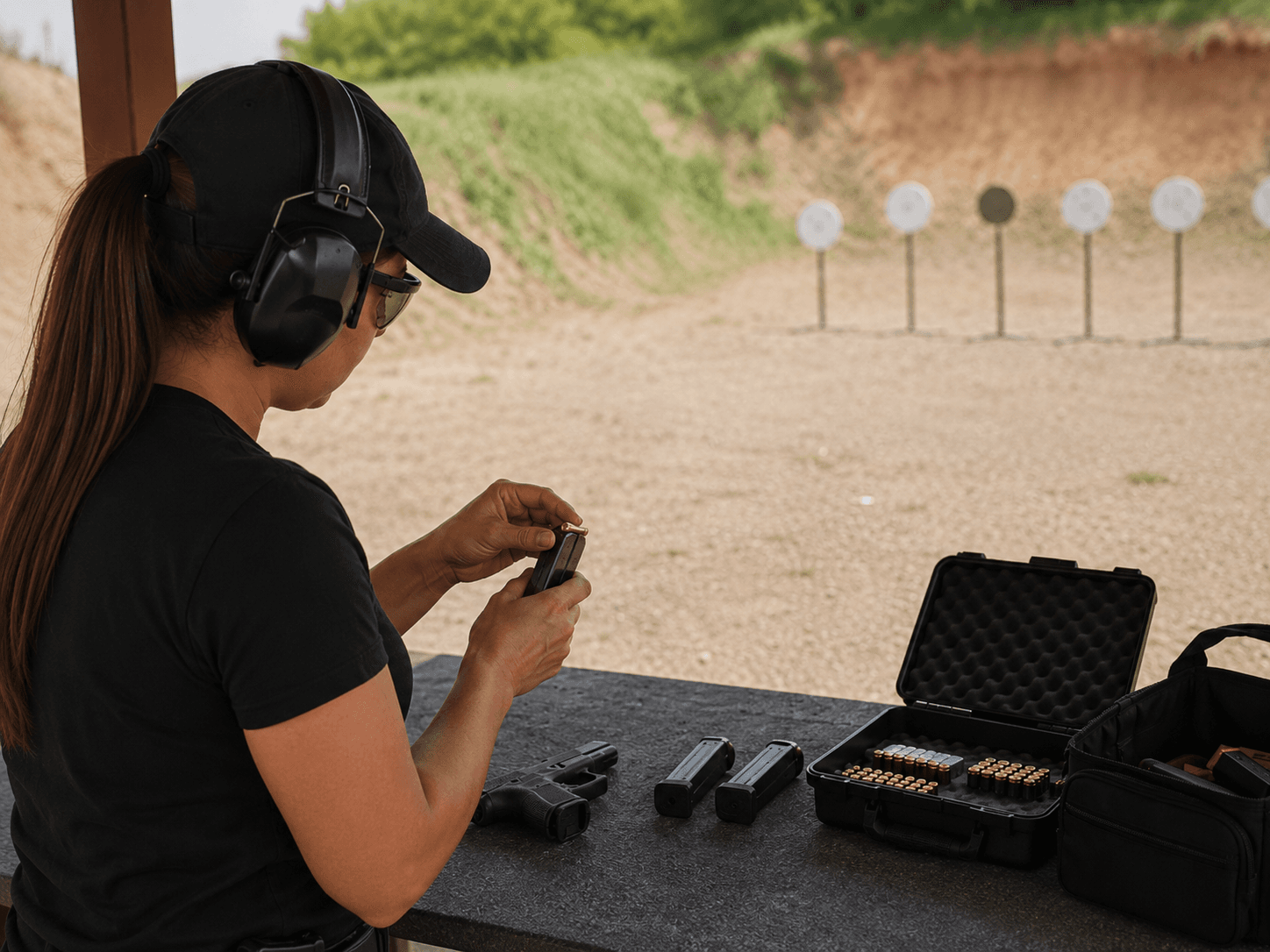
A friend talked me into trying a shooting club in 2021. I didn't stick with it right away. There were no regional championships to aim for back then. Brazil offers little institutional support for the sport, and getting legal access to a firearm here is its own multi-year project.
My first shots were surprisingly good. I kept my shooting certificate active even when I wasn't training seriously. By my club's rules, keeping that certificate active meant eight club visits a year, minimum, or the paperwork lapses. From 2021 to 2025 that's mostly what I did: eight visits, two to five strings each time, enough to stay legal and not much else. Ammunition is expensive, and without sponsorship there wasn't a way to train more than that.
A club saw something worth backing in March 2026 and started sponsoring my training ammunition. In June 2026, competing in the Production division at a CBTE-sanctioned regional match in Curitiba, I earned first place. Four competitions now sit on my record, one second place and one first. The jump from occasional shooter to winning didn't come from more range time alone. It came from fixing two things I was doing wrong without knowing it, and I still don't own the gun I compete with.
The Magazine That Wasn't Full
The clearest lesson cost me a course of fire. I needed to be faster than my opponent on a six-plate stage, and I was mentally running it while my husband loaded my magazine. He loaded seven rounds. I missed two targets, and I ran out of ammunition before I could finish the course. I hadn't knocked down every plate. I hadn't checked the count. I hadn't checked that the magazine was full before stepping to the line.
The magazine mistake taught me to verify my equipment. My targets taught me to verify my technique. In my own shooting, a shot to the left usually meant too much finger on the trigger, high meant anticipating the recoil before it happens, right meant a bad squeeze, and low, more often than not, pointed me back to my grip. Reading those patterns is what got my grip corrected.
None of that helps, though, when you run dry or hit a malfunction mid-stage. Malfunction drills matter for the same reason: a stage is not the place to find out you can't clear a jam fast, under a clock, in front of people. I confirm the magazine count myself before I step to the line. It was a silly mistake that will never happen again. The rule is clear: load your own magazine.
It was a silly mistake that will never happen again. The rule is clear: load your own magazine.
Running the Match Before the Match
In the week before a match, I run the whole thing in my head, every day. The venue, loading the magazine myself this time, chambering the round, the range officer's instructions, the start signal, every target going down, the last plate falling. I want the match to feel familiar before I ever step to the line. When the match actually started, I felt faster to the first shot and steadier under pressure, and it added up to a first-place finish.
I want the match to feel familiar before I ever step to the line.
The ones who fall apart tend to do it before they even step to the line. In my experience, it's usually from trying to correct a technique problem on the day of the competition or the day before, when there's no time left to rebuild it properly. Knowing there's a formidable opponent does the same kind of damage, and it's easy to let my own mind sabotage my performance.
Taking ownership of my preparation also meant questioning techniques that didn't work for me. The other habit I had to unlearn came from a coach, not from me. I trained in the staggered “attack” stance because that was the position I had been taught to use. It wasn't until I changed coaches and moved away from that rule that I found what worked better for me: feet parallel, not staggered. In my own experience, that position produces my best performance. Standard advice isn't automatically right advice.
None of this means training harder in the traditional sense. It means training realistically, and that shift made the biggest difference for me. There's no point manufacturing artificial pressure in practice. Your heart is going to race on match day regardless, and there will be a crowd whether you like it or not. What works is making practice as close to competition conditions as possible, training frequently even when that means dry fire without live ammunition, and going into each session with a specific correction in mind rather than repetition for its own sake.
I still don't own a firearm. Purchase authorization here takes one to two years, so I train and compete on whatever the club or someone else can lend me. Muscle memory doesn't build cleanly under those conditions: frequently switching guns means adapting all over again in a short amount of time, instead of building the kind of familiarity that comes from training on one weapon. The sponsorship covers my training ammunition. That's what the club provides, not a gun of my own. A gun of my own would mean one trigger, one grip, instead of a different borrowed one every time.
One trigger, one grip, instead of a different borrowed one every time.
Until that changes, I make sure the one thing I do control stays mine. I load my own magazine. I run the match in my head before I ever run it for real. And I check my own count before I step to the line.