
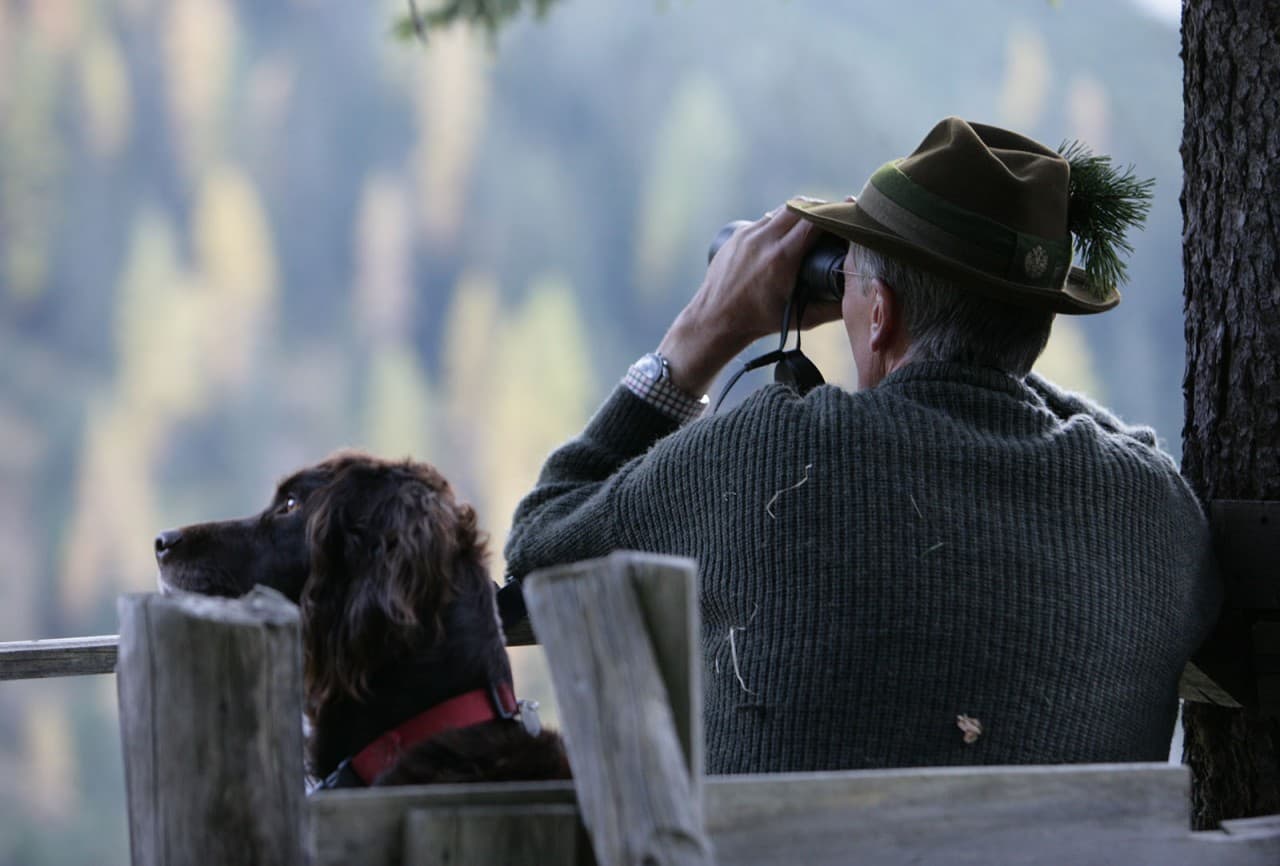
Many years ago, a friend of mine shot a roe buck on an evening hunt. He felt sure about the shot. Darkness was closing in and the weather was warm, so we needed to find the animal quickly. I brought in my Deutscher Wachtelhund, a German spaniel bred for this kind of work. The dog went into the cover and found the buck less than ten meters in. We could easily have walked past it and never seen it.
I have had the same experience many times since. An animal can be lying close by and still stay almost impossible for a person to find in thick vegetation. It taught me one of my most important rules. After a shot, never trust your own eyes too much. When there is any doubt, use a properly trained dog. Recovering the animal is not separate from the hunt. It is part of the same responsibility.
That same lesson keeps repeating in different shapes every season, long before an animal is ever found or missed.
The Shot I Don't Take
During driven hunts, I have watched roe deer do something that sounds simple in theory and feels startling the first time you see it from a high seat. When a deer is disturbed by beaters or dogs, it does not always run. Sometimes it stops, glances back at whatever is approaching, then lies down and goes completely still. I have watched deer hold that position until the beaters were nearly on top of them, or a dog passed within a few meters. A hunter standing at ground level could easily believe the animal had already moved off.
It taught me not to underestimate how well a roe deer can use stillness instead of flight. Sometimes the animal you are looking for has not disappeared at all. It is still there, waiting for the last possible moment to move.
The same discipline applies before the shot, not only to reading the animal afterward. Over 52 years of hunting, deciding not to shoot has mattered to me as much as taking the shot itself. On a driven hunt, an opportunity can look clean for a second or two. If I am not certain about the animal, the ground behind it, the angle, or whether I can place the shot cleanly, I let it pass. There is always another hunt. A bullet, once fired, cannot be called back.
Hunters argue endlessly about calibers, but for most European game I have learned that caliber matters far less than shot placement. About 40 years ago I bought a rifle in .308 Winchester and asked my gunsmith whether it really carried enough stopping power. His answer stayed with me ever since. Put the bullet where it belongs. If you shoot an animal in the backside, every caliber is a bad caliber.
He was right. A well placed shot from a sensible caliber does more than a bigger cartridge used badly. Knowing your own rifle counts for more than any argument about calibers ever will.
Put the bullet where it belongs. If you shoot an animal in the backside, every caliber is a bad caliber.
The Shooting Cinema
The biggest change in how I hunt did not happen in the field. It happened in training. Forty years ago I put no particular weight on rifle practice. Shooting felt natural to me, nothing that needed extra attention. That changed once driven hunts became a regular part of my season. Shooting at moving game is a different skill, and today I do not think you can practice it too much.
Germany has something called the shooting cinema: an indoor range where real hunting scenes with moving game are projected on a large screen while you shoot with your own rifle. What makes it valuable is that you are not only practicing the shot. You are practicing the decision behind it. With wild boar, you have to read the situation the second you see it: which animals are young, which are mature, where the sow stands, where the boar stands, whether a responsible shot even exists. It teaches you to observe first and shoot second.
In the shooting cinema, animals appear and disappear without warning. Several boar can move together, changing position from one moment to the next, the same as on a real driven hunt. I have only seconds to identify what I am looking at and decide if the shot is right.
It teaches you to observe first and shoot second.
A real driven hunt is not a shooting range. On a conventional range I know my target before I ever raise the rifle. In the shooting cinema, as in the field, the situation is still forming while I am already looking through the scope. The hard part was never squeezing the trigger cleanly. The hard part is deciding whether to squeeze it at all.
Regular practice, especially in the shooting cinema, has taught me what I can do reliably, and just as important, what I should not attempt. On a driven hunt, situations develop fast. Good training buys me a little more time in my head to read the animal and make the call. Training does not just make a better shot. It makes a more responsible hunter.
WHAT IS A GERMAN SHOOTING CINEMA?
The German term is Schießkino, literally "shooting cinema." It is an indoor, live-fire range where real hunting footage, running boar, driven deer, is projected onto a large screen, and hunters shoot with their own rifles at the moving image. There are roughly a dozen or more such facilities across Germany. Some hunting clubs use them to log required skill-maintenance hours for driven-hunt participation. The training is built specifically to combine marksmanship with decision-making, since a shooter has to judge age, sex, and safety of the shot in the instant before deciding whether to fire at all.
I see the same mistake repeated among hunters I know, and it is not only a beginner's problem. Hunters overestimate how well they shoot under real conditions. Shooting a few good groups from a bench is one thing. Shooting from an awkward position, under time pressure, or at moving game is something else entirely. Experienced hunters can grow too confident simply because they have hunted successfully for many years, but experience does not replace practice. Knowing when not to shoot is part of good marksmanship.
On the range, the distance is known, the target is visible, you are set before the shot, and the footing is usually good. Hunting rarely gives a hunter any of that. In the field the animal may be moving, the angle may be wrong, brush may be in the way, the light may be poor, and the decision has to land in seconds. The mistake is not necessarily a lack of shooting ability. It is a failure to adjust expectations to the situation actually in front of you. A hunter should never take a shot simply because he knows he could make it on the range. He should take it because he knows he can make it under the conditions in front of him.
Knowing when not to shoot is part of good marksmanship.
And after all those larger questions of judgment, there is another lesson hunting has taught me: small details still matter. One habit sits above all the rest, and it sounds almost too small to mention. Make sure the rifle is actually off safe. In more than 50 years of hunting it has happened to me twice. The opportunity was there, everything lined up, I pulled the trigger, and nothing happened. The rifle was still on safe. You can discuss calibers, shot placement, ballistics, and equipment endlessly. None of it matters if the rifle does not fire at the decisive moment. It is a very small detail. And precisely for that reason, it is surprisingly easy to forget.
After more than 50 years in the field, hunting has become less and less about pulling the trigger for me. When I was young, success was naturally important. Today, I enjoy observing wildlife, understanding its behavior, working with the dogs, being outdoors, and sharing the day with good friends just as much as taking an animal home. A hunter can come back from a full day without firing a single shot and still call it a good day. Perhaps that is something you only really understand after many years of hunting.