
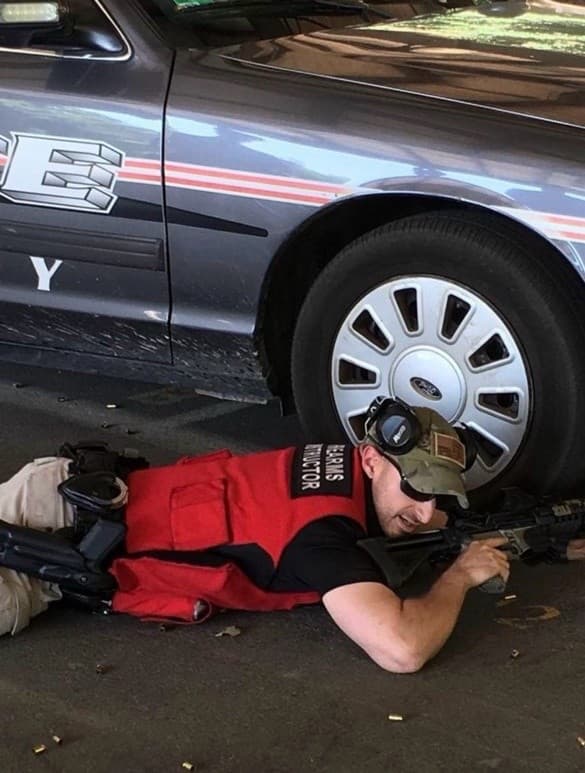
Coming out of the Army, a soldier's weapon is part of him. It gets carried, checked, cleaned, trusted the way you'd trust a limb. After the academy, a police officer’s service weapon often becomes a second thought. The academy hands a new officer a duty weapon, and from there it competes for attention with mental health calls, traffic stops, domestic violence response, and investigations. Most of the time it loses.
Firearms training gets whatever is left over. Department-wide mandatory training is often focused on topics such as domestic violence and sexual assault. Even the Taser pulls more attention than the pistol on an officer's belt. The firearm sits at the bottom of that list because it's the one skill officers use the least on duty.
What most departments land on is the state minimum: one or two qualification days a year, four hours each. Officers show up, put the required rounds downrange, and complete qualification. When I raised this with administration and the training department, the answer came back the same every time: they get their training during qualification. As an instructor, I corrected that every chance I had. Qualification is not training.
The Four-Hour Range Day
Most qualification courses exist to satisfy one thing: the state's round count and its list of required strings, standing, kneeling, decision shooting, movement. Range limitations shape everything else. Barricades and shoot-on-the-move drills get squeezed into whatever the physical range allows, which means agencies end up building a course that fits the range instead of one that fits a fight.
Low-light qualification showed this the clearest. Ours used to be standing and kneeling, light on and light off, rushed the moment the sun dropped so everyone could get out for the day. Nobody covered telegraphing your position with a flashlight, or using your own shadow against you, because there was never a separate low-light training block, only the thirty or so rounds buried inside qualification. When I rebuilt the course, I had to fold those concepts into those same thirty rounds, because that was the only window I was ever going to get.
The deeper issue sits under all of it. Departments train to a standard, not to reality. Stress can be built into a square range, but it competes with safety rules written for officers moving on command, in a way a real encounter never will. An officer with real shooting deficiencies won't get diagnosed by forty rounds of qualification, let alone fixed by it. Firing lines turn into logistics before anything else, moving officers on and off like loading people onto a Disney ride, safety first, teaching a distant second. Engagements don't happen on a static firing line with commands and breaks.
Qualification is NOT training.
Building Officers Who Move Like They Mean It
When I became an instructor, the first thing I wanted to change wasn't a drill. It was a mentality. The instructors before us did little to make qualification week matter. Officers showed up with lawn chairs and treated the range like mandatory overtime, because that's what it had become and nothing more.
We asked for two more hours a day, six instead of four, to get through pistol, rifle, and shotgun qualification. That extra time became a training block ahead of qualification: cover, reloading behind cover, clearing malfunctions with dummy rounds, team movement, vehicle drills. We used it to break habits nobody had ever corrected, officers picking a clean spot to tuck an empty magazine into a pocket instead of dropping it. We reinforced dropping it and reloading in the workspace, the way we expected them to move under fire.
The week stopped being about putting holes in paper. New instructors came in straight out of instructor school, and the complacency that had settled into the old guard wasn't allowed to take root again, because the people running the range are the ones everyone else copies. It slowly changes the mindset for younger guys, some of whom may eventually become instructors themselves.
The response surprised me. Officers actually liked the training. Nobody was burning a day off just to check a box anymore. The younger officers especially were moving and shooting better, sometimes the same day on the range. Maybe it would inspire a few of them to go shoot on their own, or seek out and attend professional training on their own. My own firearms instructor school ran eighty hours, out on the line every morning, well over two thousand rounds fired. I wish every officer got that level of training and round count. Outside the academy, most never will.
Imagine what we could do if we trained more often.
Officers actually liked the training.
This gap isn't unique to one department. It comes down to budget and time, and most agencies have neither, so firearms rarely gets first claim on what little exists. Law enforcement is generally reactive with training, particularly tactical and firearms training, unlike the military. Departments face public pushback against anything that looks paramilitary, right up until an incident like Uvalde happens and the same public wants to know why officers weren't better trained.
I think we have to start viewing officers as warriors and a first line of defense, not just community problem solvers and traffic enforcers. The warrior side of policing gets reduced for public perception, and firearms training pays the price for it.
In my experience, having officers make shots past twenty-five yards isn't realistic to real-life distances and use-of-force encounters. Officers should instead be trained on short, stress-based engagements. A few departments now run officers through a short sprint from a vehicle into a target engagement instead of a static line. It isn't a perfect answer, but it's a step toward realism over requirement.
Continued training after the academy barely exists unless an officer becomes an instructor or lands a spot on a tactical unit. Officers should be encouraged to train with their firearm on their own time, provided time and ammunition to do so, and most agencies offer neither. Even as an instructor, I paid for one or two courses a year out of my own pocket and burned my own vacation days to attend them, because the agency saw no reason to keep sending certified instructors back to school. Getting it approved and funded runs through favoritism, seniority, and internal politics long before it reaches a firearm.
None of that sits apart from the training problem. It starts at the top, sometimes beyond department leadership, with political leaders and town councils, and works its way down to the individual officer. There is still no standardization for how law enforcement officers train with a firearm. We have to get out of the one-and-done, check-the-box mentality.
We have to get out of the one and done, check the box mentality.