
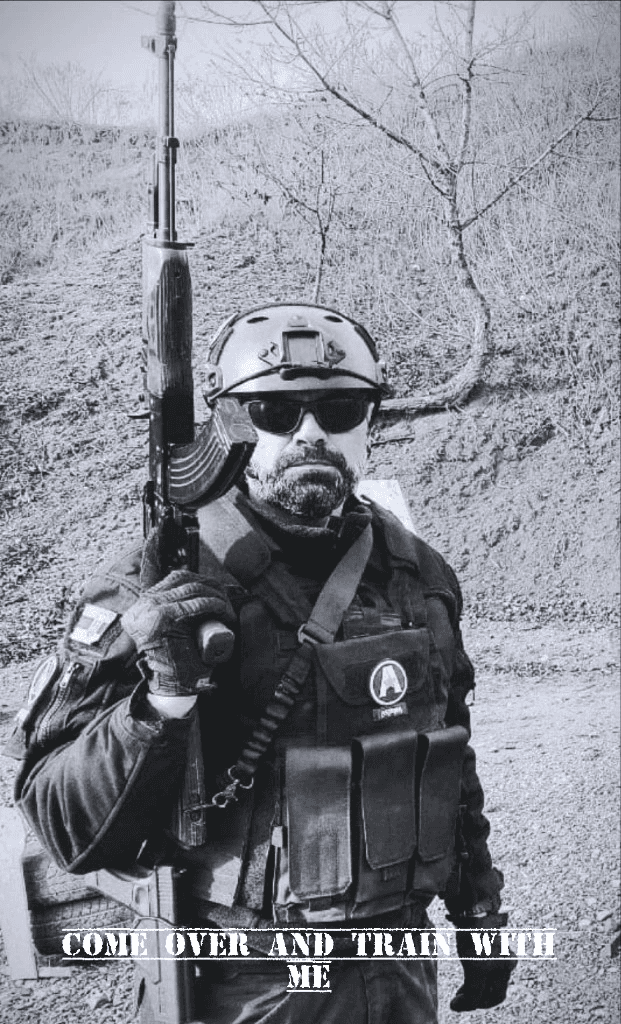
I have spent eighteen years teaching firearms in Niš, Serbia, working with students across security, law enforcement, and civilian backgrounds. Every one of those sessions still feels like something I do not take for granted.
Students need correction. They need safety rules. They need structure. But I believe they also need enough freedom to discover what works, ask questions, and learn how they behave with a firearm when I am not standing over their shoulder.
My work is connected with Asteria MTEC here in Niš, whose training programs range from tactical pistol and close-quarters work to maritime security. Asteria uses a phrase that describes much of my own approach to instruction: efficiency over ego.
STUDENTS NEED ROOM TO LEARN
A lot of instructors miss something basic when they teach tactical courses, and that is freedom. Security operators, law enforcement students, and regular civilians all come to a range hoping to work through their own process, alone with themselves and a weapon. Instead, many of them spend the whole session aware that the instructor is standing right over their shoulder.
In my classes, students get room to work within the four basic safety rules, and beyond that they are free to explore. If you interrupt someone constantly, if you never let them relax and stay focused on their own process, the session stops teaching them anything. They came to train themselves with guidance, not to be managed through every single rep.
That freedom starts with something simple. Many students arrive from other instructors who trained them never to ask questions mid-session. I think that habit is backwards. There is no such thing as a stupid question. There are only useless answers.
There is no such thing as a stupid question. There are only useless answers.
It also starts before the first shot is fired. I have my students set up their own gear the way that feels right to them first, then we move into everything else. From there, I lean on dialogue more than instruction. Talking with a student almost always surfaces what they actually want to improve, and once I know that, I can quietly steer the session toward it. The goal is always the same two things: accuracy and confidence.
THE INSTRUCTOR CAN BECOME THE PROBLEM
Every student is different, and that is not something to fight against. We are not machines, and none of us are built the same way. Whatever it takes to move a shooter one level up is what I will do, and that changes from person to person.
When people ask me where instructors tend to misread a problem, I look at the instructor too. Confidence is necessary, but it can also become a blind spot. If you walk into every lesson already certain you know what the student needs, you stop listening.
Mechanical corrections still matter, especially when someone has learned a bad stance. But in my experience, the psychological change comes first. A student has to be comfortable enough to listen, experiment, and understand what needs to change.
Confidence is necessary, but it can also become a blind spot.
If I could leave a new instructor with one thing, it would be this: become familiar with your firearm until handling it feels natural. Work with it, run drills, and practice until operating it takes less conscious thought. It needs you the same way you need it, to secure a point or do the job.
Be one with your weapon, the way you are with your own fingers.
The goal is for handling the firearm eventually to require less thought, not more. That is what real competence with a firearm looks like to me.