
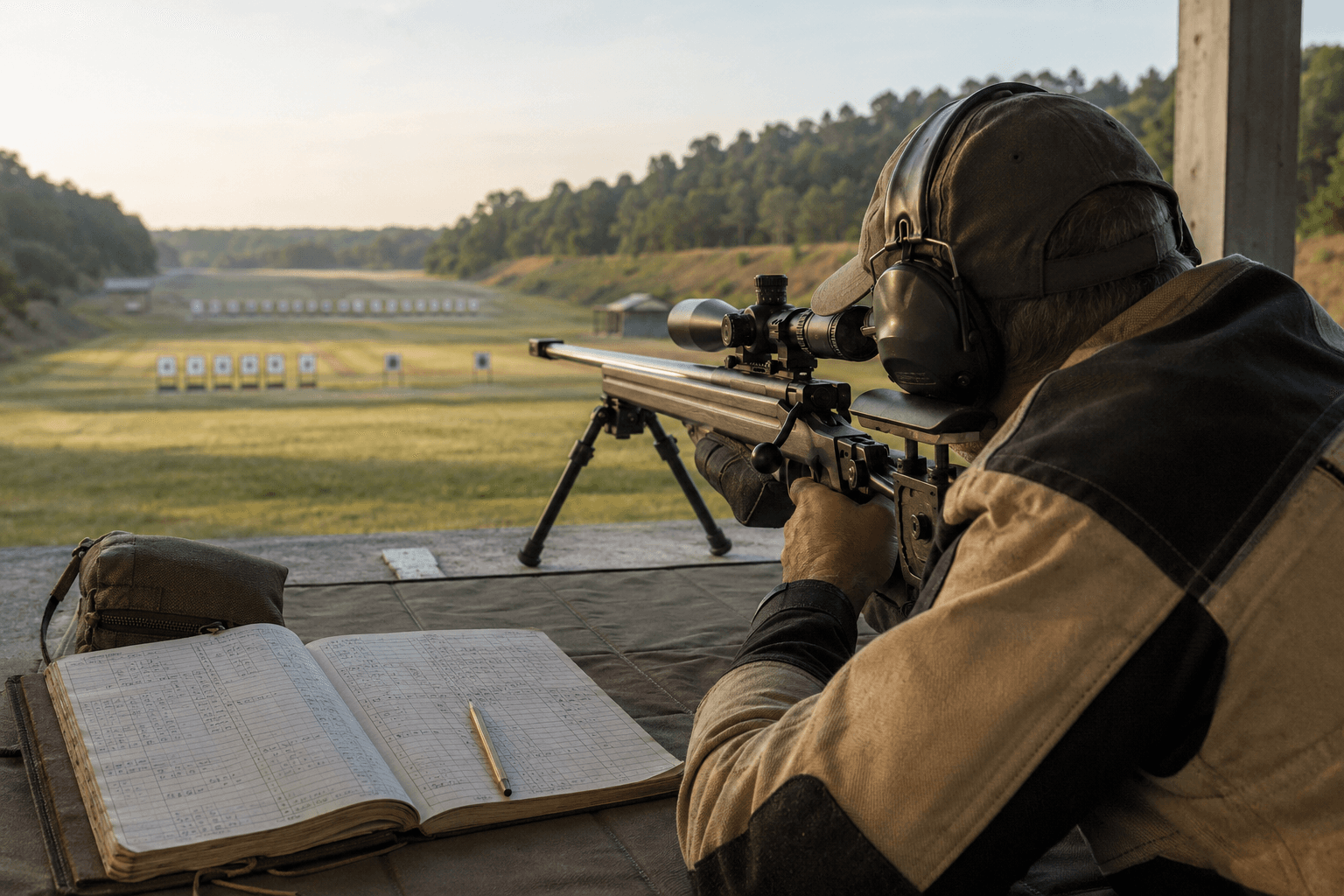
The evening before the 2001 Tennessee Regional Rifle Championships, I opened my data book and reviewed my peak performance for each stage. I realized I could win if I just executed shot by shot, the way the numbers said I could. I carried that number onto the line the next morning and stayed on it through every stage. I hit my aggregate, posted a personal best overall score, and won the championship.
Since that 2001 match, I have continued to build my seasons around what that data book proved. That match changed how I read every number I write down since.
Read the Data Book Like a Case File, Not a Diary
Most shooters treat a data book as a logbook. Zero for this distance, wind call for that condition, score from last month's match. Useful information, but it stops at description. It tells you what happened. It does not tell you what you are capable of.
The shift happens when you stop reading your own history and start building a case with it. Pull your best individual stage performance from your last several matches and stack the numbers on top of each other. That total is not hope. It already happened, stage by stage, under real match conditions. It shifts your mindset from wishful thinking to a realistic execution strategy.
It shifts your mindset from wishful thinking to a realistic execution strategy.
Most competitors walk to the line hoping to shoot their average, or just feeling good about the morning. Exceptional preparation means walking to the line already knowing you can win, because your own hard data proved it before the match ever started.
The equipment is not always the limiting factor. Fatigue, nerves, dehydration, mistimed caffeine, or medication can affect the same trigger control and sight alignment a shooter assumes have failed mechanically. None of that lives in a data book unless a shooter writes it down and starts treating it as data instead of noise.
A performance plateau is not a permanent limit. It means the training and the mental program that got you here have already maxed out what they can produce. A new goal paired with an upgraded mental management framework is what opens the next level, not more repetitions of the same process that stalled out.
A performance plateau is not a permanent limit.
When the Groups Open Up, Check the Shooter Before the Rifle
When accuracy drops off midway through a match, most shooters look at the rifle first. A loose mount or a worn trigger sear. I check the shooter before I check the gun. Poor trigger control, jerking the shot or anticipating the break, deflects the muzzle away from the intended point of aim. Improper sight alignment guarantees the shot lands wrong regardless of what else was done correctly. Both errors get blamed on the rifle far more often than they get traced back to the hands actually running it.
I check the shooter before I check the gun.
Physiology hides in the same blind spot. Staring through an optic or holding a front sight post too long fatigues the eye's ciliary muscles. The brain fills in the missing picture. The reticle looks dead center while the eye has actually drifted low right or high left. A shooter reads that drift as a zero shift and starts second-guessing a setting that never moved. Disciplined hydration and nutrition, along with enough rest to keep the eyes sharp late in a match, matter more for group size than most shooters assume.
Individual mechanics are not universal. Early in my career, instructors kept telling me to copy the form of national-level shooters, technique built around someone else's body, not mine. I tried it. It never fully fit. The fundamentals stay fixed. How a shooter applies them does not.
After several years competing in high power rifle, I stopped trusting other builders to hit the tolerances I needed and built my own competition rifle instead. I sourced my own components, hand-fit the tolerances that actually mattered, and built the ergonomics around my own finger length, neck height, shoulder width, and eye dominance instead of an average shooter's. We as competitive shooters must find and develop our own authentic shot process, and for me that meant the hardware had to be built around me first.
Factory rifles are not built wrong. They are built loose on purpose, wide enough in tolerance to run reliably on mass-produced ammunition across a wide range of environments. Running reliably for a broad market is a different target than shooting one specific person's best possible group, and closing that gap meant building around my own body instead of an average one.
Once the rifle stopped fighting my anatomy and settled into my frame the way it was built to, and once I paired it with a mental management program built around my own cognitive process instead of a borrowed one, my scores stopped swinging between a great stage and a rough one. The average climbed instead of bouncing between the two.
Other competitors run into the same wall. I have seen the same underlying problem across shooting disciplines. The training, the gear, and the mental program either match the shooter standing on the line or they do not, and most shooters never find out which because they never checked.
Most competitors will read that and nod, then go back to running someone else's form through a rifle built for someone else's hands, and blame the next bad stage on nerves. The proof that says otherwise is already sitting in a data book most shooters have never opened the right way. Reading it that way is a choice.