
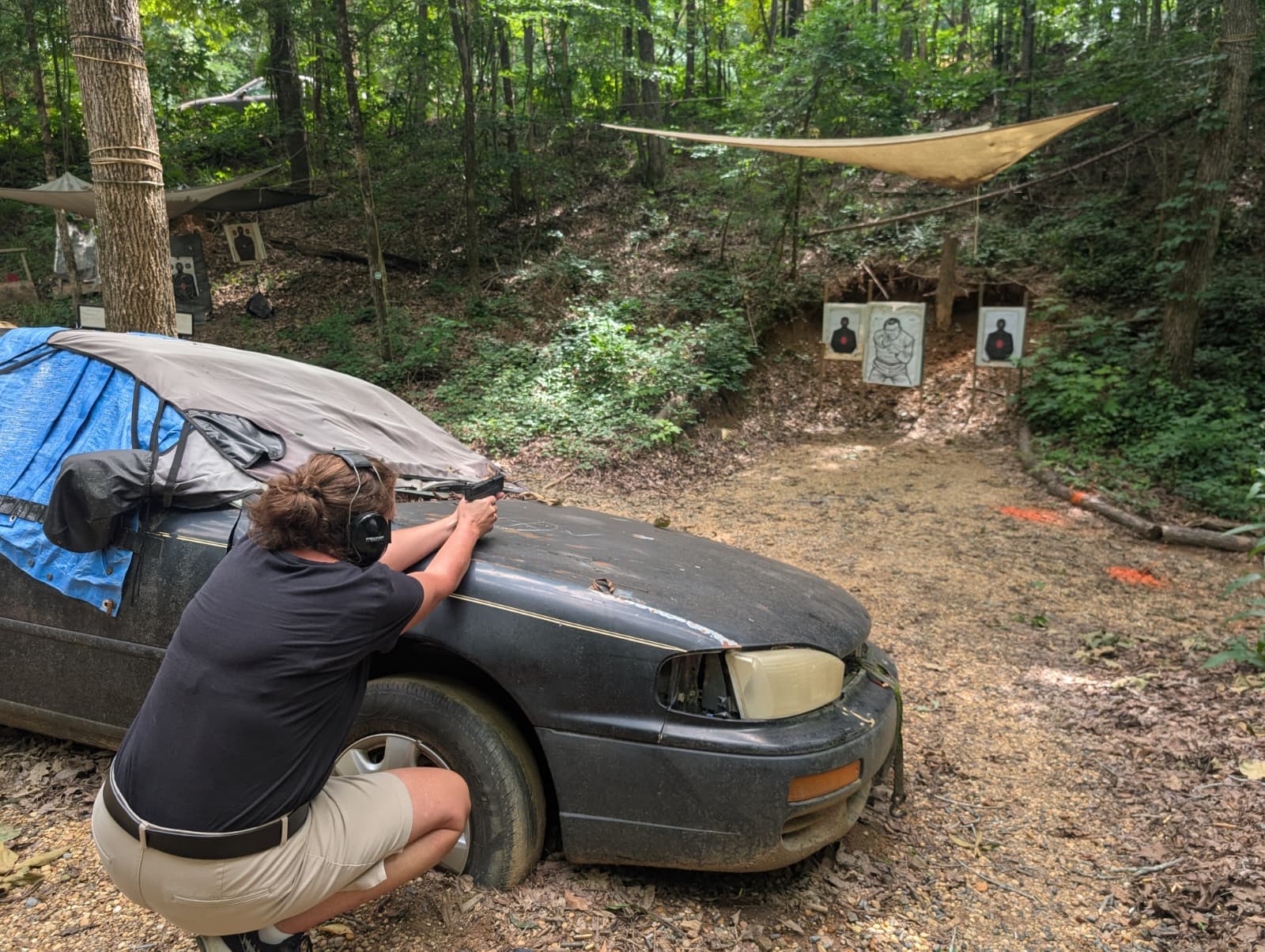
A high-ranking specialist did not say much. He came in quiet, surveyed the range, and after a few minutes he turned to me and said, in a tone that was almost reluctant: that is the greatest range I have ever seen. He was not effusive about it. That made it mean more. I had built that range with one idea in mind: that everyone, regardless of background or experience, should be able to train in a space designed around real scenarios. Not paper punching. Not a static line and a buzzer. Real situations. Hearing that from someone who had been inside serious environments his entire career told me the idea was right.
That moment also reminded me of something I return to constantly as an instructor. You can build a technically excellent environment and still fail the person standing in it if you have not taken the time to figure out what they actually need.
A specialized program built around one student's needs will always outperform a standardized one built around nobody's.
There are talented instructors everywhere in this industry. Technical knowledge is not the limiting factor. What separates effective instruction from average instruction is the ability to reach the individual in front of you. Every student arrives with a different background, a different threat model, a different reason for being on that range. Some are there for concealed carry. Some are law enforcement trying to tighten a qualification score. Some are people who have never held a firearm and carry a weight of anxiety along with the unfamiliar weight of the gun. A program that treats those three people identically will serve none of them well.
The fundamentals are not negotiable. Grip and stance are where everything starts, and they are where a significant number of shooting problems actually live. What looks like a trigger control issue, a sight alignment issue, even a follow-through issue, often traces back to a grip that breaks under recoil or a stance that was never really stable to begin with. Muscle memory is built on correct mechanics repeated under low pressure until the body no longer needs to think about them. That process cannot be abbreviated.
The challenge is that students resist the basics. Not because they are arrogant, though that happens, but because the feedback loop of early training is slow. A student fires a few rounds, the fundamentals feel uncomfortable, and without visible improvement in the first session they want to move forward. They tolerate grip instruction for a handful of rounds and then mentally check out of it. This is one of the most common failure points I see, and it is not really a student problem. It is a communication problem on the instructor's side.
If a student is not yet convinced that the basics matter, that is your job to fix before you move to the next drill.
The correction is not to repeat the instruction louder or more frequently. The correction is to make the student understand why the foundation matters before you ask them to build on it. When a student genuinely grasps that their grip is often one of the largest variables in their group size, they engage with the repetition differently. The feedback loop becomes meaningful. The results on the target become the argument. When that understanding lands, you can see it in how they approach the next magazine.
The drill structure matters less than the feedback loop. Repetition, structured practice, and honest correction are the tools. But the prerequisite is that the student trusts the process, and that trust comes from the instructor's ability to explain not just what to do but why it is worth doing. That explanation looks different for every student. For some it is a data-driven argument about group size. For some it is a scenario: if your grip breaks at the third round, what happens on the fifth? For some it is simply showing them what the result looks like when the fundamentals are correct versus when they are approximate.
Situational awareness tends to get treated as an advanced topic, something you layer on after the basics are solid. I would push back on that framing. Awareness belongs in the training environment from the beginning, not as a formal module but as an orientation. A student who understands from their first session that the goal is not just mechanical accuracy but functional readiness in an uncontrolled environment will develop differently than one who is only ever measured on a static line. The range is a controlled environment. What they are preparing for is not.
After more than twenty years and more than five thousand students across experience levels, the thing I come back to most often is this: there is no universal student. The curriculum exists as a starting point, not a ceiling. A new instructor who memorizes every drill and masters every technical concept and still cannot adapt what they know to the person in front of them will plateau quickly. The instructors who grow are the ones who treat every student as a diagnostic problem: what does this specific person need, what is getting in the way of that, and what is the clearest path to building genuine capability rather than a passing score.
The broader training industry has no shortage of drills, qualifications, and course templates. What it lacks is a stronger feedback architecture around the individual shooter: what changed, what repeated, what improved, and what still fails under pressure. Individualized instruction becomes much more powerful when the instructor can see the student's progression over time instead of relying only on memory and a single day's target.
Adapt individually for every student. That is not a philosophy. It is the job.
The range does not lie about mechanics. But the student's performance on that range is only as meaningful as the instruction that shaped it. Build the foundation correctly. Make the student understand why it matters. Close the feedback loop on every session. And never stop asking whether what you are delivering is what that individual actually needs.
That is what the work requires: not more standardized motion for its own sake, but better diagnosis, better feedback, and better adaptation to the person standing on the line.