

I remember the morning I qualified for the first time more than I remember most of the arrests I made afterward. Not the ceremony where they hand you the badge. The range. Academy classes teach stance and trigger control long before anyone straps on a duty weapon that might actually get used on a person. None of that classroom time prepares a recruit for the way the line goes quiet right before your turn.
I stood at that line with my hands steadier than I expected and my head somewhere past the target entirely. I passed. Walking off that range, I already knew the score on the paper target didn't tell the whole story. Something else was being tested that morning, and it had nothing to do with grouping.
A training weapon in an academy classroom and a duty weapon on a real belt do not weigh the same, even when the specs on paper say they should. One is a training aid. The other is a decision waiting to be made. Nobody tells a recruit that difference out loud. A recruit finds out standing at the line.
Thirty years and several ranks later, I coordinate community policing programs for a county sheriff's office, and I still measure new officers against that morning. A passing qualification score tells you almost nothing about how that same officer treats a firearm on an ordinary Tuesday, holstered, half-forgotten, nobody watching.
THE CARELESSNESS NOBODY SCORES
What I watched most across three decades and more than one department was not incompetence. It was carelessness. A finger resting on a trigger guard during a routine clear when it had no business being there. A holster strap left unsnapped through an entire shift because snapping it back takes two extra seconds nobody bothers spending. A firearm passed across a table muzzle first because reholstering it the right way felt like one more step in an already long day.
None of that shows up on a range scorecard. All of it shows up eventually, usually at the worst possible moment, in a parking lot or a hallway rather than under range lighting where an instructor is standing three feet away.
The score records what happens during the course of fire. It tells you far less about the habits surrounding it: how consistently an officer handles, secures, and reholsters a weapon when no score is attached. Carelessness lives in that gap.
Organizational researchers have a name for that gap. Scott Snook's study of a 1994 friendly-fire shootdown, in which two U.S. fighter jets destroyed two American helicopters over northern Iraq, coined the term practical drift to describe the gradual uncoupling of everyday practice from written procedure. A range scorecard was never built to catch that kind of drift. It measures the ten seconds on the line, not the habits that form everywhere around it.
The score records what happens during the course of fire. It tells you far less about the habits surrounding it.
Somerville sits at the middle of a county, not the edge of one, and every department in it trains the same recruits on the same range calendar. I have sat across from young officers who could recite the four safety rules from memory and still hand a partner a pistol muzzle first out of habit built somewhere else, long before they ever reached my range. Nobody corrected it the first time they did it, so it became the way they carried a weapon.
I stopped one officer mid-shift once over that same habit and got a puzzled look back, not defiance, genuine confusion about why it mattered when the weapon was obviously clear. That confusion told me more than the mistake did. Nobody along the way had ever made the correction stick long enough to become instinct instead of a rule written on a wall somewhere.
THE RUSH THAT LOOKED LIKE BAD AIM
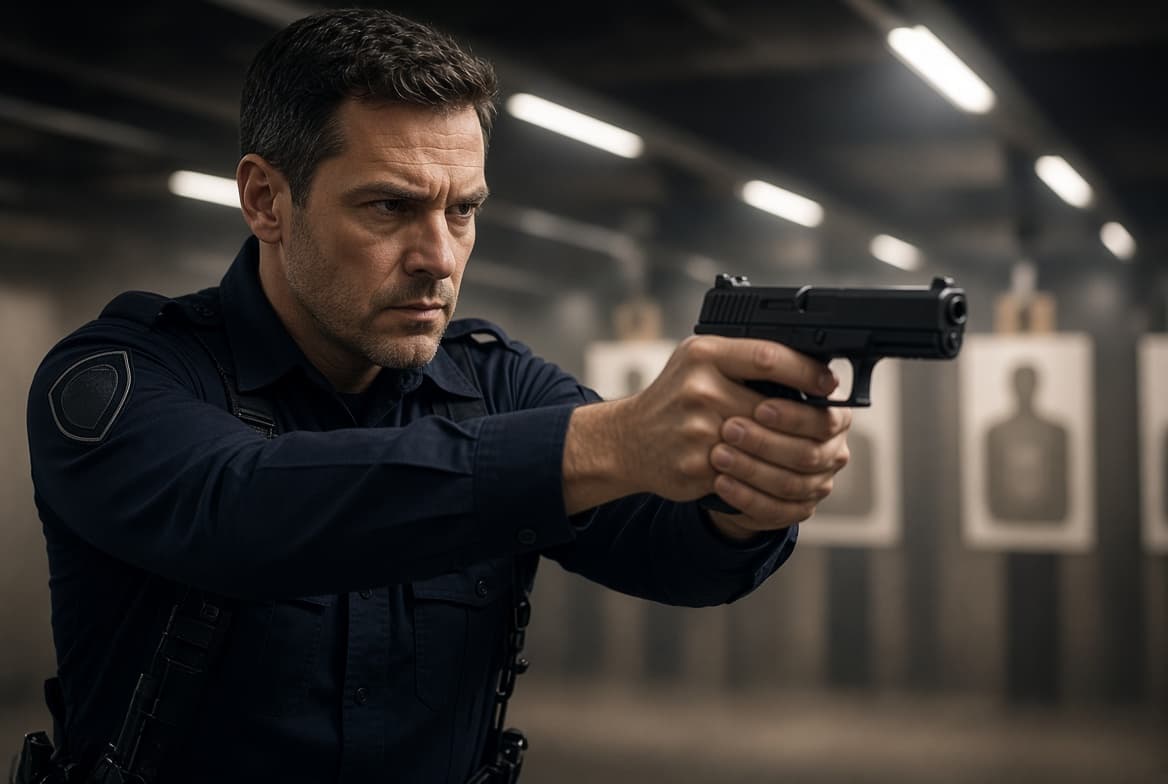
I had an officer years into the job whose groups opened up wide the moment a shot clock got added to a drill. Every instructor on that line called it a marksmanship problem. Flinching. Bad trigger control. Needs more dry fire at home. I put the same officer back on an unlimited clock and watched the groups tighten right back to where they belonged within a single string.
The trigger was never the problem. The rush was. Rushing does not look like one mistake. It looks like the front sight disappearing first, then the press turning into a slap, then follow-through dropping out entirely, almost always in that order once the clock gets reintroduced.
I ran that officer through the same drill three separate ways before I trusted the diagnosis. Slow, no clock. Fast, no clock. Fast, with the clock running and a par time called out loud. The groups only opened up on the third version. Nothing about grip or stance changed across any of the three. Only the pressure changed, and the pressure is what exposed the actual fault line.
Too often, the response I saw was to treat that pattern as a basic marksmanship deficiency and prescribe more deliberate-fire practice. Slow fire fixes a shooter who genuinely cannot group rounds. It does nothing for a shooter who can group rounds just fine and falls apart the moment a real threat forces speed into the equation. Two different problems. One drill gets assigned, and the second problem never gets touched.
That is not just one instructor's read on it. A 2024 meta-analysis in the journal Human Factors found that marksmanship accuracy declined by an average of 14.8 percent in higher-pressure conditions, and that years of experience only offsets part of that decline. The same review found that early exposure to training built around realistic pressure, rather than accuracy drills alone, improved how well that training held up later, though the underlying studies were mostly conducted in training and simulation settings, and how well that holds up in an actual life-threatening encounter remains an open question. Slow fire was never going to touch the problem I saw, because slow fire removes the one variable that was causing it in the first place.
The block of instruction most departments budget for a new officer delivers just enough repetitions to pass qualification and stops there. Nobody fails that budget on paper. Recruits meet the minimum, get certified, and carry a skill onto patrol that has never once been tested under real time pressure. I pushed for additional range time built around the clock instead of around accuracy alone. Not a longer curriculum. More repetitions, run under time, until the fundamentals held even when the hands wanted to move faster than the eyes could track.
Slow fire fixes a shooter who genuinely cannot group rounds. It does nothing for a shooter who can group rounds just fine and falls apart the moment a real threat forces speed into the equation.
I watched the same officer requalify eight months after that change. The groups held under the clock this time. Nobody had touched the officer's grip or stance in the interim. The only thing that changed was how many times that officer had already felt the rush before it mattered, on a range, with an instructor standing close enough to correct it.
Budget conversations never capture that part. A line item can fund more range days. No line item measures how many times a given officer has already failed under pressure somewhere safe, before the day comes when the pressure is real and nobody is standing close enough to correct anything.
I have told every rookie I have trained the same two words, and I will tell the next one. Be safe. It reads like something you print on a certificate, but I never meant it that way. I mean check the holster snap before the shift starts instead of after something already went wrong. I mean treat the two seconds it takes to reholster correctly as part of the job, not as friction to skip past.
The officers walking a beat in this county now are the same ones I used to stand beside on a line, and the math has not changed since I qualified. Departments still hand out pins and plaques for marksmanship scores. Far fewer budget the range hours that would actually keep an officer safe on an ordinary Tuesday. Fewer repetitions under pressure now means more improvisation under pressure later, in front of a person instead of a paper target.
A training calendar decides how many of those hours exist. Officers live with that decision every ordinary Tuesday when nobody is standing three feet away with a scorecard.
Fewer repetitions under pressure now means more improvisation under pressure later, in front of a person instead of a paper target.