
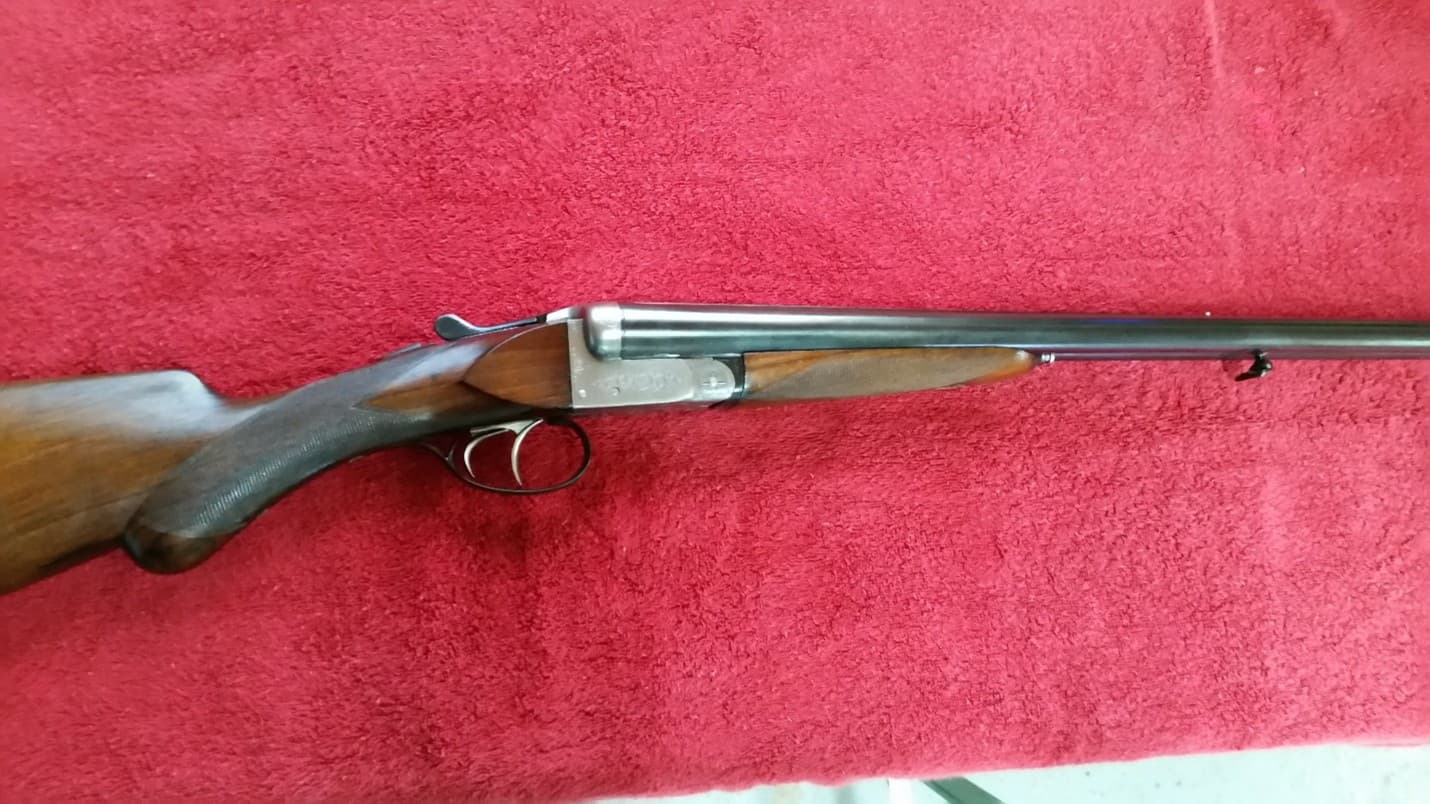
About two years into running Buckshot Industries, I was at my bench in my apron, actively repairing a gun, when an elderly gentleman stepped through the door and asked: “Are you a gunsmith?”
I thought the question answered itself.
“Yes,” I said.
He followed up. “Are you a gunsmith-gunsmith? Do you do bluing?”
I told him no, but that I’d been thinking about it.
He shook his head. “You just can’t find a gunsmith who does bluing anymore.”
He left without leaving a gun. But he left something behind: the clearest market signal I’ve ever received in seventeen years of this trade. There was demand sitting out there, deferred and uncollected, waiting for a shop willing to do the work.
I decided to find out how deep it ran.
The Market That Fell Asleep
What I found when I added bluing to my shop was not a niche. It was a backlog.
I call it the closet market. Guns sitting in closets, in safes, in the back of gun cabinets, all of them owned by people who know exactly what they want done and have been waiting, sometimes for years, for someone capable of doing it. When word gets out that a shop offers bluing, those guns start moving. Not a trickle. Droves. From across the county, across the state, from people who drove past three other gunsmiths to get to one who does finishing.
The two things I hear most often at intake: “I’ve got an old gun that needs bluing,” and “I’ve always wanted to get this done but I could never find anyone.” Both statements point at the same failure in the market. The demand never went away. The supply did. Those guns didn’t disappear. They just stopped getting carried into shops.
What happened is straightforward: as shops consolidated and generalized, finishing specialties got dropped. Bluing requires dedicated equipment, significant chemistry knowledge, and a process discipline that doesn’t fit a shop optimized for volume service work. So most shops stopped offering it. The customers who needed it had nowhere to go. The guns went into closets and stayed there.
That gap is still open. It is wider now than it was when that old man walked into my shop. The equipment investment to build a real bluing operation is not trivial, the learning curve costs real money, and most gunsmiths running lean shops aren’t positioned to absorb either. Which means the closet market keeps filling up, and the number of shops positioned to serve it stays small.
For the shops that are ready: the work is there. It does not advertise itself, because the customers have given up looking. But when they find you, they don’t come alone. They come with the gun they called about, and they mention you to the next person they know with a gun in a closet.
What Customers Think They’re Paying For
Before I do a single hour of work on a new customer’s gun, I correct one misconception. It comes up at almost every intake.
Customers believe bluing is a protective coating. It is not.
Bluing is a controlled oxidation process. It is not applied to the surface of the steel; it is formed within it. The result is a conversion layer, chemically bonded to the metal, not sitting on top of it. Cerakote sits on top. Duracoat sits on top. Enamel spray sits on top. Those finishes fill scratches and cover pitting because they are coatings. Bluing does not fill anything. It transforms what is already there.
This distinction has real economic consequences. A customer who understands it brings in a gun expecting honest prep work and a result proportional to the condition of the steel underneath. A customer who doesn’t understand it brings in a gun expecting the finish to hide what the years did to it. Those are two different conversations, and the one you don’t have at intake is the one you have at pickup, in the worst possible context.
The other thing customers get wrong is durability relative to modern finishes. Bluing is not as resistant to corrosion as a polymer coating. It will rust if neglected. It will scratch. What it offers instead is authenticity: the original finish language of the gun, restored. For the customers who want that, no substitute exists. For the customers who want maximum protection and don’t care about historical finish, there are better options and I tell them so.
Setting that expectation correctly at intake is not customer service. It is quality control. It determines whether the finished piece lands right.
Why Most Bluing Jobs Fail Before They Start
The difference between a quality bluing job and a mediocre one is almost entirely decided before the parts reach the tank.
This is the thing that separates shops that build a bluing reputation from shops that do it once and quietly stop offering it. The bluing process itself is not complicated to execute at a basic level. Chemistry, temperature, time. But the process is completely honest. It shows you everything that was there before it, amplified. Scratches that were barely visible under prep polish stand out under a fresh blue. Pitting that wasn’t fully worked out becomes permanent. Bluing does not hide the prep work. It grades it.
The shops that fail at bluing economically are almost always failing at prep, not chemistry. They underestimate the time required to strip and polish the parts correctly, they rush the disassembly to save labor cost, they blue assemblies together instead of taking them apart properly. The result looks acceptable to a customer who doesn’t know better. It looks like a problem to everyone else in the trade.
Quality prep means full disassembly of every part going into the tanks. It means cleaning everything, including parts that aren’t being blued, because contamination travels. It means polishing to the customer’s specification, not to whatever the surface will accept without more work. It means addressing pitting honestly: some of it can be worked out, some of it is too deep, and the customer needs to know which before the job starts, not after.
Take your time. Bluing is not very forgiving. Overlooked scratches and pitting will stand out and detract from all the long hours you put in.
There is also the matter of which parts actually go into the bluing tanks. Early in my operation I had to learn this boundary clearly. Barrels, receivers, cylinders, external hammers, triggers and trigger guards, some bolts, magazine caps, forearm steel, pins and screws: these are the parts that take the blue. Stocks, grips, plastic, wood, chrome, aluminum, stainless steel, brass, and most internal parts never go near the tanks. Keeping that boundary clear is what allows you to take your time with the parts that matter, because you’re not trying to manage a process for components that were never candidates for it.
The before and after on a job like this is not a trick. It is the direct result of prep discipline applied correctly. The guns that come out looking transformed are the ones where every hour before the tank was taken seriously. The ones that come out looking merely done are the ones where someone was watching the clock.
The Cost of Finished-Job Thinking
My first caustic bluing job came out right. Deep, even finish, glass surface, everything I’d been working toward. I set it on the bench and took photos. I couldn’t wait for the customer to see it.
Then I knocked over a bottle of bluing remover acid with a half-closed cap.
I stripped it down and did it again. The customer got the work he paid for. I blued it twice and got paid once.
The mistake wasn’t the acid. It was the mental state that comes right after finishing: pride drops your guard before the job is actually done. The piece is on the bench. The hard work is behind you. That is the moment the shop gets dangerous, because it is the moment you stop seeing what is still in front of you.
The customer pays for the finished job. Every mistake you make getting there comes out of your pocket, your time, or your reputation.
Now my finishing area operates on one rule: when a part reaches the finished stage, everything that could damage it leaves the bench. Chemicals go to a cabinet across the room. Tools not needed for that step go away. The part is treated as the customer’s property, because that is what it is. The few extra steps that costs have never once eaten a finished job.
The Operating System
Over seventeen years I have distilled the discipline of a bluing operation into three steps in a fixed sequence. I call them the three Rs.
Repair first. Before any metal is stripped, before any polishing begins, the firearm gets a function check. Not the customer’s word that it works fine: an actual function check on my bench. I learned this the hard way on a gun that came in looking like a straightforward reblue job. The customer told me it worked. It didn’t. I found out after the bluing was complete, during reassembly, on a gun old enough that parts no longer existed. I had put a $200 saddle on a $20 mule. Beautiful work. Nowhere to go with it. I don’t take anyone’s word on function anymore, including my own assumptions about a gun I’ve seen before.
Reblue when ready. Not when the schedule pressure says so. Not when the customer is asking. When the prep is done correctly and the parts are in the condition the process requires. Bluing absorbs the time you put into it and shows you everything you didn’t. The tank doesn’t care about your timeline.
Return it right. The customer gets a gun that looks and works the way they would want their own gun to look and work. That standard doesn’t flex based on what the intake condition was, what the job cost, or how long it took. The return condition is the only thing the customer judges, and it is the only thing that follows your name in the trade.
The Opportunity Is Still There
That elderly gentleman was right about one thing: you still can’t find a gunsmith who does bluing.
Not easily. Not in most markets. The shops that built real bluing operations in the last generation have aged out, and the shops coming up behind them are not replacing that capability at the same rate the demand is accumulating. The closet market I walked into seventeen years ago is larger now, not smaller. More guns sitting. More customers who have stopped asking because they’ve stopped expecting an answer.
The equipment investment is real. The chemistry knowledge takes time to build. The prep discipline is not optional and it is not fast. None of that changes what I see in my market and hear from others in the trade: there is latent demand for this work in almost every region, and from what I can tell, the number of shops positioned to capture it is not growing fast enough to meet it.
For the gunsmith who is ready to build that operation correctly: the market is not waiting to be created. It is waiting to be found. Those guns are already in the closets. The customers already know what they want. They are waiting for a shop that can actually do it.
That is still the most reliable thing that old man ever told me.