
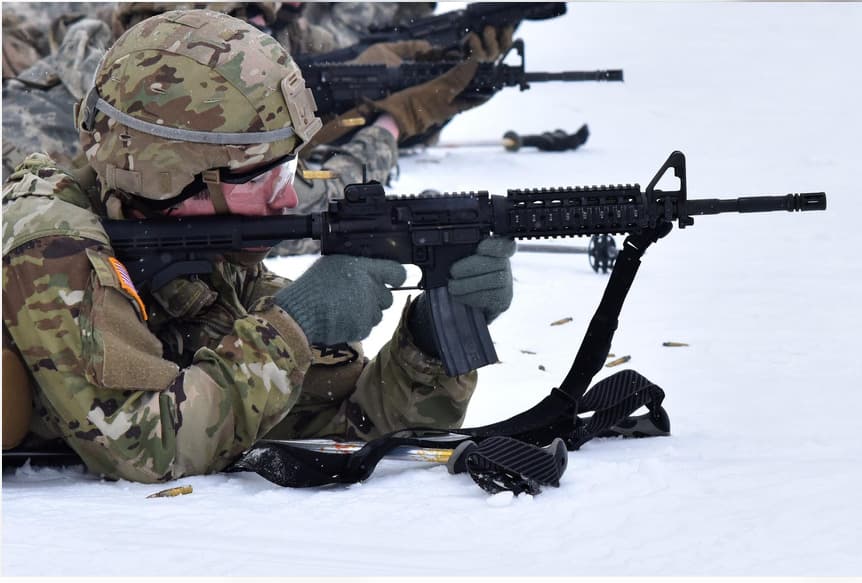
I was training a group of guards in New Hampshire in November 2017. The morning started sunny and forty-eight degrees. By eleven o'clock the sky had gone grey, snow had started falling, and in about thirty minutes the temperature dropped to twenty-five degrees. Everyone in the class began falling apart. Thirty minutes earlier, everyone in that class had been running two man advancing rifle drills which involved moving from one point of cover to the next without difficulty. Then I watched “Matt” fumble a magazine change he had clean thirty minutes before. He was not a different shooter. The environment had changed.
People were slipping in the snow. Cold hands could not execute basic tasks with any dexterity. The students who had brought gloves discovered that they either did not fit inside the trigger guard or made it difficult to manipulate their gear. Everyone running an optic was blinded, either by fogging or by snow collecting directly on the glass. It was a real eye-opener.
That is the gap this article is about. The problem was not a lack of basic firearms training. The weather had introduced variables the firing line had not. A qualification tells you whether a shooter can meet a standard under good conditions. It does not tell you how that performance transfers once temperature and weather become part of the problem.
COLD CHANGES THE SHOOTER
Cold does not switch off manual skill at one magic temperature. A 2019 review in Safety Science found that cold-related losses in manual performance depend on several factors: how quickly the hands cool, whether the cooling is local or affects the whole body, and what the task actually requires. Tasks that depend heavily on the fingers tend to be affected more than those driven primarily by the larger muscles of the hand, arm, and shoulder. Earlier research generally placed significant manual-performance degradation somewhere between twelve and twenty degrees Celsius of finger skin temperature.
More recent work suggests meaningful deterioration can begin before the hands feel truly numb. A 2025 study from the U.S. Army Research Institute of Environmental Medicine exposed subjects to prolonged occupational-style activity in cold environments and found that greater losses of dexterity began around 22.9 degrees Celsius at the fingers and 24.9 degrees at the hand, well above the older 15-degree figure often cited as the point of marked degradation. That figure remains a useful marker, but it should not be treated as an on-off switch. A shooter does not have to lose all feeling in the hands before performance starts to change.
There is also evidence that training in the cold itself matters. A 2006 study published in Military Medicine had subjects practice weapon assembly and disassembly, magazine loading, and another military task under different temperature-training sequences. Those who learned the skills in a warm environment and then practiced them in the cold performed six to twenty-eight percent faster in cold conditions than subjects who had trained only in warm conditions. The lesson for an instructor is straightforward: establish the skill under controlled conditions, then make sure it still works in the environment where it may actually be needed.
What I watched in New Hampshire was that problem arriving all at once, across an entire class, in real time.
Sunny and forty-eight degrees became grey and twenty-five in thirty minutes, and everyone in the class began falling apart.
GLOVES ARE EQUIPMENT, NOT CLOTHING
Gloves are often treated as clothing rather than part of the equipment system. In the field, they are equipment, and they either work with the rest of the gear or they do not. In New Hampshire, several students found out mid-class that their gloves would not fit inside a trigger guard, or made routine manipulation of their gear noticeably harder. That is not a small detail. It is the difference between a shooter who can function and one who cannot, and it should never be discovered for the first time during an actual incident.
Cold-weather research also shows why glove selection is more complicated than simply choosing the warmest pair. A 2026 field study involving soldiers working in temperatures from roughly minus two to five degrees Celsius found that clothing insulation and hand-protection design materially affected finger temperature and manual performance. In the magazine-loading test, the lower-insulation condition produced an average decline of about eighteen percent, compared with roughly two percent in the highest-insulation condition. The soldiers used the same thin gloves during that specific test, which let researchers separate the effect of colder hands from the mechanical effect of different glove designs, and the broader study still found that overall clothing and hand-protection choices meaningfully affected finger temperature and performance.
The practical issue is a tradeoff. The hand needs enough protection to preserve temperature and function, but the glove also has to allow the shooter to perform the required tasks. After that New Hampshire class, I changed how I evaluated gloves. I stopped thinking only about warmth and started looking for enough thermal protection without sacrificing the dexterity needed to operate the firearm and gear. What matters is testing the actual tasks: trigger access, magazine changes, and equipment manipulation, not simply standing on a firing line wearing gloves.
WHEN THE LUBRICANT BECOMES THE PROBLEM
Cold does not only affect the shooter. It affects the gun. I was training local law enforcement in Texas in January 2019, in conditions cold enough that slides began to stick 25-30 degrees, and nearly all of the 12 students in class, a mix of Glock and Sig Sauer 9mm duty pistols, experienced slide issues and stoppages. The lubricant we were using, a standard CLP, was turning thick and gummy exactly when it needed to keep moving parts free. We switched the whole group to Slip 2000 EWL 30, and it resolved the problem immediately. I used it exclusively since and have no financial interest in that product.
That experience is consistent with U.S. Army winter-weapons guidance, which warns that an unsuitable lubricant can thicken in extreme cold and contribute to sluggish operation or stoppages. Under its cold-weather procedures, the Army specifies an arctic-rated lubricant rather than conventional CLP for most infantry weapons, with platform-specific exceptions. That is not a recommendation that every law enforcement or security firearm should use the same lubricant the Army uses. Firearm manufacturers and agency maintenance policies should determine the appropriate product and procedure. The broader lesson is that lubricant performance observed on a comfortable range should not automatically be assumed to remain identical once temperatures drop. Equipment has to be validated in the environment where it is expected to work.
A lubricant validated on a warm range should never be assumed to behave the same way once temperatures drop.
COLD TO WARM, AND BACK AGAIN
Cold-weather reliability is not only about what happens while the firearm stays outside. Army guidance also warns about condensation when a weapon moves from extreme cold into a heated environment. Moisture can form on and inside the weapon. If that firearm is returned to freezing conditions before the moisture is properly managed, the water can refreeze and interfere with its operation.
That means environmental testing should consider transitions, not just temperatures. A firearm and equipment system that functions outdoors in the cold may face a different problem entirely after moving into a heated vehicle or building and then returning outside.
OPTICS AND THE SNOWBALL PROBLEM
Snow does something to an optic that most shooters do not think about until it happens to them. If a rifle is slung and the shooter is simply standing around in falling snow, the optic can collect snow across the lens without anyone noticing. It sits there. It can freeze. Then, when the shooter finally mounts the rifle to fire, they are not looking at a target. They are looking at a snowball. I have seen this happen many times, and it never fails to catch someone off guard the first time.
The fix is simple once you know to look for it: a hand cupped over the optic while the rifle is slung and not in use will keep it clear. For ordinary fogging, an anti-fog treatment approved for coated optical lenses can help, applied according to the optic manufacturer's guidance rather than whatever happens to be on hand. Neither of those fixes matters if nobody has ever been forced to discover the problem in training.
THE MISTAKE MOST INSTRUCTORS MAKE
The most common mistake I see in adverse-weather training is not a technique problem. It is a scheduling one. When the weather turns bad, most instructors stop the class. That is a lost opportunity. The conditions that make an instructor want to pack up and go inside are often precisely the conditions a shooter is least prepared to handle, and training should be built around them rather than cancelled because of them. That does not mean training through unsafe conditions. Ice underfoot, lightning, and genuine cold-injury risk still set the limits, and range safety and agency policy do not get suspended because the lesson is a good one.
Thirty minutes was all it took in New Hampshire for a familiar training day to become a very different test. The shooters had not suddenly forgotten the fundamentals. The environment had exposed where performance, clothing, and equipment began to degrade.
Cold-weather training should not be about proving who can tough it out. It should be about discovering those limits deliberately, under controlled conditions, while the consequences are still instructional. A qualification can show what a shooter can do under the conditions of the test. Adverse-weather training answers the harder question: what remains when those conditions stop cooperating? The best time to discover that gap is still on a training day, not a real one.
COLD-WEATHER VALIDATION: FIVE QUESTIONS
• Do the gloves provide enough protection while still allowing the shooter to operate the firearm and required equipment?
• Which manipulations become slower, less reliable, or impossible as the hands cool?
• Do the optic and sighting system remain usable through snow, moisture, and external fogging?
• Has the firearm, lubricant, and equipment configuration actually been tested at the temperatures and environmental transitions in which it may be used?
• Are footing, weather exposure, and cold-injury risk still within safe training limits?