
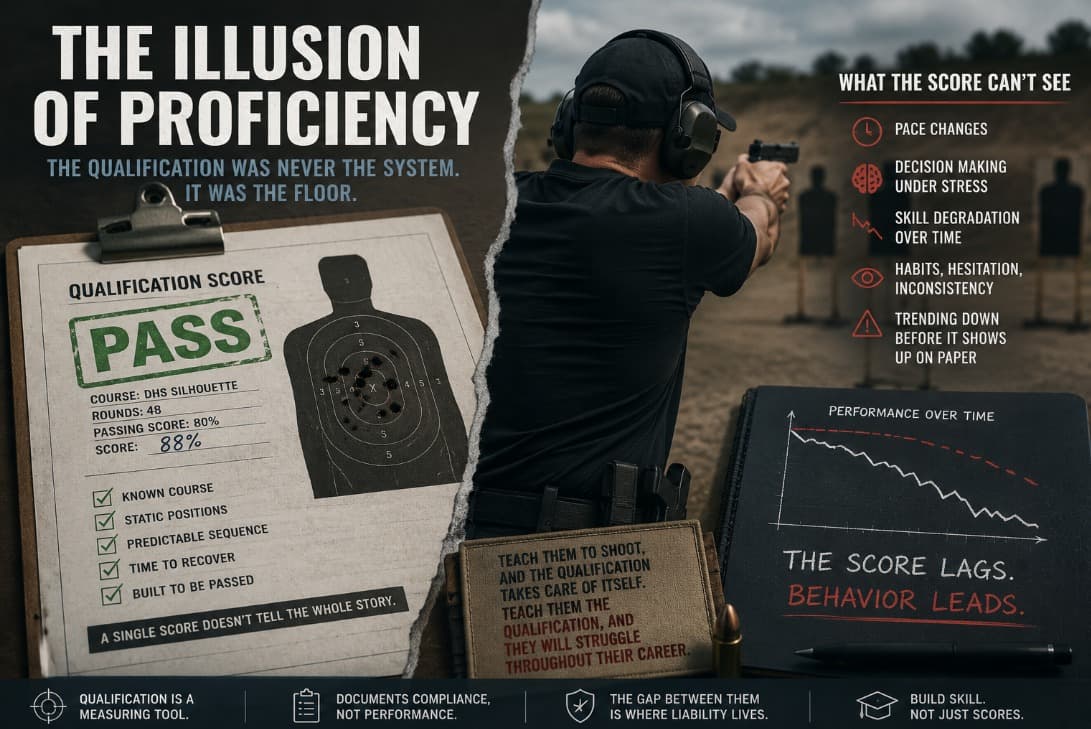
A clean qualification record does not mean a prepared officer. It means the officer passed a test designed to be passed. Most instructors already know this. They have watched students perform well on a known course of fire, then fall apart the moment pace changes or conditions shift. The gap is not theoretical. It shows up on the range.
CBP runs 48 rounds on a DHS silhouette, 80 percent to pass. FLETC sits at 70. Some agencies push to 80 or 85, but the structure stays familiar: static positions, known sequences, time that allows recovery. A competent instructor can shoot side-by-side targets at the same cadence and pass both without difficulty. That outcome does not surprise anyone who has spent time on a line. The standard is not demanding because it was not designed to be. It was designed to establish a baseline that can be applied consistently and documented. That is a legitimate institutional need. The problem is what happens to that number once it is recorded.
That baseline becomes a problem when it is treated as something more. One qualification produces one data point. One day, controlled conditions, known sequence. The result gets recorded as a pass, and the system moves on. What it does not capture is everything outside that moment. I have seen officers shoot well on a qualification and struggle shortly after when pace increases or attention splits. I have also seen shooters trend downward across multiple cycles while continuing to pass. The system records the pass. The behavior tells a different story, but nothing in the record reflects it.
Most agencies run one or two qualifications a year, some quarterly. That frequency is not arbitrary. Skills degrade. Attention shifts. Habits form in ways instructors do not always see until something goes wrong. If performance were fixed, one qualification would be sufficient. But frequency alone does not create development. Running the same course more often does not change what the system measures. It still produces isolated results, separated by time, with nothing connecting them. The score moves up or down and without context, the movement means nothing. A shooter trending down can pass for years before the record catches up to what the range already showed.
Shooters adapt to that structure quickly. Given enough repetition, they learn where time can be managed, where pressure is low, where points can be recovered. They start solving the course instead of building skill. I worked a CBP class where the plan was straightforward: run the course of fire twice per session, every session. By the end of the week, pass rates were fine. One student in particular had cleaned up his splits on the 7-yard strings and was hitting 88 percent. Then I moved him back to 15 yards and changed the cadence. He froze on the first transition. Not hesitation. A full stop. He had been solving the known problem for five days. He had no idea how to shoot.
Teach them the qualification, and they will struggle throughout their career.
Training often makes this worse without meaning to. Instructors pull pieces of the qualification and drill them repeatedly. Two to the body, one to the head, run it again. What gets lost is the underlying process. When does the shooter shift vision? How is the gun managed through recoil? Where does control break under speed? Those questions do not get answered through repetition alone. They show up when the shooter experiments, fails, adjusts, and understands what changed. Without that layer, repetition produces compliance with a pattern. Students learn to complete the drill. They do not learn why it works or what to do when it stops working.
My view has always been simple: teach them to shoot, and the qualification takes care of itself. Teach them the qualification, and they will struggle throughout their career. The course of fire is a measuring tool. It cannot also be the curriculum.
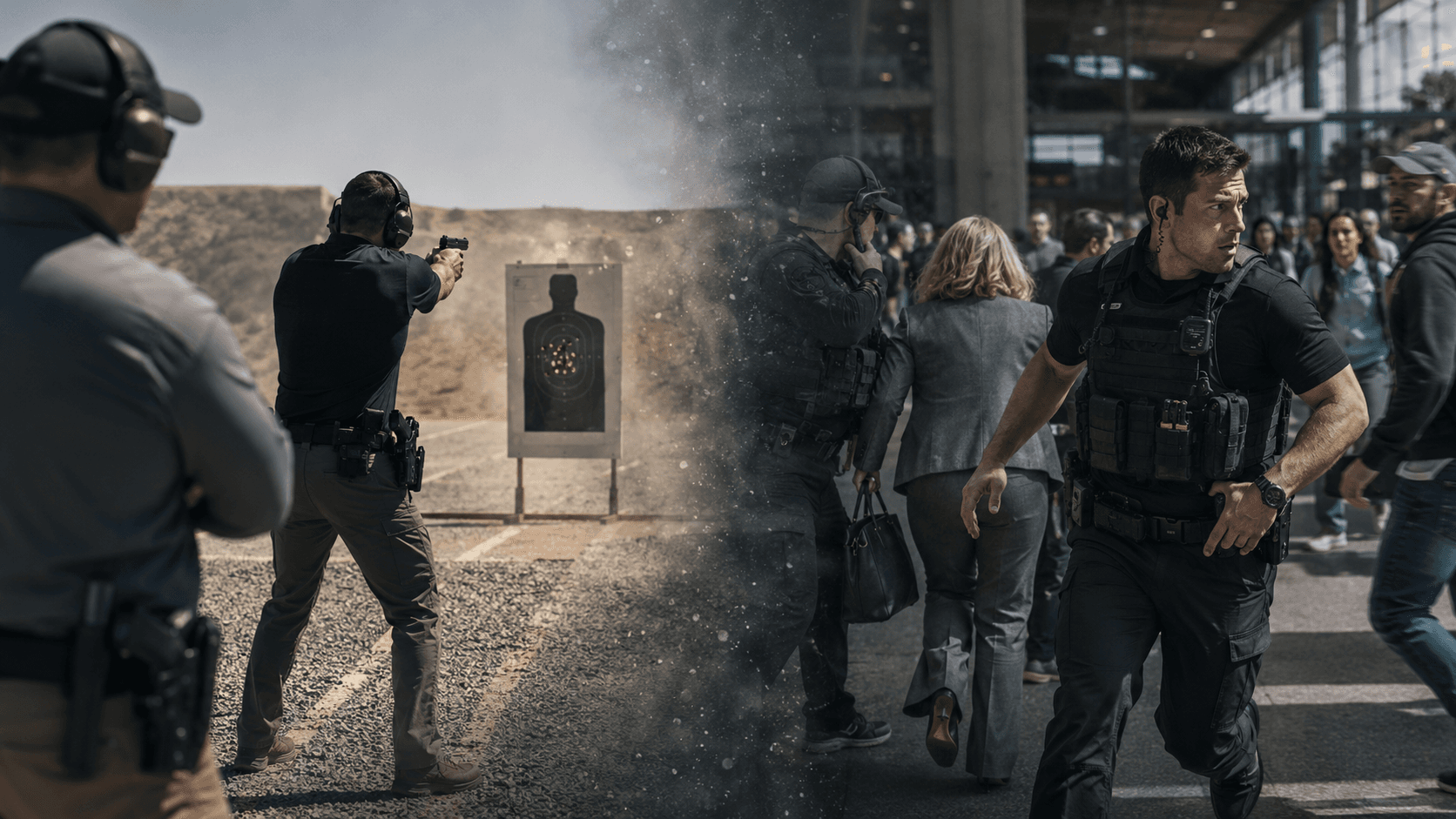
The qualification does not show where efficiency was lost, where hesitation appeared, or whether a shooter is improving or declining. Two shooters with identical scores look the same on paper when their performance is moving in opposite directions. One moves from 88 to 90 to 92. Another moves from 92 to 88 to 84. Both pass. The direction is different. Decline shows up in behavior first: slower corrections, hesitation under time, inconsistency across strings. The score lags. By the time it reflects the problem, the pattern has already been there for a while.
An instructor watching closely will see the decline. The record will not.
Qualification also serves a documentation function. It creates a record that can be referenced when performance is questioned. That role is not secondary — for many agencies, it is the primary reason the system exists in its current form. But that means the system has to hold up under scrutiny. A single passing score shows a minimum standard was met on a given day. Most agencies are not measuring performance. They are documenting compliance. Those are not the same thing, and the gap between them is where the real liability lives.
Most agencies are not measuring performance. They are documenting compliance.
It does not show consistency. It does not show change over time. It does not show how the agency responded when decline was already visible on the range. A record that only captures passing obscures everything that happened between qualifications. When decisions get examined after the fact, those gaps matter more than the score itself.
None of this removes the need for qualification. The baseline serves a purpose. The issue is treating it as a complete picture. It was built as a checkpoint inside a larger system that often does not exist. The checkpoint functions. The system around it is missing.
Something has to sit on top of it. Not to replace it to complete it. A way to track performance across time, not just capture a moment. A way to see change before it becomes failure. A way for instructors to act on what the range is already telling them, rather than waiting for the score to confirm what they already know. None of that requires a new institution. It requires deciding that the direction of a shooter's performance matters as much as whether they passed on a given Tuesday. Most agencies have not made that decision yet. Some have. The difference shows up eventually.
The system is producing exactly what it was designed to produce. The question is whether that is still the right design.