
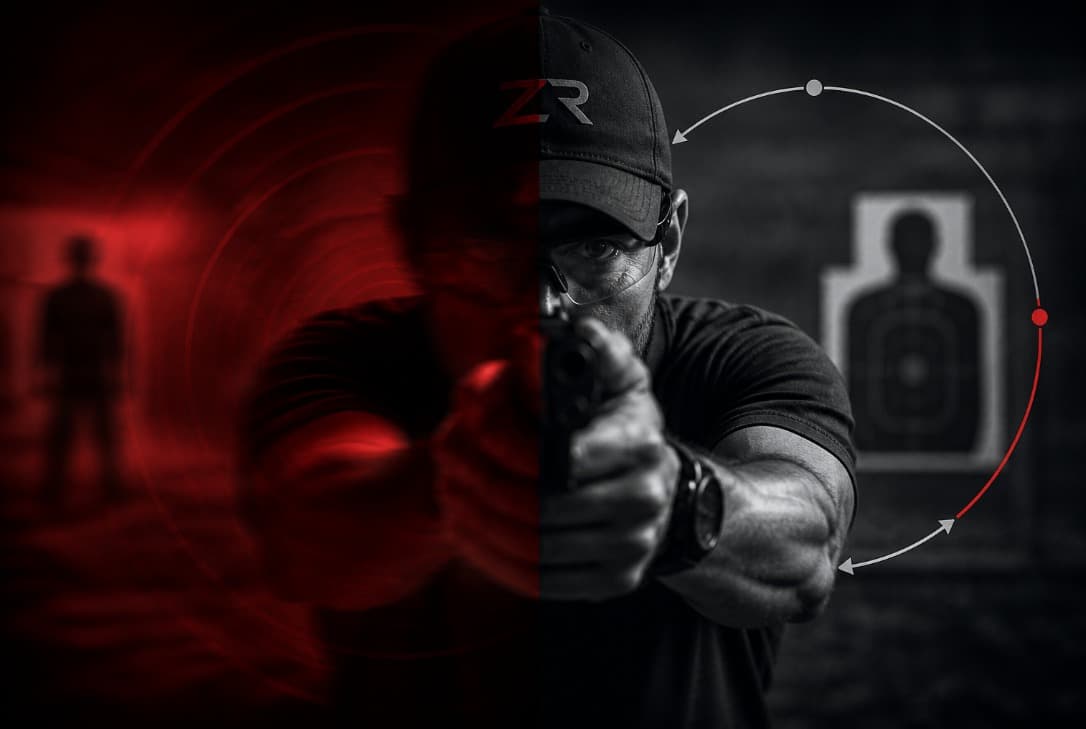
There is a moment in every high-stress event where performance either holds or collapses. Most people assume that moment is about courage, or training volume, or marksmanship. After enough time in this work, the evidence points somewhere less dramatic.
You have seen it. The student who shoots clean but solves the wrong problem.
The moment almost always hinges on one thing: whether the person can still accurately process what is in front of them. That is a breathing problem before it is anything else.
WHAT THE OODA LOOP ACTUALLY REQUIRES
The OODA Loop is one of the most cited frameworks in military, law enforcement, and protective operations. Most people treat it as a speed model. Get through the loop faster than the threat. React first. Win through initiative.
That reading is incomplete. Under pressure, it becomes dangerous.
Boyd's contribution was not about speed. It was about accuracy of interpretation under pressure. The most important stage in the loop is orientation where raw observation becomes meaning. Where experience either serves or misleads. Where bias enters, tunnel vision locks in, and a person either updates their read on the situation or doubles down on a false one.
If orientation is wrong, faster action produces faster failure.
Most bad decisions are not made under pressure. They are made after orientation has already failed.
Acute stress degrades the systems the loop depends on: working memory, attentional control, the ability to hold off a premature response. The loop does not break because a person lacks training. It breaks because the physiological state has made accurate interpretation impossible. The person sees, but cannot assign meaning. They decide from a corrupted baseline. They act often with clean mechanics on a false picture of reality.
This is why qualification scores look clean while real decisions fall apart.
WHERE BREATH ENTERS THE PROBLEM
Breath is not peripheral to this process. It is mechanically central.
When the sympathetic nervous system activates, breathing becomes faster and shallower. The body often misreads that shift as worsening danger. Shallow breathing compounds the problem: threat, then adrenaline, then constricted breathing, then panic sensation, then more tension, then worse movement, then worse decisions. The physiology spirals inward while the threat is still evolving outward.
You see it in scenario runs. A student enters a force-on-force problem already carrying elevated heart rate from the briefing. By the time the first decision point arrives, they are breathing in their chest, their grip is white, and orientation has narrowed to a single point. They are not seeing the environment anymore. They are reacting to one signal while everything else disappears.
That is where the decision fails. Not at the trigger. Before it.
The double inhale interrupts that spiral at the source. The structure: a full nasal inhale, a second shorter inhale on top, then a long controlled exhale. The second inhale helps re-recruit lung volume that shallow stress breathing has abandoned. The long exhale signals the nervous system to reduce unnecessary arousal without sedating the person.
Not relaxation. Controlled readiness. There is a difference, and emergency performance requires the second one.
ANOTHER FAILURE POINT MOST TRAINING IGNORES
Breath is also a proprioceptive anchor.
Under adrenaline, a person may not notice they are holding their breath, locking their knees, overgripping, losing posture, or moving faster than they can process. The body is still moving. But the brain has stopped receiving accurate information about where it is and what it is doing.
You see it after sprint drills. Students come off a hard run, draw, and engage. The grip is wrong. The trigger press is stacked. The sights are misaligned and the student does not feel it. The proprioceptive signal is there. The interpretation has degraded. The body performs, but the person is no longer navigating it.
A deliberate breath forces reattachment. The person feels the ribcage expand. They notice the grip. The jaw. The stance. In that moment, breathing becomes body-mapping. It does not fix the threat. It restores awareness of the instrument being used to manage it.
This is where people lose the decision not because they could not shoot, but because they could not feel what they were doing.
WHAT THE ICE BATH ACTUALLY TESTS
A comment worth addressing directly, because it names the mechanism more honestly than most formal instruction does.
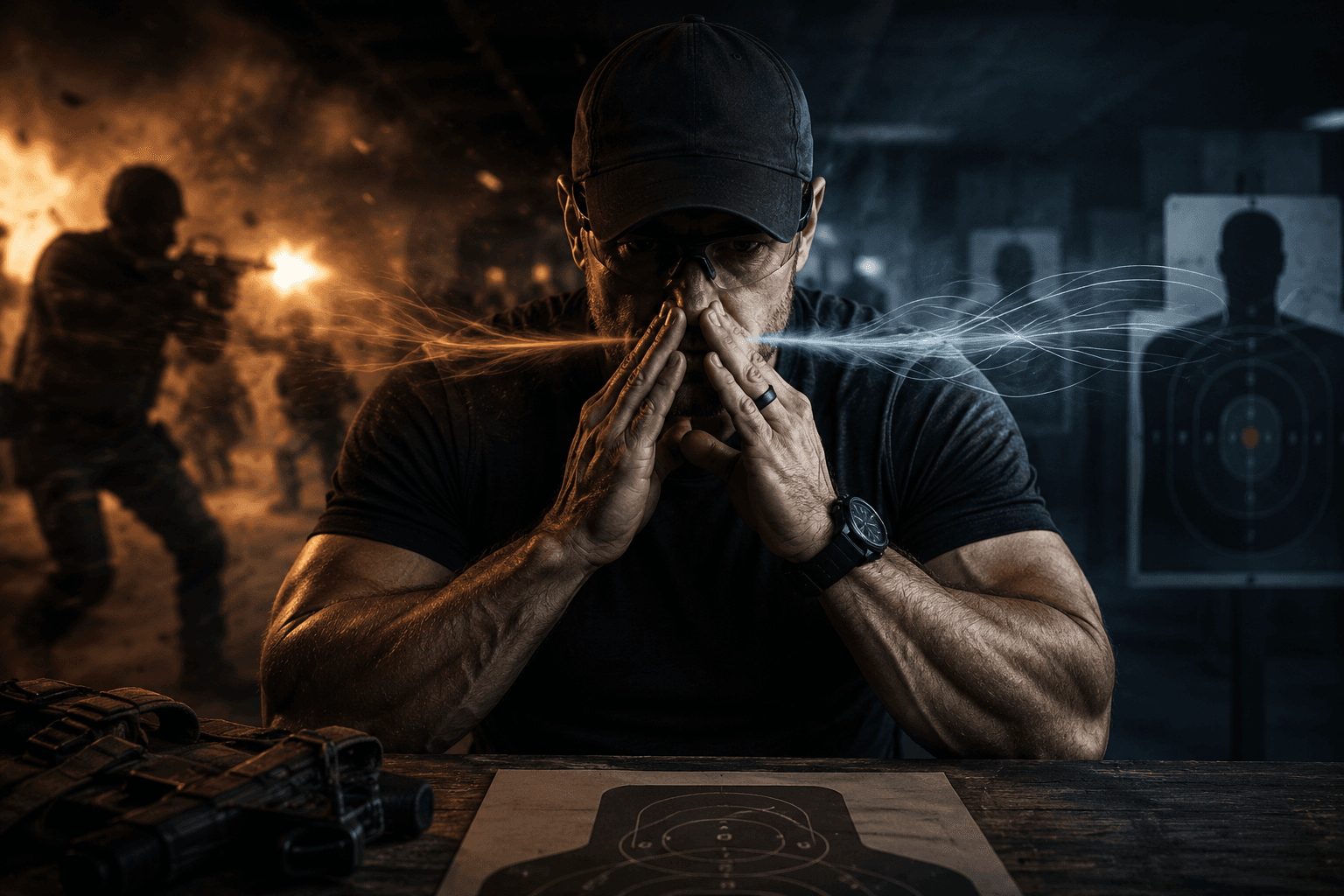
Cold-water immersion 45 degrees, head under. The panic response is immediate. But after the first forced breath, something changes. The person has to figure it out.
The cold does not matter. The loss of control does.
What repeated exposure builds is not cold tolerance. It is the ability to override the cascade stimulus, activation, disrupted breathing, panic and find the breath that restores orientation. The cold bath compresses that learning into a short, unambiguous window. Find breath control, or the situation controls you.
The double inhale does the same work in an operational context. The cold bath makes it visceral. The technique makes it portable. Both train the same competency: return to deliberate breath control when the body's default is to abandon it.
Neither works without rehearsal under pressure. An intellectual understanding of the technique provides no guarantee it surfaces under load. Rehearsal in cold water, in force-on-force scenarios, in post exertion recovery blocks that is what makes it reliable when the cost of failing is real.
THE CONNECTION BACK TO ORIENTATION
Return to the loop.
Orientation fails when physiological state outruns regulatory capacity. The person observes through a narrowed aperture. They orient through a system running on degraded resources. They decide reflexively, because the deliberate processes that evaluate competing interpretations have already been overwhelmed.
Breath control is the most accessible intervention available before that sequence completes. It does not replace the loop. It protects the conditions under which the loop can function.
A person who can stabilize breathing in the two or three seconds after a significant stress event after a startle, after exertion, before a verbal engagement, before a use-of-force decision has bought back the cognitive space to orient correctly.
In What Holds Up After the Shot, the failures that matter most are not mechanical. They are the decision failures: the latency windows, the premature escalations, the verbal collapses. Every one of those failures occurs inside orientation. Every one becomes more likely when physiological state has outpaced the ability to regulate it.
Breath control keeps orientation open long enough to function.
WHERE THIS MATTERS IN PRACTICE
The double inhale does not require a separate training block. It requires integration into every context where stress appears.
Specific windows where the decision gets lost:
Before issuing verbal commands the two seconds where the voice either lands with authority or collapses into noise. After running, fighting, or any physical exertion that precedes a choice. After a startle or sudden contact. In the seconds after a threat has stopped and the reconstruction process begins where what gets said next becomes part of the record.
One to three cycles. Inhale through the nose. Second shorter inhale. Long exhale. Drop the shoulders. Release the jaw. Feel the feet. Orient. Act.
Not complicated. What makes it effective is that it has been trained often enough to run under load.
The OODA Loop breaks at orientation.
Orientation breaks when physiological state outruns regulation.
Physiological state is most directly accessible through breathing.
That is the chain.
The person who controls their breath under pressure is the person who can still process what they are seeing. The person who can still process what they are seeing is the one who can make a correct decision.
Adrenaline is not the problem. Losing control of it is.
The double inhale is not a technique. It is a trained interruption one that keeps the loop intact long enough to matter.
Train the breath. Protect the loop.