
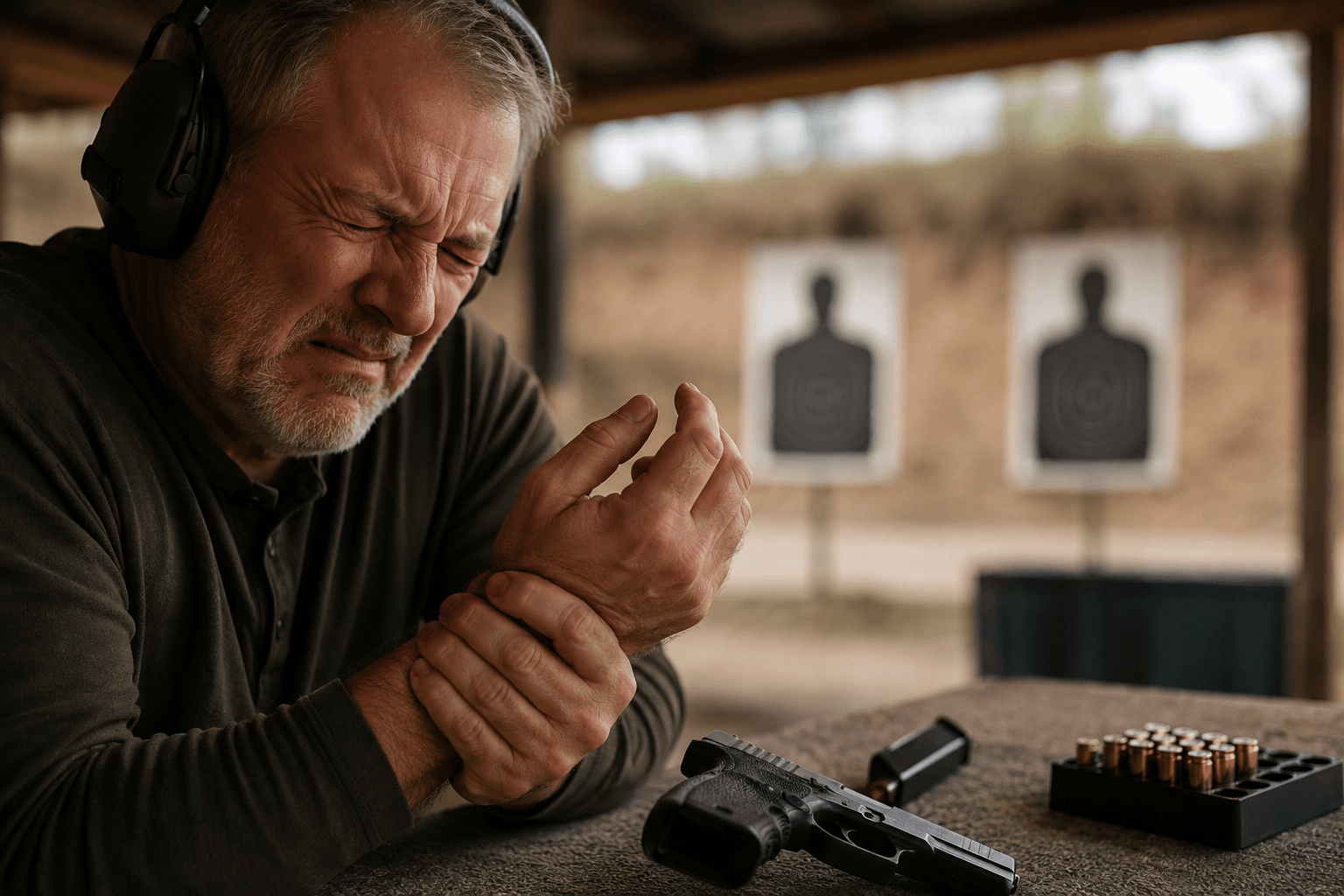
You've seen the shooter who winces after every round. The one who shifts grip halfway through a string, or holds the gun a half inch off the body like distance will absorb the recoil. The regular who used to shoot two boxes and now packs up after twenty rounds.
I watched one of mine for the better part of a year before I said anything. Retired, shot a full-size .45 for decades, showed up every other Saturday like it was church. Then the two boxes became one, the one became a half, and one morning he was casing the gun before I had finished my coffee. I asked where he was headed. "Hands don't want to play today," he said, and smiled like it was a joke. It wasn't a joke. It was the whole problem, wearing a smile so nobody would have to talk about it.
Nobody says anything because there has never been a script for it. Pain sits in the space between disability and equipment problems, and most of us have no language for that space at all.
This is the framework I use. It is not a diagnosis, and it is not a medical opinion as that is not my area. It is a way to read the signs, ask the right question, and adapt the firearm to the person... and alleviate some, if not all, of the pain.
THE PATTERN ON THE LINE
Pain changes shooting behavior in predictable ways, and it does so before anyone says a word about it. Those are the people we most need to work with, because this is the generation of grin and bear it.
• Wincing or grimacing after shots, especially during rapid fire
• Changing grip pressure or hand position mid-string
• Shooting fewer rounds than planned, then quietly packing up
• Avoiding certain positions, namely, standing, kneeling, prone
• Flinching or anticipating recoil before the trigger breaks
• Asking for lighter recoil ammunition, or asking if the gun can be made "easier"
• Showing up less often, for no stated reason
None of these alone means anything. Together, they mean pain is running the gun, not the shooter.
Pain doesn't equal weakness, and no pain doesn't equal full capability.
Some of these shooters have disabilities. Many do not. Some are recovering from surgery, managing arthritis, carrying an old injury, or just having a bad day. It isn't the instructor's job to provide a label... the job is to keep them safe, capable, and honest about what is actually happening on the line.
THE CONVERSATION
Before you recommend anything, ask. Start with observation, not assumption: "I noticed you seemed uncomfortable out there. Everything okay?" Then stop talking. A tough ask for some of us, I know (I bill by the hour, silence does not come naturally), but stop talking.
If they confirm it, find out where the discomfort is, when it shows up, whether it is sharp or dull or just fatigue, whether it is getting better or worse, and whether they have seen a doctor about it. Ask what they want out of this: keep coming to the range, carry concealed, home defense, competition. The answer changes the recommendation.
A few questions do most of the work.
• Is that discomfort, fatigue, or pain?
• Does it show up right away, or only after a few magazines?
• Is the goal today range practice, carry confidence, home defense, or just staying active?
• Do you want to adjust the drill, the gun, or the round count?
Do not diagnose. You are not a doctor, and if the pain is significant and unexamined, suggest they see one. Do not assume capability either way. And do not tell someone to push through it. That is not a framework, that is how people get hurt and become unsafe to everyone on the line.
The hardest part is rarely the pain itself…it is pride. Most shooters won't volunteer discomfort because they think it sounds weak, old, or unprepared, and the same man who will happily tell you about his triple bypass over lunch will deny to your face that his wrist hurts when the slide cycles. Make the conversation normal before you expect the shooter to make it honest.
GUN, TECHNIQUE, OR CHANGE
Once you understand the problem, work it in a fixed order: evaluate the match first, fix the technique second, modify the equipment third, and replace the firearm only when nothing else answers.
Evaluation first. Is this firearm the right match for this shooter right now, today, not the shooter they were thirty years ago? A compact 9mm often produces a sharper peak recoil impulse than a full-size gun in the same caliber, and that spike is exactly what a hand, wrist, or shoulder with arthritis feels first. A shoulder carrying an old rotator cuff injury often does better with a heavier gun or a lower-recoil load, not a smaller one.
Technique second, and always before you touch the equipment. Grip changes can reduce recoil transmission, stance adjustments can improve stability, and trigger control work cuts down on anticipation and flinching. Sometimes positioning alone, standing instead of kneeling, removes the limitation entirely. Technique is free, it stays with the shooter, and it builds the kind of confidence a grip sleeve never will.
There is a reason technique work matters this much. Shoot through pain long enough and the body learns the lesson better than any instructor could teach it. Pavlov rang a bell and the dog drooled. Our shooter hears the hammer fall and braces for the hurt, whether the hurt comes or not. That conditioning is one of the hardest problems we face, and the only cure I have found is time and pain-free rounds, stacked patiently, until the body unlearns what it was taught.
Modification third, and when you get there, make the smallest change that solves the problem. Grip tape before a new frame or grip module. A trigger evaluation or better sights before a new gun. Replacing the firearm entirely is the last resort.
Here is one I see so often I could set my watch by it. A woman in her seventies comes in with a micro-nine her son bought her, because it felt light and manageable at the counter and he loves her and wanted her to have something she could handle. On the line, the short grip gives her two fingers of purchase, the light frame turns every shot into a slap, and by the second magazine the wincing starts, followed shortly by the conclusion that she is "just too old for this." She is not too old for anything but this wrong gun. The fix, and this surprises people every time, is frequently not less gun but it's more gun, a lighter round, a better and softer grip surface, or a different goal for that day's session.
WHAT WORKS AND WHAT FAILS UNDER STRESS
The changes that hold up best are the boring ones: better grip texture, upgraded sights, appropriate ammunition that remains reliable in that firearm, a sling adjustment on a rifle, and/or conservative trigger work. They support the technique a shooter already has instead of forcing a new one under stress.
Recoil reduction devices, braces, compensators, and rail systems that change how the gun handles are a different animal. They often require new techniques to run correctly.
Under stress, a shooter reverts to trained technique. A modification that requires new technique is a modification that without a significant amount of work, could get ignored when it most matters.
Range comfort can tolerate experimentation, because there is time to go slow and rehearse it. Concealed carry and home defense have less room for complexity. A range-only fix is fine if the shooter has time to practice it. A defensive setup has to work cold, under stress, with the shooter they actually are today, not the shooter they used to be. This is not the easiest conversation to have, but it may bear the most fruit.
THE PAPER TRAIL
This is where the attorney in me shows up (he never fully leaves). Documentation is not paperwork for its own sake. It sets a baseline, shows a conservative approach was actually taken, and protects everyone if something goes wrong later. Keep it factual. Do not speculate, and do not diagnose in your own notes any more than you would out loud.
Document only what you observed, what the shooter reported, what you recommended, and what was agreed to next.
2026-01-15: Shooter reported hand pain during rapid fire with a compact 9mm. Recommended a full-size 9mm to reduce peak recoil. Shooter agreed to test. Follow-up scheduled.
That's the whole note. Clear, short, defensible.
WHEN THE ANSWER IS NO
Sometimes the honest answer is not with this firearm, or not right now. Pain that is severe and undiagnosed, pain that is getting worse despite everything you have tried, a shooter who cannot safely run the gun even after modification: these are the signals that tell you to stop adjusting equipment and start redirecting the person.
I had a fellow ask me for a lighter trigger because his hand "gave out" on the press. Not tired, not sore…it gave out. Sharp pain, getting worse over weeks, no doctor involved yet, and his solution was to make the gun require less of the hand that was failing. No trigger job on my bench fixes a hand that is quitting mid-press, and pretending otherwise would have put a doctor's visit off for months and a loaded firearm in an unreliable grip in the meantime. He saw his doctor and the trigger stayed where the factory put it. For everyone’s sake, stay within factory set parameters or face the consequences, namely, dealing with attorneys in a lawsuit (and no one wants that).
Discomfort and a red flag are not the same thing. Stop and redirect when pain is sharp, when it is getting worse, when it is unexplained, when it comes with loss of control of the firearm, or when it is producing unsafe handling. At that point the answer isn't another grip sleeve or another drill. The answer is to end the session, change the goal, or suggest they see a doctor.
It might mean a different gun entirely, or a doctor's visit before another range session. It might mean telling someone that concealed carry isn't the right goal this year, while home defense or supervised range work still is. Nobody wants to say it but it beats watching someone get hurt because you didn't.
The goal is never to turn every ache into a medical case or every limitation into a new gun sale. The goal is to notice early, ask with respect, adjust conservatively, and keep good shooters on the line instead of losing them to a problem nobody was willing to address. Continuing to safely do something people enjoy builds happiness and autonomy, and I will take my chances defending the claim that those two things make for a longer and better life.
My Saturday regular still shoots, by the way. Different grips, a technique adjustment, and an honest conversation that took ten minutes and was a year overdue. The half box is back up to two, and his hands want to play just fine. That is the whole framework, working as intended: notice, ask, adapt, and keep them shooting.
...and remember, like my father always said: use your head.