
Most departments treat a failed qualification the same way every time. The officer goes to remediation, gets a review of the fundamentals, qualifies, and returns to duty. It looks like a solved problem. It rarely is.
I spent 27 years with a municipal police department in New Jersey, the last stretch of it as supervising firearms instructor and lead armorer. In that time I saw the qualification cycle repeat itself with the same officers, the same dead ends. The fundamentals were always in there. What the system couldn't account for was everything that happened between one qualification date and the next.
Shooting is a deteriorating skill. I know of very few people that can go six months between qualifications without shooting a round and submit 100% accuracy.
The Type A Problem
Law enforcement attracts a particular personality type. Type A, performance-oriented, culturally conditioned to project competence in every situation. The job reinforces it. The stereotype demands it. Fear nothing. Admit no weakness.
Officers avoid what they are not good at. Not laziness. A protection mechanism. Exposing a gap in shooting performance carries weight that peers and supervisors will remember. So they don't practice. The skill deteriorates on schedule.
Remediation interrupts the cycle temporarily. An officer who struggles to qualify will, after a review of the fundamentals, usually qualify. But if the meaningful repetitions never happen afterward, the skills don't stick. The next qualification arrives and the cycle repeats. The department logs another pass and moves on. Nobody asks why the same officer needed remediation again.
When the Platform Is the Variable
We had an officer who consistently struggled to qualify with our issue sidearm. He went through remediation. He qualified. The cycle repeated for years. The record showed a performance problem. What it didn't show was whether the problem actually belonged to him.
When we transitioned to a striker-fired platform from a DA/SA variant, the officer's qualification struggles stopped immediately. No additional remediation. No fundamental review. The platform changed and the problem disappeared.
Was it the grip angle? Was it the consistent trigger pull of the striker-fired system? I really cannot say. But the operating system had been creating friction that had nothing to do with the officer's ability to shoot.
Scores improved across the department during the transition. Elevated round count, not improved habits. When volume returned to normal, scores followed. The officer in question has not significantly increased his training between qualifications. By every metric the system tracks, not much changed. But something else did.
What the Scores Didn't Capture
Before the transition, the officer rarely carried his issue sidearm off duty. After the transition, he purchased two pistols of the same platform and wears them routinely when not on the clock. My successor as supervising firearms instructor tells me the officer experiences no qualification issues.
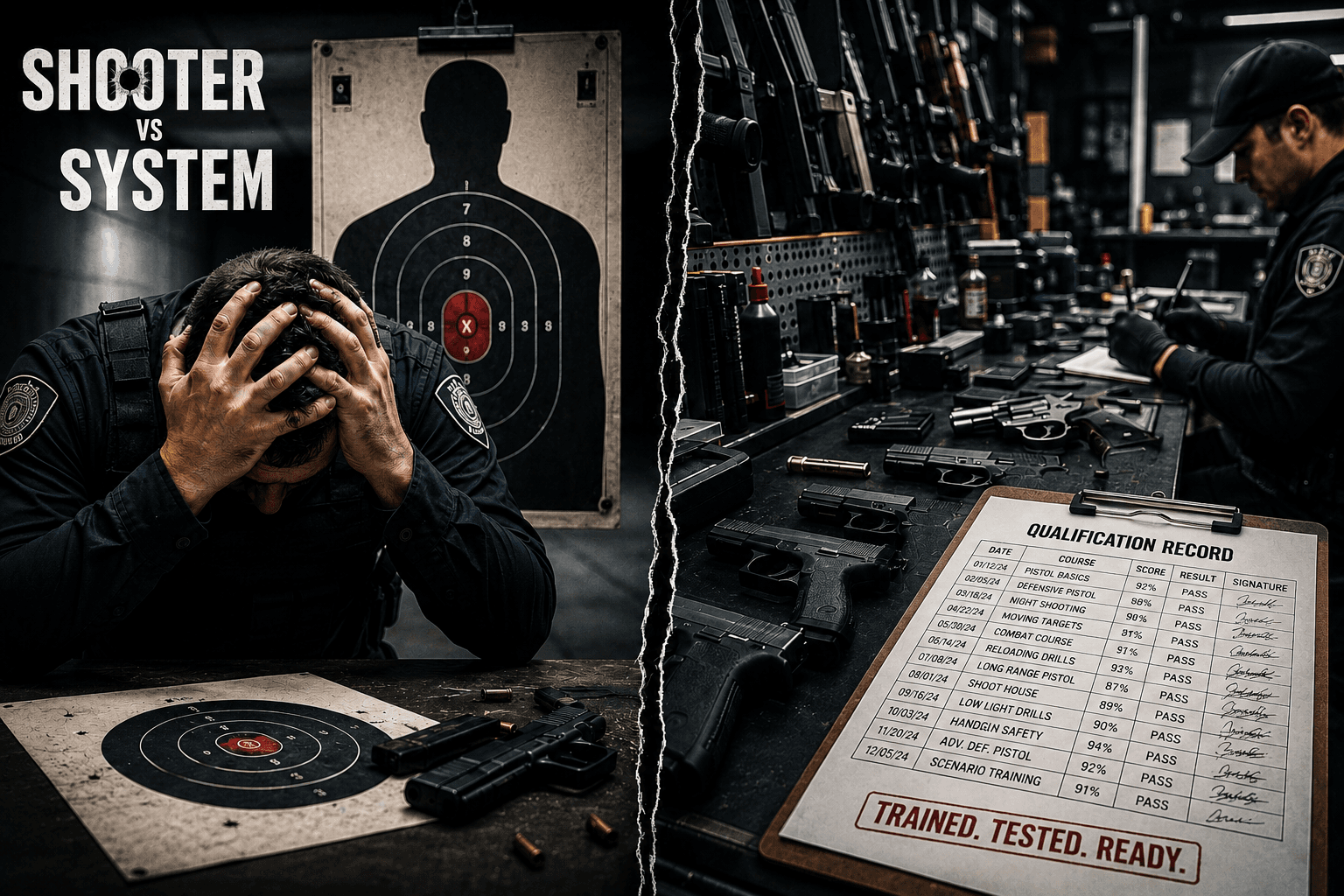
The qualification record shows a pass. What it doesn't show is that this officer went from avoiding his weapon to trusting it enough to carry it voluntarily. A pass doesn't measure that. Nothing in the current system does.
No qualification system has a column for off-duty carry behavior. Commanders built this infrastructure to verify a minimum standard at a point in time. Qualification is not training. A passing score tells you the officer performed adequately on a specific course on a specific day. What happened the six months before, and what happens in the six months after, is invisible. If the system cannot see the variable, it cannot solve for it.
The system only captures what it was built to see.
Departments running the same remediation cycle on the same officers year after year are not solving a performance problem. They are managing a measurement problem. The qualification cycle was designed to produce a pass or a fail. It does that reliably. The avoidance behavior, the equipment friction, the confidence that either builds or doesn't: all of it exists outside the frame.
Any experienced firearms instructor can name the variables. Does the officer practice between qualifications, and if not, why not? Was the issued platform selected for the officer's mechanics, or handed down for procurement reasons? Most departments never ask because supervisors don't require it and the qualification system doesn't flag it.
The remediation model assumes the officer is the problem. What it doesn't account for is that an officer can understand every fundamental of marksmanship and still fail consistently if the equipment is working against him. Fundamentals instruction fixes a knowledge gap. It doesn't fix a platform mismatch. The repetitions still have to happen.
The departments that get this right are asking better questions before they assign blame. Whether the qualification record reflects actual readiness. Whether the officer trusts what he's carrying. Those are different questions than pass or fail.
The system keeps attributing failure to the shooter because that is what it was built to surface. Not platform friction. Not the six-month gap. Not whether the officer carries voluntarily. The system is producing exactly the answer it was designed to produce. Departments that accept that answer without asking what it missed are choosing to repeat the cycle.