
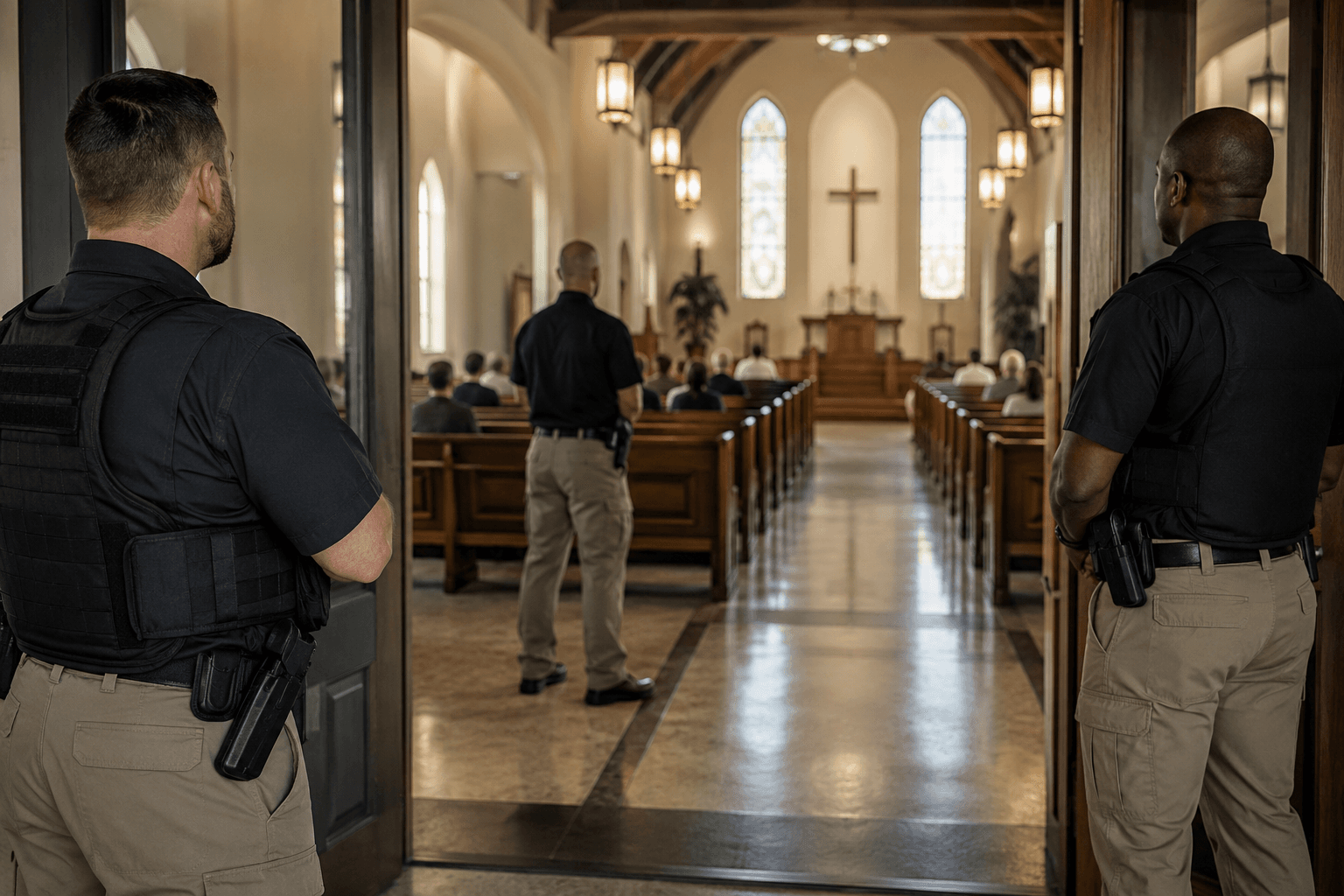
The lobby was wide, well-lit, and fully accessible from three entry points. Two volunteers stood near the main doors. A third was visible through a glass partition to the right. The sanctuary doors were propped open. A secondary corridor to the left was unwatched.
I had been invited to observe a volunteer security team at a house of worship on the East Coast. Roughly a dozen people. Several were armed. A few had completed a state guard licensing course. They had a plan: visible posts, a clear chain of command, team members who took the role seriously.
What they did not have: a threat assessment for their own facility. No documented patrol pattern. No defined response protocol for the geometry of their building. No communications fallback for the moment a radio dies or a cell network goes down under load. Medical readiness that amounted to one volunteer who mentioned a CPR course from the previous year.
They had presence. They did not have preparation.
The distinction matters more than most congregational leadership understands. Until it does not.
THE COMFORT OF PRESENCE
Security presence is not security. It is the first step, and it is often mistaken for the destination.
Houses of worship are architecturally and culturally built for access. Wide entry points. Unlocked doors during services. Parking that extends to the perimeter. Staff trained to welcome strangers rather than screen them. These are features, not flaws. They reflect the mission of the institution. They also create an exposure profile any motivated observer can map in a single visit.
When a congregation forms a security team, the instinct driving that decision is usually correct. Recent history has removed any ambiguity about whether houses of worship can be targeted. The question is no longer whether it could happen. It is whether the people already inside the building are prepared to act before outside help arrives.
Law enforcement cannot teleport. The immediate response will almost always come from the people already in the room. What those people have practiced matters more than that they are present.
The failure mode in the gap between presence and preparation is predictable. A volunteer carries a firearm. A credential has been obtained. The congregation feels safer. The team has not stress-tested its response protocols, walked the building from a threat actor’s perspective, or run a scenario under conditions that replicate the physiological state of a real emergency. The presence is real. The readiness is assumed.
Assumed readiness is the most dangerous kind.
WHAT THE BUILDING IS ACTUALLY TELLING YOU
Every facility communicates. Entry and exit points, sightlines, crowd flow, places where movement naturally concentrates, areas where someone can linger without attracting attention. All of it is readable to anyone willing to observe. Most security teams never look at their own building the way a threat actor would.
The exercise: stand outside the building before a service. Walk the perimeter at a normal pace. Note what you can see, where the crowd stacks, which entry points are monitored and which are not. Notice where team members cluster, because that pattern is visible to anyone watching from outside.
What most teams find: the building is more legible than they assumed. Entry and exit patterns are predictable. Guard positions are identifiable. The moments of highest vulnerability are consistent: entry, the beginning of services when attention is forward-facing, and dismissal, when crowd movement creates noise and confusion that compresses response time.
None of that is unique to houses of worship. What is specific to them is the cultural resistance to thinking about the building this way. Turning a sanctuary into an object of threat assessment can feel like a violation of what the space is for. That discomfort is understandable, and it points to a deeper tension congregational leaders rarely name. Their mission is welcome, trust, and openness. Security measures can feel like a betrayal of the atmosphere they have spent years building. That conflict is real. It cannot be the reason the assessment does not happen.
FIELD NOTES | QUESTIONS BEFORE THE NEXT WALK-THROUGH
- Can someone enter a secondary access point without being seen by any posted team member?
- Where does crowd movement create a natural blind spot for your current patrol pattern?
- What happens to your communications plan when the scenario stops following the script?
- Who makes the call, and does every team member know it without looking for guidance?
- What is the medical response capability if someone goes down in the first sixty seconds?
CREDENTIALS CREATE THE FLOOR. TRAINING BUILDS THE RESPONSE.
The credential conversation is necessary: licensing, firearms qualification, background checks. But it is not sufficient. Credentials establish a floor. Training builds what happens above it.
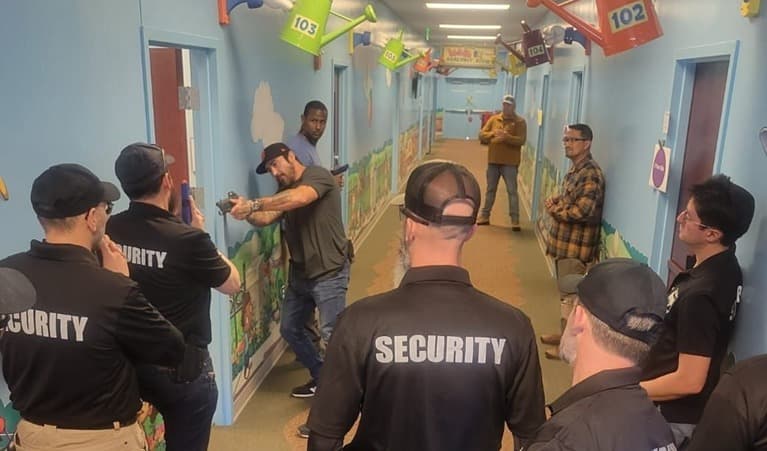
Professional training for volunteer armed guard programs covers ground most people who carry a firearm have never systematically addressed: de-escalation applied under physiological stress, not in a calm classroom. Threat assessment methodology for the specific environment where the team operates. Legal use of force as it applies to the jurisdiction and the role. Communications protocols that hold when noise is high and attention is split. Medical response in the minutes before EMS arrives. Coordinated movement that accounts for what happens when the plan breaks.
That last item is where most training gaps live. Plans do not survive contact with a dynamic event intact. What survives is the decision-making framework built under stress: the internalized logic that tells someone what to do when the radio is down, the threat is not coming from the direction anyone rehearsed, and two armed volunteers are moving toward the same sound while nobody watches the secondary door.
The credential says you were present for the instruction. The capability says whether it held when the scenario stopped cooperating.
Some specialized programs are already operating at this standard. Six13 Guard Academy, for example, trains licensed volunteer armed guard teams across New York and New Jersey. The gap is not access. The gap is the willingness of congregational leadership to recognize that a firearms license and a sense of duty are not the same as a trained security team, and to invest accordingly.
THE VOLUNTEER WHO SHOWS UP UNDERTRAINED
Considerable respect is due to the volunteers who step forward. The willingness to accept responsibility for protecting a community, train, carry, and take that role seriously is not something most people will do.
That respect is exactly why the training standard has to be high.
An undertrained volunteer in an active event is not a neutral factor. Consider what failure actually looks like in sequence: the first radio call is unclear. Two armed volunteers move toward the same sound from opposite sides. Nobody watches the secondary door. The radio channel becomes crowded. A medical casualty waits because the only CPR-trained person on the team was not assigned a medical role. Leadership does not know whether to evacuate, lock down, or shelter in place. No one knows who makes that call.
Friendly fire is a real risk when multiple armed individuals respond under stress without rehearsed coordination. A volunteer who freezes at the moment of commitment is not necessarily showing cowardice. The physiological state of a real emergency is nothing like the state in which most people practice. That is not a failure of character. It is a failure of preparation.
The solution is not to exclude volunteers. Train them to the level where the gap between what was rehearsed and what is actually happening is narrow enough that the framework holds. The most dangerous volunteer is not the one who refuses responsibility. It is the one who accepts responsibility without a system strong enough to support him.
THE STANDARD IS NOT PERFECTION. IT IS PROOF.
Security is not something a team provides to a congregation. A congregation builds it together, then delegates execution to people trained to carry it out.
Leadership must accept that emergency planning, access control, communications infrastructure, and medical readiness are not optional. The volunteer who shows up to protect the community deserves the resources and training to do it correctly. Recruiting from within the congregation means identifying individuals whose mindset, judgment, and commitment make them suitable for the role, then investing in their preparation rather than placing them at a post and calling it done.
Most congregational leaders have never asked their security team to walk through a specific scenario. Most have never tested whether response protocols account for the geometry of their actual building. The goal is not to turn a congregation into a tactical unit. The goal is to prove that the team has tested its assumptions before an emergency tests them for real.
A firearm in a sanctuary does not create a security program. It creates a higher obligation to build one.
THE ONLY VARIABLE YOU CONTROL BEFOREHAND
When a hostile event begins, most variables are outside your control. You do not choose the timing, the entry point, or the nature of the threat. You do not choose whether the radio is working or whether the crowd’s response creates a sightline or obscures one.
The only variable entirely within your control is the state of preparation before the moment arrives.
Houses of worship have been targeted with enough frequency that the question has been answered. What remains is whether the people inside did the work before it mattered: the volunteers who stepped forward, the leadership that empowered them, and the community that chose to take this seriously.
Hope is not a plan. Neither is presence. Neither is a credential earned once and never revisited.
The work is specific, ongoing, and testable. Do it.