
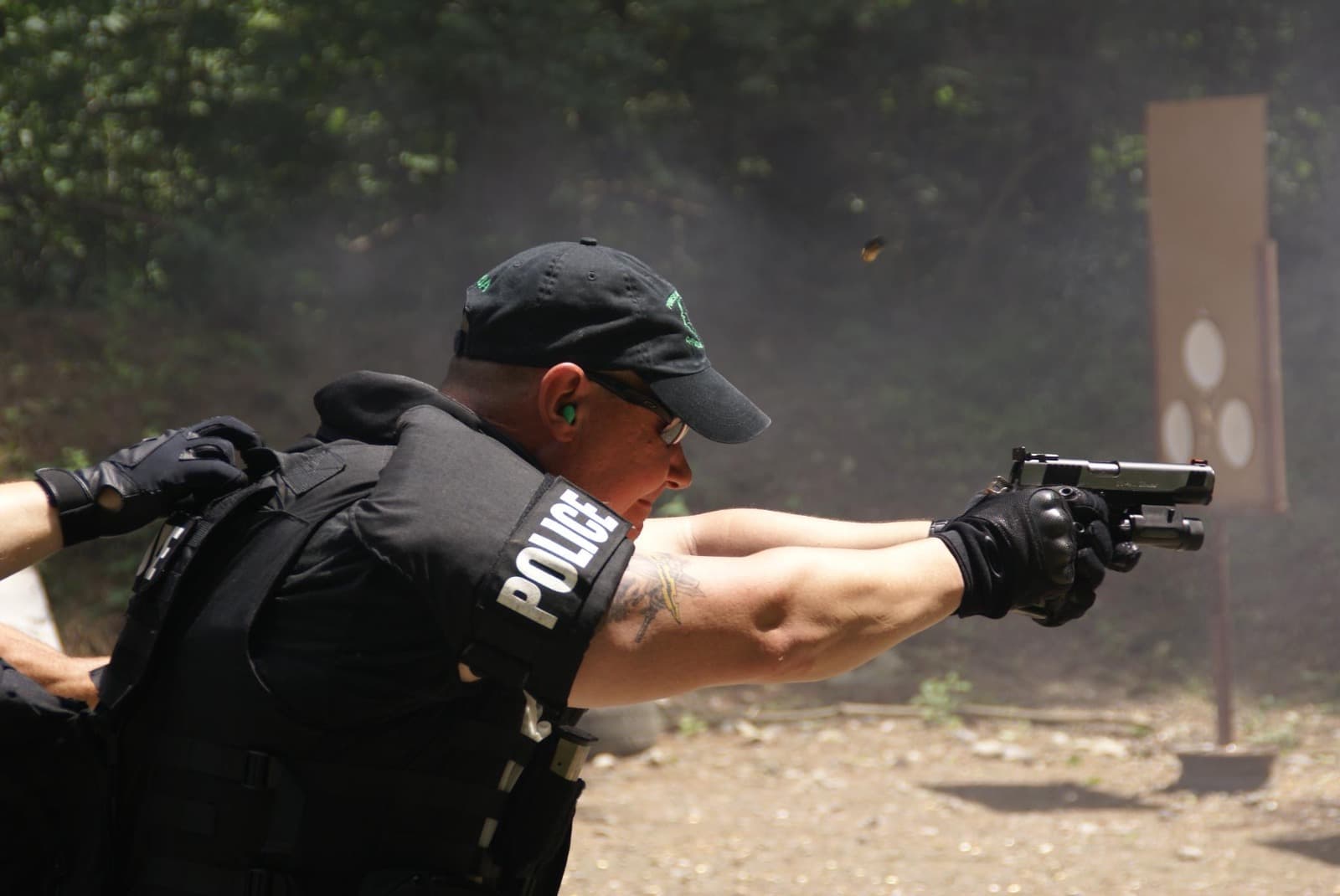
Many officers who pass on the range have been measured, but not truly tested. They have met a standard built around control, distance, commands, and known conditions. The street does not offer any of those things. That gap, between the range standard and the street standard, is where confidence, judgment, and survival are tested.
I spent thirty-one years in law enforcement, training officers in every discipline the job demands. Somewhere early in that career I had the chance to train alongside a tactical unit that ran hundreds of operations a year. What I learned from them changed how I think about firearms training for good.
They never argued about gear. They never wasted time on minutia. They talked about ability, vision, and efficiency. That conversation stuck with me, because it was the opposite of what I saw everywhere else in law enforcement training.
Fighting for your life is not the same stress as qualifying.
The range standard is clean. The street standard is not. On the range, the officer usually knows the course, the distance, the target, the command, and the scoring method. On the street, the officer may be moving, injured, surprised, emotionally flooded, physically entangled, or forced to decide before there is time to think.
Most departments still build their training around the range. In many agencies, the passing standard still sits around 70 percent, built on slow-fire marksmanship under controlled conditions. An officer can meet that standard and still have no idea what to do when the threat is moving, the distance is changing, and their own body is flooded with adrenaline they have never trained against.
Marksmanship matters. I am not arguing against it. But marksmanship without speed, without decision making, without exposure to fear, is half a skill set. It looks complete on the range. It falls apart on the street.
The Conscious Mind Problem
After years of watching officers shoot, in training and in after action reviews, I noticed a pattern most instructors miss. What gets labeled a marksmanship issue is rarely about marksmanship. It is about the conscious mind being too involved in the act of shooting.
Officers try to control too much. They put unnecessary input into a process that should be running on trained reflex. When the conscious mind takes over a skill that needs to live below it, speed disappears and so does accuracy, because the brain is busy managing details it should have already automated.
This is where range-based training falls short on a structural level. Very few departments bring an officer to what I would call unconscious competence. Officers practice long enough to pass, then move on. They are rarely given the repetitions needed to make the gun an extension of decision making rather than a separate task competing for attention.
It changed the attitude. Instead of a relaxed posture, officers were forced to become more athletic.
What I Changed, and Why It Worked
Over time I pushed for two things in the training I ran. First, raise the standard itself. Second, build in time above and beyond the range course specifically to address real world speed, decision making, and fear.
The shift in posture alone told me everything. Officers who trained only to the old range standard stood relaxed, comfortable, and slow. Once we introduced faster recoil management, faster movement, and real-time constraints, the entire physical approach changed. Officers had to move like athletes, not like people standing on a line waiting their turn.
Confidence was the first result, and it was the most visible one. The second result mattered more long term. The training exposed weaknesses officers did not know they had. An officer who looked solid under the old range standard often discovered real gaps the moment we added speed and stress. That discovery, uncomfortable as it is, is the entire point of training. You want to find the weakness in a controlled environment, not in the street.
Where the Range Standard Falls Short
This is not unique to one department or region. In my experience training thousands of officers and working alongside hundreds of tactical operations, I see the same pattern everywhere. Agencies build training around the range standard, not around what the street demands. Once the box is checked, training stops.
The focus is on meeting the qualification standard, not making officers improve.
Competition shooting has value. It can make an officer a better shot, faster with the gun, and more efficient under time pressure. But competition methodology is not gunfighting methodology. It does not automatically train fear, physical contact, emotional control, decision making under threat, or the ability to act once the situation stops following a script.
Those are different skill sets built for different purposes. Treating them as interchangeable is part of why so much law enforcement training stays theatrical instead of functional. It looks good on the range. It does not prepare an officer for what actually happens on the street.
Theatrical training is easy to spot once you know what to look for. It follows a script. The threat behaves the way the drill needs it to behave, not the way a real person under real stress actually behaves. Officers run the same scenario enough times that their bodies memorize the choreography instead of the decision. That is rehearsal, and rehearsal only works if the street agrees to follow the same script. It never does.
What I Want People to Understand
If there is one truth I wish more people in this profession would internalize, it is this. A real encounter is a fight, and a fight does not follow a script. It could be fast or slow. It could start with empty-hand techniques and move into a weapon. It could require one-handed shooting, two-handed shooting, or both within the same ten seconds. You will not know the shape of the fight until it starts, and the street will not wait for you to be ready.
You won’t know until it starts.
The range can reveal skill. The street reveals preparation. The agencies that understand the difference do not treat qualification as the finish line. They treat it as the beginning of the work that actually matters.
I have trained roughly twenty five hundred students and supported around four hundred tactical operations alongside the units I learned from. None of that experience changed my opinion on this. If anything, it confirmed it every time. Agencies that treat the range standard as the ceiling are setting their officers up to learn the hardest lessons of their careers on the street, with consequences a range can never replicate. Agencies that treat it as the floor are the ones whose officers walk away from the worst moments of their careers still standing.