
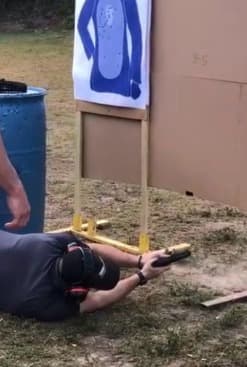
The officer's hands were still shaking when he unloaded his weapon at the end of the drill. Not from adrenaline—the drill was over—but from something quieter and more corrosive: the specific humiliation of discovering, at thirty-eight years old with nine years on the job, that he did not know how to clear a malfunction under pressure.
The range smelled the way it always does—copper, burnt propellant, the faint chemical bite of Hoppe's solvent baked into the concrete barriers. I had been watching from the left side of the line, close enough to see his support hand come off the frame completely when the gun locked back on a double feed. He stared at it for nearly three seconds. Three seconds, on a training range, in the middle of a force-on-force scenario where the role-player standing eight yards away had already "shot" him twice by the time he remembered the tap-rack-assess sequence his agency had nominally taught him two years prior.
He had qualified the previous month. Ninety-one out of a hundred. His sergeant had initialed the card without comment.
After the debrief, I walked to my truck and sat with the door open in the late afternoon heat of South Florida. I had watched some version of that moment unfold hundreds of times across three-plus decades in municipal law enforcement—the officer who performs cleanly on the static line and dissolves under the first introduction of genuine pressure. I had filed the incident reports. I had sat in the review rooms. I had heard every administrative explanation for how a person who passed every required test could, in the moment it counted most, simply stop functioning.
I have never stopped finding it unacceptable.
THE ILLUSION THE RANGE CREATES
Let me describe what a qualification range actually measures: the ability to hit a stationary target at a fixed distance, in good light, with a known round count, on a schedule the shooter has rehearsed. It measures whether a person can perform a practiced routine in the absence of consequence. Nothing more.
What it does not measure—what no static qualification course I have ever seen is designed to measure—is what happens to that routine when the environment turns against the officer. When the gun double-feeds mid-string. When a failure to extract leaves a spent case wedged in the chamber and a fresh round jammed behind it. When the light is wrong, or gone entirely. When someone is screaming. When the cognitive load of managing a radio call and a closing threat and a decision about force all land simultaneously on a nervous system already flooded with cortisol.
The first thing adrenaline does is simplify. Not sharpen—simplify. Tunnel vision is not a metaphor; it is a measurable neurological event. The visual field narrows. Fine motor skills—the precise manipulation of a thumb safety, a slide release, a trigger with a six-pound pull—become unreliable somewhere north of 175 beats per minute. The complex cognitive architecture an officer uses to think through a malfunction drill on a calm range simply goes dark. What remains is whatever is structural. Whatever has been drilled so deeply it lives beneath conscious access.
That officer on my firing line had been shown the malfunction clearance sequence. He could walk through it at the bench. Under the simulated stress of a role-player closing distance with a marking-cartridge pistol, those practiced movements vanished and left behind only the raw, unstructured hesitation of someone who had learned a procedure but had never actually trained under the conditions that would demand it. His qualification score was real. His readiness was not.
Adrenaline does not reveal your training. It reveals what your training actually built—and it makes no allowances for the difference.
WHAT THE POST-INCIDENT REVIEWS ACTUALLY SAY
I have been in enough post-incident review rooms to know what the documents look like before I open them. The formatting changes. The liability language adapts to whatever framework the agency is currently working within. The essential content does not change.
There is always a section on prior training records. And those records—always, in every case I have reviewed involving a performance failure in the field—are technically clean. The officer was current. The boxes were checked. The gap between that paper record and what actually happened in the street is where officers get hurt, where bystanders get hurt, where careers end and lawsuits are filed and families are permanently altered.
The failures are consistent enough that I have stopped calling them individual ones. They are institutional, produced reliably by the same conditions:
- The Grip Failure: The grip that holds on a static range collapses the moment recoil cycles through a hand that has never been conditioned to absorb it under stress.
- The Malfunction Freeze: The malfunction that was smooth in rehearsal becomes a three-second freeze when the stimulus arrives without announcement, during a ground fight, or at the end of a foot chase.
- The Spatial Disconnect: The movement drill that looked competent on a choreographed walk-through becomes rigid when a real environment replaces the familiar lane.
None of this is advanced doctrine. This is the foundation beneath every other skill in the curriculum. And it is precisely what the current system, under the compounding pressure of staffing shortages and schedule compression, has stopped protecting.
We are cannibalizing the safety of the next generation of officers to satisfy the demands of a spreadsheet.
THE ARCHITECTURE BENEATH THE CONSCIOUS MIND
There is a principle in performance psychology that the training community has spent decades failing to apply with institutional seriousness: under sufficient stress, the conscious mind does not lead. It follows. Or, more precisely, it watches.
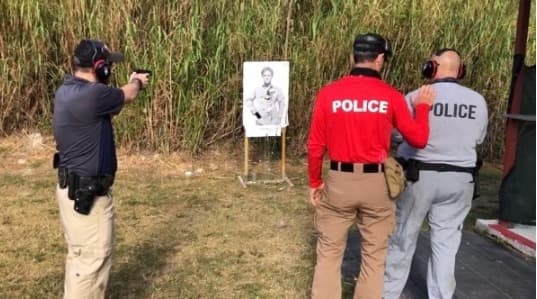
When an officer's system crosses the threshold that a ground fight or a foot chase will reliably produce, the prefrontal cortex—the seat of deliberate reasoning—is functionally bypassed. The system that remains online acts on patterns. On grooves cut deep by repetition. On reflexes so structural they operate below the level where conscious thought can interfere.
This is the irreducible argument for scenario-based training—and for the volume of stress inoculation that most agency calendars currently do not protect. An officer can understand malfunction clearances in theory and be unable to execute one during a fight, because that understanding lives in the prefrontal cortex, and the prefrontal cortex is the first thing the alarm response takes offline. What remains is whatever was built structurally.
The body, in this sense, has no imagination. It can only go where it has already been. Prepare it for low light, for rain-slicked barricades, for the physical degradation of a fight—and it will perform. Withhold that preparation, and the officer encounters those conditions for the first time on the worst day of their life.
The body cannot go where the mind has never been. Scenario-based training is not a supplement to the curriculum. It is the curriculum.
WHAT REAL TRAINING ACTUALLY LOOKS LIKE
The officers I have watched perform reliably share one thing: they have been broken before. Not demoralized—broken diagnostically. They have experienced their own performance failures under controlled stress, identified the gaps, and spent deliberate time closing them. Their training was not a rehearsal of competency; it was a systematic stress test of the architecture beneath it.
What that training contains is specific. Malfunction drills must be executed under conditions that mirror the street: at the end of physical exertion, during movement, in positions of physical compromise. Movement must be trained as inseparably as any static fundamental. Shooting while moving forces the integration of marksmanship with spatial reality.
Physical conditioning is not peripheral; it is central. The malfunction that is manageable at rest becomes a crisis at the end of a foot chase. Officers who are not physically conditioned have a ceiling on their operational performance that no amount of range time can raise.
The malfunction drill run on a calm range teaches a procedure. The malfunction drill run after a ground fight teaches a reflex. Only one of them transfers.
And then there is the piece that most training programs treat as optional: what happens after the shooting stops. Tactical medicine belongs inside the same curriculum as the malfunction drill, because the officer who is hit does not have the luxury of waiting for EMS. That skill must have been practiced until it is structural.
Scenario-based training is the architecture that holds all of this together. It is the only modality that replicates the integration of decision-making, physical performance, and environmental chaos. A scenario that forces an officer to manage a malfunction, navigate cover, and then apply a tourniquet to themselves while the environment is still escalating has put them somewhere their body has now been. And the body remembers.
THE INSTITUTIONAL BARGAIN WE MADE
Somewhere in the last two decades, law enforcement agencies made a quiet bargain. The training standard that produces operationally reliable officers is more expensive than the one that produces a defensible paper record. Faced with resource scarcity, agencies chose the paper record.
Closing the gap requires institutional will. Three commitments can begin to do it:
- Protect the fundamentals from compression. Grip, stance, and movement are protected first when schedules tighten.
- Restore the volume of repetitions. Subconscious reflex requires deliberate repetition under demanding conditions: time pressure, fatigue, and chaos.
- Build scenario-based training into the core calendar. Force-on-force and medical response are the baseline of street-level encounters.
THE WALK BACK TO THE PARKING LOT
At the end of that drill, I watched the officer walk back down the range. He moved like someone testing ice. He had entered carrying a qualification score and the assumption that it meant something. He left carrying the knowledge of exactly where his performance ended and his vulnerability began.
The operational environment does not become less complex as the years pass. Against that backdrop, the fundamentals are the foundation on which every correct split-second decision is constructed.
In thirty-six years, I have not found a reason to revise this: when the moment arrives, an officer will not rise to the occasion. They will default to the level of what they practiced. Not what they were shown. Not what they understood. What they practiced—until the body knew it without being asked.
That officer drove back to patrol. He had a passing score and a new understanding of what it did not mean. Whether the institution gives him the repetitions to close that gap before the street reveals it—that is the only question that matters.
Training is survival. The body cannot go where the mind has never been—and the street will not wait for the mind to catch up.