
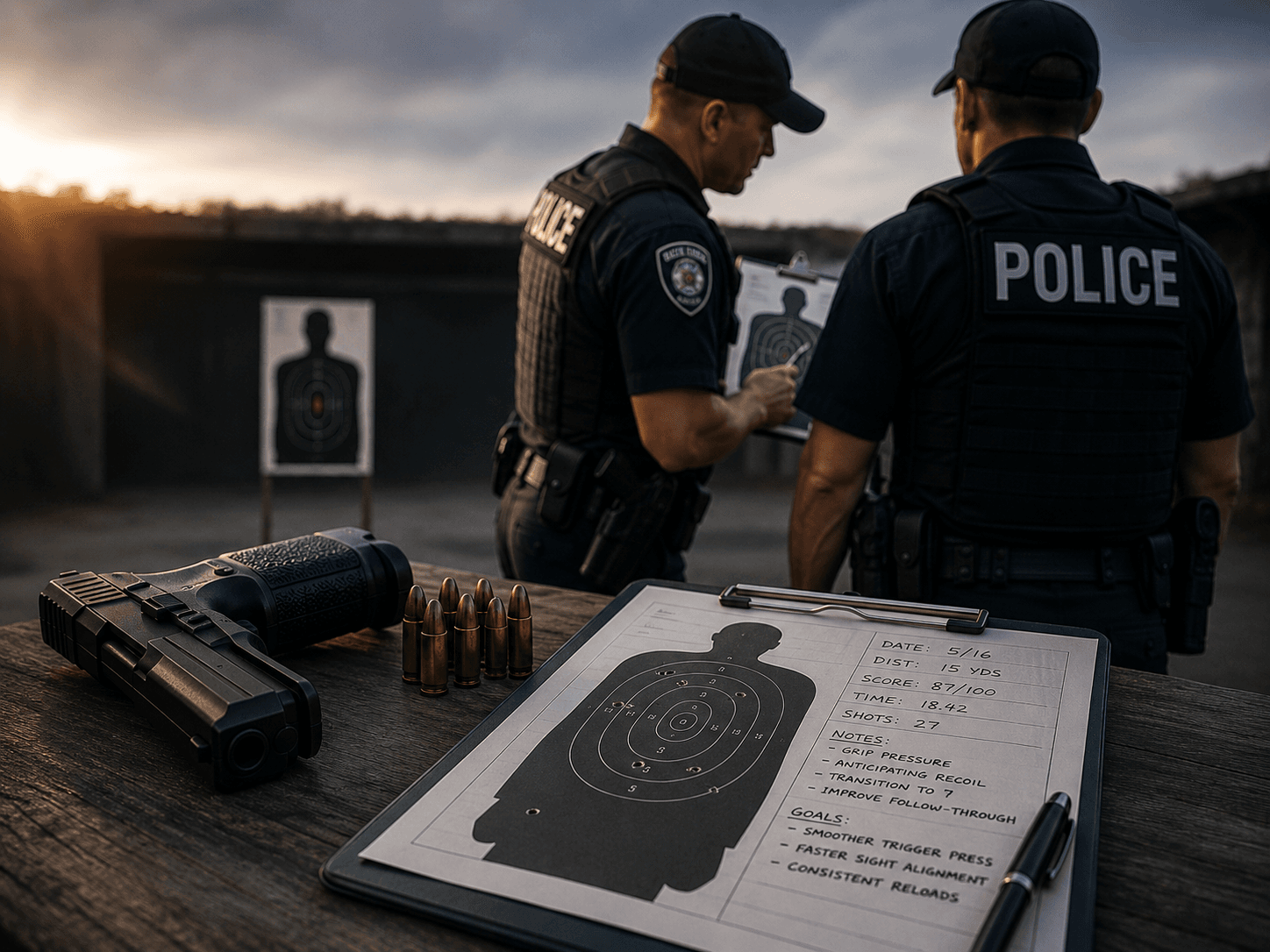
Qualification matters. The record it produces, who shot, what course of fire, what score, on what date, with what weapon, is foundational data. Without it, there is no baseline. Without a baseline, there is no way to measure progress, identify officers who need additional support, or demonstrate to command and to the public that professional standards are being maintained.
The problem is not that agencies qualify their officers. The problem is that most agencies treat qualification as the finish line. The record gets filed. The data goes nowhere. And an officer who barely passed the same static course they have shot for fifteen years is considered just as prepared as one who trains consistently and performs under stress.
That is the gap American law enforcement needs to close.
Qualification measures whether you met the minimum standard. Proficiency is what you build through repetition, stress exposure, and realistic application.
The Difference Between Qualified and Proficient
Motor learning research is clear: complex physical skills degrade without consistent, varied, and realistic practice. A firearms qualification happens in a controlled environment. The shooter knows when the string starts. They know where the target will be. They know the course of fire. None of that is true in an actual encounter.
Physiological stress does real damage to performance. Elevated heart rate, adrenaline, tunnel vision, degraded fine motor control. An officer who shoots a clean qualification in a relaxed, familiar environment may look nothing like that same officer managing a violent subject at 2 a.m. after a foot pursuit.
Research in Criminal Justice and Behavior and Police Quarterly has consistently documented the gap between controlled-environment performance and real-world decision-making under stress. Officers who train regularly in scenario-based, stress-inoculated environments perform demonstrably better when it counts.
Qualification measures whether you met the minimum standard. Proficiency is what you build through repetition, stress exposure, and realistic application. Those are two different things. The training model that treats them as equivalent has created a structural problem across American law enforcement.
What Officers Actually Say
The practitioner survey data here is consistent and worth taking seriously. National surveys conducted in 2024 and 2025 by Police1 among working law enforcement found that significant percentages of officers view current use-of-force and firearms training as insufficiently realistic and inadequately connected to what they actually face in the field.
Many officers report receiving little meaningful training after academy graduation. Many describe their annual qualification as an administrative requirement rather than a developmental opportunity.
These officers are not asking for less communication training or less de-escalation work. What the data shows is that officers want integration: training models that develop tactical awareness, legal reasoning, firearms proficiency, and communication skills simultaneously, in realistic scenarios, rather than in isolated silos that never connect.
How We Compare
The Police Executive Research Forum and researchers across the field have documented a significant gap between American police training duration and the systems used in many European nations.
The U.S. national average for recruit academy training is approximately 833 hours. German police education commonly runs two to three years, integrating academic coursework, practical application, supervised field experience, and continuous assessment. Scandinavian models treat policing as a profession requiring the same investment as other complex occupations.
The number of hours is not the only issue. International models build in continuing education structures that reinforce and advance professional development throughout an officer's career. In the United States, the dominant model is: train them hard at the academy, certify them, and then largely leave them to maintain those skills while working full-time on patrol.
The results are predictable.
The In-Service Problem
New York State is a useful example because it represents one of the more comprehensive recruit programs in the country. The Basic Course for Police Officers covers constitutional law, ethics, crisis intervention, use-of-force decision-making, and active shooter response. The curriculum reflects genuine progress.
But there is no statewide mandate requiring extensive recurring tactical training after graduation. Continuing education frequency depends on agency resources, staffing levels, leadership priorities, and budget. Agencies running short on personnel pull officers from training to fill patrol gaps. The training that does happen tends to be the training that is legally required, not the training that would produce the best officers.
This is not a New York problem. It is a national pattern. Recruit training standards have become comparatively robust. In-service training requirements have not kept pace.
The qualification record is not the problem. It is the most underused asset in American law enforcement training.
Qualification Isn't the Enemy. Amnesia Is.
Here is where the conversation needs to shift.
Qualification records, properly captured and maintained, are among the most actionable data points an agency has. They document baseline performance. They create a longitudinal picture of how individual officers develop or decline over time. They give training staff the information needed to identify who needs remediation, who is ready for advanced instruction, and where agency-wide gaps exist.
The failure is not the qualification itself. The failure is what happens to the data afterward. In most agencies, it disappears. A paper form goes into a binder. A spreadsheet entry sits in a folder nobody opens. Command has no visibility into performance trends. Training staff have no systematic way to connect qualification outcomes to in-service development decisions.
When the record is treated as evidence rather than paperwork, everything changes. A tamper-evident, time-stamped qualification record tied to a specific officer, weapon, course of fire, and instructor creates accountability in both directions. It protects the agency when performance is documented accurately. It identifies the officers who need more support before a critical incident makes that need visible in the worst possible way.
The qualification record is not the problem. It is the most underused asset in American law enforcement training.
Scenario-Based Training Is Not Optional
The research literature has reached a strong consensus: scenario-based training produces meaningfully better outcomes than isolated drills and lecture-based instruction.
Officers don't encounter neat, single-skill problems in the field. They encounter a man in a parking garage who may or may not be armed, who is agitated, who doesn't speak English, where the lighting is bad, and where backup is four minutes out. Training that only exercises one skill at a time does not build the integration needed to manage that situation.
Scenario-based training forces officers to communicate, assess threats, apply legal authority, manage stress, and make tactical decisions simultaneously, under conditions that approximate real encounters. Research consistently shows it improves decision-making, enhances retention, and builds functional confidence.
This is not an expensive luxury. It is the baseline of what professional preparation should look like.
Using Outside Providers Correctly
Many agencies lack the internal capacity to deliver advanced firearms instruction, tactical scenarios, leadership development, and force-on-force training at the frequency the research supports. That is a real constraint, not an excuse.
Qualified third-party training providers can fill that gap. The key word is qualified. The field has documented cases of external programs that promoted legally questionable use-of-force standards, unnecessarily aggressive enforcement philosophies, or instructional approaches that created liability rather than reducing it.
Agencies bringing in outside providers need formal evaluation processes: curriculum review, instructor credential verification, and outcome tracking. Evidence-based programs get priority. Programs built primarily on war stories and ideology do not.
When vetted properly, third-party partnerships meaningfully expand what agencies can offer their officers. The oversight cannot be an afterthought.
Passing a qualification course is not the destination. It is the first measurement in a professional development system that should follow an officer throughout their career.
What Needs to Change
The argument here is not complicated. Policing is a complex profession operating under extreme public scrutiny, expanding service demands, and life-or-death stakes. The training model should reflect that.
That means taking the qualification record seriously as a data asset, not filing it and forgetting it. It means building in-service training requirements around what the data actually shows, not around what the calendar requires. It means scenario-based training that integrates tactical, legal, and communication skills. It means using third-party providers where agencies lack capacity, with real accountability for outcomes.
Passing a qualification course is not the destination. It is the first measurement in a professional development system that should follow an officer throughout their career. The agencies that understand that distinction are building something different. The ones that don't are hoping nothing goes wrong.
That hope is not a training program.