
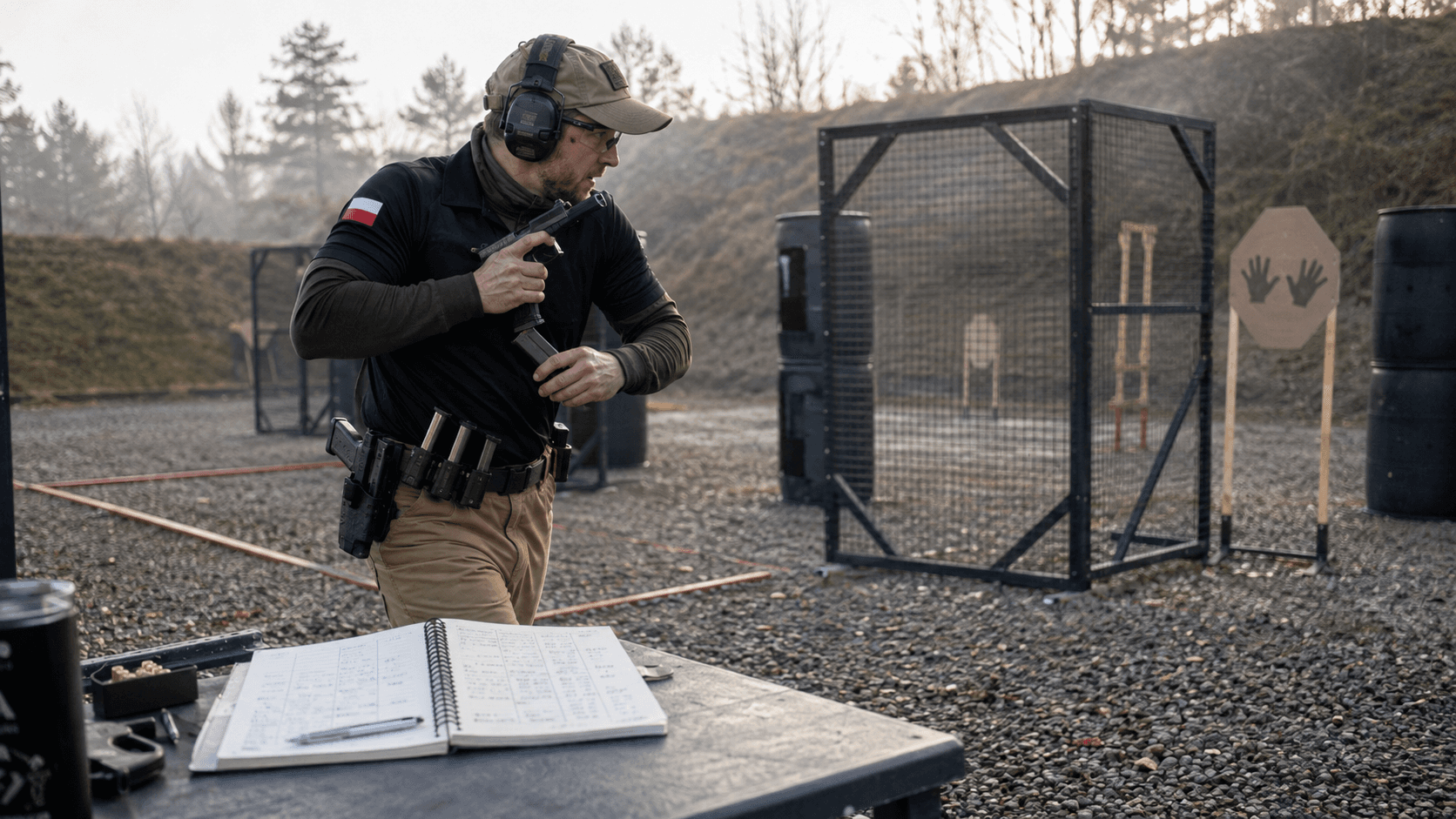
People ask me for the match that changed everything. I don't have one. That question assumes competitive shooting works like a movie: one range day, one revelation, and suddenly you're a different shooter. It doesn't work that way.
The clearest example is a local match here in Warsaw, an IPSC-style stage in Production division on a cold morning. The stage called for a mandatory reload after six rounds and two position changes, scored on points and time. I'd built a plan with four transition points and told myself I had it memorized. Ten seconds in, running a 9mm double-stack out of a Production-legal holster, the reload came half a second late. My focus jumped straight to the mag catch, then the trigger, then the sights, hunting for an explanation instead of running the next position. I finished the stage slow. That one run dropped me from second to fourth in the division standings for the day. On the drive home I blamed the gun before I'd even opened my notebook.
That stage wasn't unique, it was just the one I finally wrote down properly. The grip issue had shown up two months earlier, same division, a different range. Three stages into a six-stage match, my support hand started riding lower on the grip without me noticing. Shots that should have stayed center mass drifted low-left under a par time I'd hit clean all season. I chalked it up to a bad batch of ammunition. It wasn't the ammunition. Small failures, repeated often enough that I finally noticed the shape of them. What actually changed me came from that string of ordinary sessions: learning to manage a mistake instead of letting it cascade, holding form once the timer started running.
What Most Competitors Skip Past
Talent gets the attention. Gear gets the budget. Consistency gets ignored. It doesn't look like anything from the outside. I've watched competitors log range time for months and never ask why the same mistake keeps showing up. They log rounds, not what those rounds are teaching them.
My own notebook only has two columns now: what went wrong, and what changes before the next match. No score column, no round count, just those two lines, written before I leave the range.
That gap is where most plateaus start. A hit count is easy to write down; admitting why a stage fell apart takes real discipline.
The Diagnosis I Kept Getting Wrong
Back to that reload. In the notebook that night, the first entry blamed the trigger. The next morning it was the magazine spring. By the following week I'd half convinced myself the mag catch needed replacing. None of that was true. Grip pressure faded late in the stage. Focus narrowed onto the wrong thing at the wrong moment. It looked like a technique problem because that's easier to accept than admitting the fundamentals had slipped.
What looks like an equipment problem is usually a consistency problem wearing a different jacket.
Blaming the gear is the easier story. A part is external, it can be swapped, and swapping it doesn't ask anything of you. Admitting your grip faded or your focus slipped means admitting the limit was you, not the equipment. Every competitor I know has reached for the gear excuse first, not because it's convincing, but because it's cheaper.
Standard advice says put in the volume, so I did: a dozen more reps of that same reload, high round counts with no reflection built in, leaving the range tired, not better. The shift came when I started grading each session on two things instead: consistency, and whether fundamentals held when it got uncomfortable.
Quality asked more of me than volume ever did. Volume just asked for time.
The numbers backed it up. Before, that reload split ran anywhere from 1.9 to 2.6 seconds depending on the day, with two or three procedural penalties a match. After I cut the plan down, the split settled inside a tenth of a second, 1.8 to 1.9 every time, and penalties dropped to almost none.
What Actually Moved the Needle
I simplified: fewer variables to track mid-stage, fewer adjustments mid-match. That reload plan went from four transition points down to two: sight focus and grip pressure, nothing else competing for attention.
It worked because it cut the number of decisions I had to make while the clock was running, fewer places for a plan to break, and execution could repeat itself when it counted.
Three months later I ran a similar stage at a range outside Radom, two hours south, same reload rhythm, same six rounds. The split came in at 1.85 seconds, inside the window I'd built. No scrambling for an explanation this time, no drive home spent blaming the gun, just a stage that behaved the way I'd built it to.
What Changed in My Head, Not My Hands
The mental side is where most of this actually lives. Simplifying a stage plan doesn't just save time, it saves attention, the resource that runs out first under pressure, not skill. A shooter with good mechanics and a cluttered head still loses to a shooter with average mechanics and a clear one. I found that out watching a stage I should have won slip away because I was still deciding between two options when the buzzer went.
The skill was there before. It just wasn't getting a clean path to the trigger.
A Pattern, Not an Exception
I see the same failure in other competitive shooters constantly: overthinking a stage before the buzzer, losing focus the moment the stage stops feeling like practice. The fix is going back to what works under a timer, not adding another layer on top of a foundation that was never checked.
For the Shooter Who's Stuck
If you've plateaued, the advice isn't complicated. Simplify. Rebuild from the basics you skipped past on the way to advanced technique. It's not a satisfying answer if you want a shortcut. But it's the one most shooters avoid, because it means admitting the basics were never as solid as the scorecard suggested.
I still cycle through this myself: push forward, then pull back and check whether the basics held. The moment I stop verifying, things start to erode again, and I won't notice until a stage tells me the hard way, not until the mag catch takes the blame again.
The notebook rides on the passenger seat now, not buried at the bottom of a range bag, closed but close enough to reach before the engine's even turned over.
The match never changed me. The record did.