
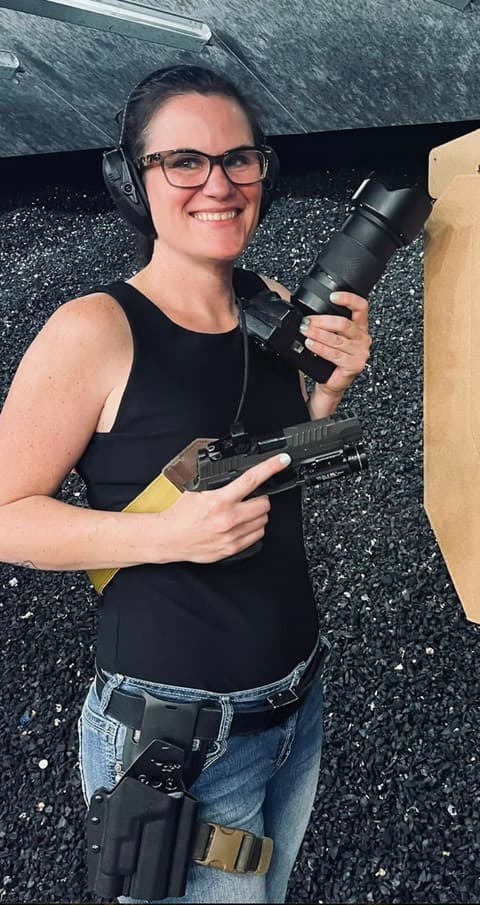
I shot my first firearm in 2019. Then I put the camera back up and didn't touch a gun again for four years.
That first class was supposed to prove a point. I walked onto the range expecting to confirm everything I already believed about guns and the people who carried them. I was a new mother, an overthinker, someone who could catastrophize a thousand scenarios before breakfast. A break-in had happened in broad daylight while my kids and I were home, and I'd still refused to consider keeping a firearm in the house. I told myself I was being responsible. What I was actually doing was letting fear make my decisions for me.
The class didn't go the way I expected. I fired one shot and burst into tears. Not from recoil or fear, but from adrenaline—the shock of doing something I'd convinced myself I couldn't do. I finished the session, thanked the instructor, and walked away. I wasn't ready. I didn't know what I wasn't ready for, but I knew it wasn't that.
Two years later, I picked up a camera and started photographing competitions.
I'd been a family photographer since 2013. Weddings, newborns, the usual portrait work. But by 2021, my marriage was unraveling in ways I wasn't ready to name out loud, and I needed a project that had nothing to do with my life falling apart. A friend mentioned a local shooting match. I showed up with my gear, stayed behind the barriers, and started framing shots.
What I saw through the viewfinder surprised me.
The first pattern I noticed was the divide between two kinds of shooters. There were the ones who moved with what looked like confidence but read, in their body language, as carelessness. They handled firearms like props. They didn't check their surroundings before moving. They reacted instead of responding. I stayed farther back when photographing them. Their egos made them unpredictable, and unpredictable people with guns made me nervous.
Then there were the others. The ones who paused before acting. Who listened when an RO gave a correction. Who asked questions without defensiveness. You could see it in how they carried themselves—no performance, no posturing. Just deliberate movement and attention to detail. Humility and critical thinking showed up the same way on the range as they did everywhere else. Those were the shooters I trusted to get close to with a lens.
I also started noticing a third group, mostly women. They'd show up shaking, unsure, but with a specific kind of resolve that didn't come from wanting to be there. It came from needing to be there. You could watch the shift happen over the course of a stage—shoulders dropping, breath steadying, that "I can do this, I have to do this" energy taking over. It wasn't about the gun. It was about something they were taking back.
I recognized that look eventually because I saw it in myself.
By 2023, I was documenting matches regularly. I knew the culture. I knew the language. I could predict who'd have a good run based on how they approached the start position. I watched instructors work with new shooters and noted who earned trust and who relied on volume. I saw women show up terrified and leave different. I captured all of it through the camera, and the camera let me stay at a safe distance while I figured out what I was actually watching.
What I was watching was a version of the life I was trying to build for myself.
I'd left my marriage by then. I was rebuilding everything as a single mother with three kids who were old enough to understand that something fundamental had shifted. I needed to know I could protect them. I needed to know I had my own back. And I needed something that reminded me I was capable of hard things, that I could step into spaces that scared me and come out stronger.
In 2023, I bought the Rose. Lena Miculek's pistol designed for women shooters. It felt symbolic in a way I couldn't have explained if someone had asked. I could be strong and soft at the same time. I could carry a firearm and still be the kind of mother I wanted my kids to see. I started training seriously—not casually, not someday, but with intention. Dry fire every week. Live fire multiple times a month. I wasn't preparing for a what-if anymore. I was preparing for the life I was already living.
The sound of a slide racking used to send me into a spiral. Fireworks made me flinch. Now those sounds ground me. Brass hitting concrete, a magazine seating, a gun going into the holster—they're reminders that I've got this. That I've got me.
In June 2025, I shot my first competition. Not as the photographer. As a competitor.
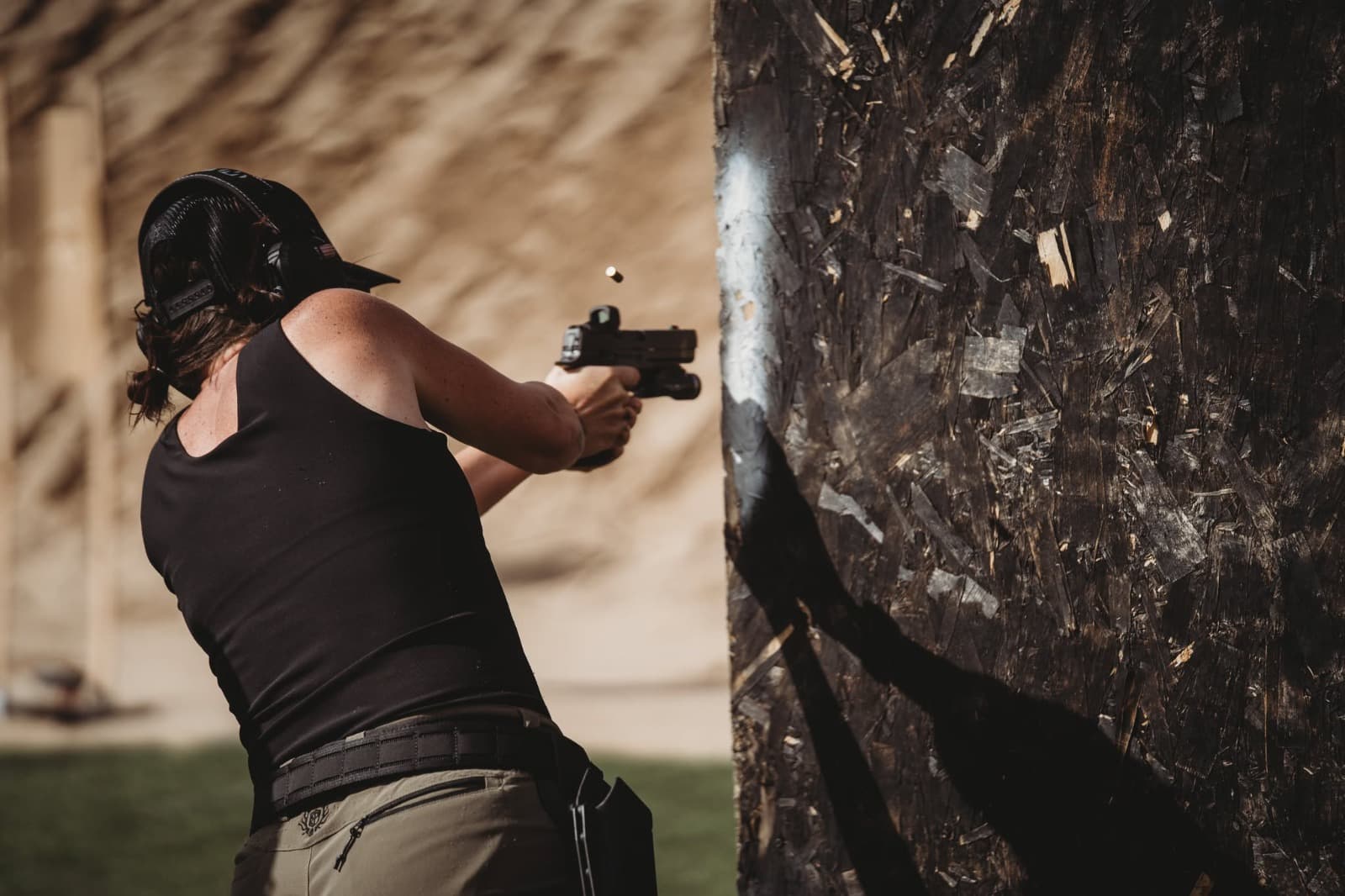
I'd watched hundreds of shooters move through stages by that point. I knew what good movement looked like. I knew where people hesitated and why. But knowing it from behind the lens and doing it yourself are not the same thing. Standing on the line with a loaded gun, waiting for the beep, is a different kind of exposure. You can't hide behind the camera when you're the one being timed.
I didn't shoot clean. I didn't place well. But I finished, and that mattered more than the score.
A few months later, in October, I was back on the range. Twenty-six men, one other woman, and me. The kind of scenario that would have paralyzed me in 2019. The kind of visibility I'd spent years avoiding by staying behind the camera. But I wasn't the same person who'd walked away after one class. I'd spent four years watching disciplined shooters move with confidence that came from repetition, not performance. I'd learned that competence is built slowly, in private, through work nobody sees. And I'd learned that the fear of being judged is just ego trying to protect itself from temporary incompetence.
So I asked when we start. Let's go. I'm wearing earrings.
What changed between 2019 and now wasn't the gun. It was everything around it. The camera gave me proximity without commitment. It let me observe the culture, study the patterns, and build trust with people who took firearms seriously. It showed me what discipline looked like versus what arrogance looked like. And it taught me that the women who show up terrified but determined are the ones who do the work, because they have a reason that goes deeper than sport.
Now I see the range from both sides. I still photograph competitions. I still capture that moment when someone's posture shifts from hesitant to committed. But I also know what it feels like to be on the other side of that frame. To be the one standing on the line, managing adrenaline, executing under pressure.
The patterns I observed as a photographer held true when I crossed over. The shooters who scared me from behind the lens are still the ones who scare me now—the overconfident ones who think the permit means they're trained, who carry a gun but haven't put in the repetitions or the scenario work. I've treated those people in the ER. Self-inflicted wounds, training accidents, negligence disguised as bad luck. The gap between confidence and competence is where people get hurt, and no amount of gear or bravado closes that gap. Only work does.
I carry every day now. Not because I'm paranoid, but because the threat assessment I do as an ER nurse doesn't stop when I leave the hospital. I've been physically assaulted at work more times than I can count. Our names are published on patient charts—patients can look us up, find us, remember us long after we've forgotten them. If someone is willing to come at me inside a hospital, they're willing to come at me outside of one. The decision to carry follows the reality of the risk, not ideology or politics.
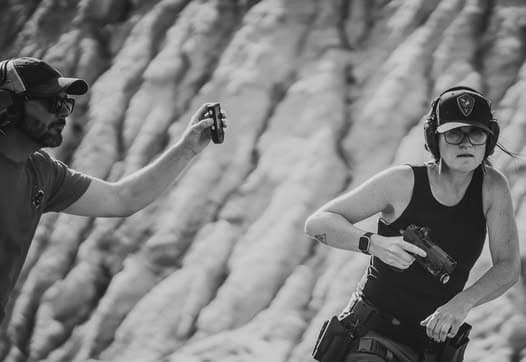
I'm also teaching now. New instructor, just getting started, working primarily with women who are standing where I stood in 2019. Terrified but determined. Overthinking every scenario. Convinced they can't do this, but showing up anyway because something in their life has shifted and they need to know they can protect themselves.
What I tell them is what the camera taught me: you're not looking for perfection. You're looking for patterns. You're building competence through repetition, not confidence through performance. The instructors worth trusting are the ones who treat you like a serious practitioner, not a fragile beginner who needs to be protected from discomfort. The best training I ever received put me in scenarios that were emotionally uncomfortable—decision-making under stress, judgment calls with real consequences. Do I draw? Do I shoot? When? Where? That discomfort was the point. You don't learn to make decisions under pressure by avoiding pressure.
The women I work with now aren't delicate. They're there with purpose. They're reclaiming something, building something, protecting something. My job isn't to soften that. It's to use it.
From behind the lens, I learned to see what most people on the range miss because they're too busy performing or competing or proving something. I learned that the shooters who pause before reacting are the ones you trust. That humility translates directly from life to the firing line. That the transformation from fear to agency happens in stages, not all at once, and it shows up in body language long before it shows up on a scorecard.
From the other side of the line, I learned that crossing over requires accepting temporary incompetence in a space you've spent years observing. That the vulnerability of being a beginner is harder than the technical learning. That competence earned through repetition carries differently than competence assumed.
And I learned that my story isn't finished. It's just beginning. Three years in, and I'm still building the path I needed but didn't have. I'm documenting it, competing in it, teaching others how to walk it. The camera taught me to see the patterns. The range taught me to live them.
I'm wearing earrings.