
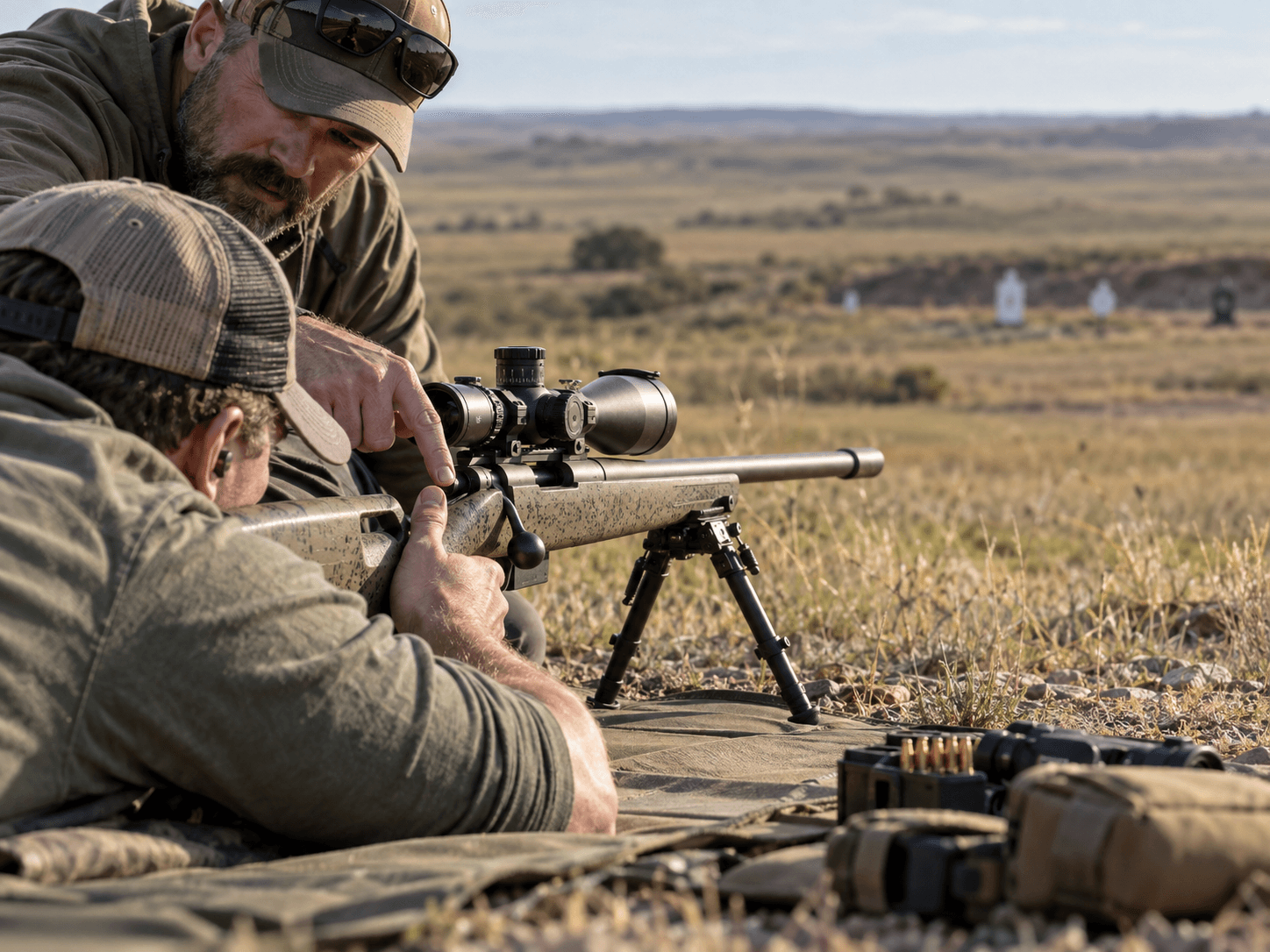
My first operation as a sniper still sits with me more than any range day since. We were deployed to a small town in central Kansas for a call involving someone shooting randomly outside in a residential neighborhood. Snipers move to the location first and start relaying information to command and the other operators while they gear up. I staked out the four wall, the back of the house, in a tree line about forty yards out.
I settled into the hide, watched, reported, and ran my checks in my head while I watched the man move through the house, yelling, alone as far as we knew. Over the next thirty minutes his demeanor changed more than once, enough that I settled on narcotics-induced psychosis or a mental health crisis, maybe both. I never forgot the feeling of watching another human being in that state, him never knowing I was there or what I had. Somewhere between alert and pity is the closest I can get to describing it.
It's not always the training or the student that sticks with you. Sometimes it's your own mind. That operation taught me to actually watch what's happening in front of me instead of what I expect to see, and that instinct turned out to matter just as much back on the range.
The Thumb, Not the Wind
I was teaching a long-range course in southeastern Kansas with a student who was drilling bullseye after bullseye from 100 out to 600 yards. We pushed him to 1,000, and he started hitting left every time. Spindrift was ruled out, it was pulling the wrong direction for that. Barrel harmonics were clean. After about twenty rounds I finally saw it: he was tightening his thumb over the stock and twisting the whole system left. At medium range that flaw is invisible. At long range it shows up as a called miss with no obvious cause. I corrected his thumb position, and the next five shots landed right on the money.
At medium range that flaw is invisible. At long range it shows up as a called miss with no obvious cause.
The same instinct applies under pressure, not just at distance. I had a student with the best rifle, glass, and base money could buy, hitting cleanly from standard prone out to 300 yards. Under time pressure, he missed a four-inch steel target at 200. The instructors around him caught it immediately: under pressure, he'd forgotten the barrel harmonics entirely and set the barrel directly on his shooting bag. Everything about his fundamentals looked fine. The bag was touching the barrel.
The hardest students to correct are often the most experienced ones. Veteran shooters tend to be set in their ways, and they'll tell you they understand a correction while doing the exact opposite. The most common failure is not following through on multiple-target engagements, and it stalls their progress every time. The most common misdiagnosis I see, from students and other instructors both, is free recoil. It works for a single shot. It does nothing for follow-through or consistency across a string, and that's exactly what most shooting actually demands. I see it fall apart most often on multiple-target strings and follow-up shots on a resetting target, the exact scenarios most of my students are actually training for.
Control the Shake, Don't Fight It
Tripod shooting is the clearest example of a skill everyone assumes is easy and almost nobody actually is. No matter how well you lock the system in, there's always some shake. The fix isn't fighting it still. It's learning to control the movement consciously: turn the shake into small circles, then slowly tighten those circles down onto the target before breaking the shot. Controlling the movement makes it predictable instead of random. That's really the whole mechanism.
The fix isn't fighting it still. It's learning to control the movement consciously.
Once a student learns that, the change shows up everywhere at once: accuracy, confidence, time, consistency. Knowing you're actually in control of the shake instead of fighting it does something to a shooter's confidence that no amount of encouragement can replicate on its own. I see the same gap constantly. Most people never train on a tripod, and almost everyone overestimates the stability it gives them. It's a lot better to find that out in training than the one time it actually matters.
If a new instructor takes one thing from twelve years of this, it's to have real confidence in your own ability and skill before you ever step in front of a class, and to keep practicing yourself. An instructor who stops learning eventually starts diagnosing from assumption instead of observation, the exact habit that misses the thumb, misses the barrel on the bag, misses why free recoil actually falls apart. Becoming an instructor doesn't mean your own learning is finished.
Don't build that confidence off the internet. Watching enough videos from people who list off Navy SEAL, Delta, Ranger, and Marine credentials doesn't mean you actually know the material. Stay open to critique, and take it seriously instead of dismissing it. If something doesn't work the way it's taught, don't throw it out. Tweak it until it fits how you actually shoot. Some of what sticks with you comes from a student. Some of it comes from forty yards out in a tree line, watching, and never being seen at all.
Some of what sticks with you comes from a student. Some of it comes from forty yards out in a tree line, watching, and never being seen at all.