
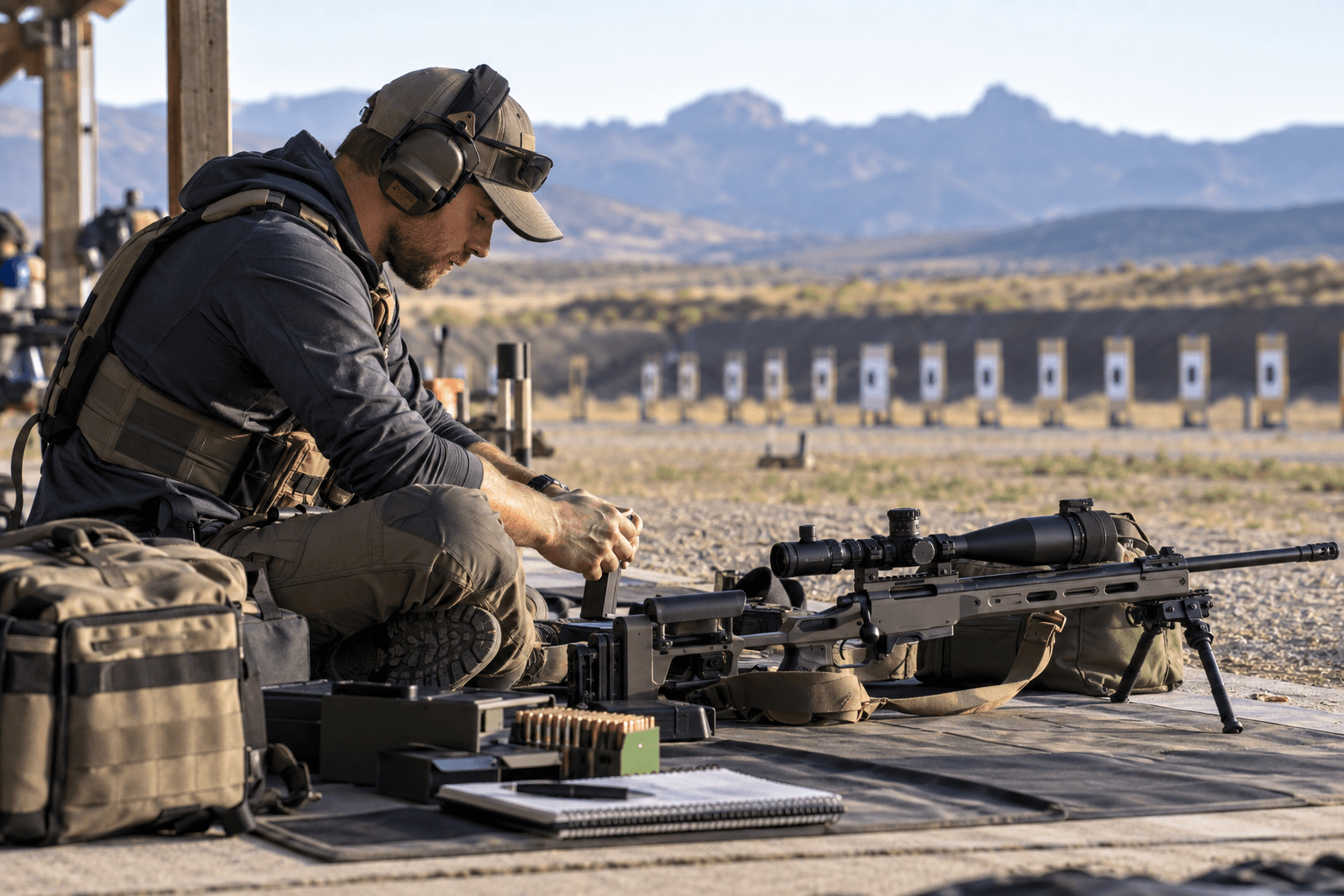
I've spent eight years competing and coaching out of Fort Worth, Texas. None of that is what actually turned my shooting around. That came from a coach who fixed one broken habit, and from a routine I built afterward that had nothing to do with the gun itself. I've trained more than 500 Sailors in small arms marksmanship since, and the routine below is what I actually teach them. It's not a theory I read somewhere.
The Follow-Through That Wasn't About the Shot
Early in my competitive career, I was struggling through an offhand stage. My shot calls kept missing their mark. I'd call a hit and watch the target say otherwise, over and over, without understanding why the two disagreed. A coach pulled me aside and told me to work on my follow-through, and explained it the way you'd explain a football throw: no follow-through, no power, no accuracy. That's his phrase, not literal firearms mechanics, follow-through doesn't add energy to the bullet. What it does is keep you from disrupting the shot process before it's actually finished. I still use his line anyway. No follow through equals no power and inaccuracies. From then on I've ensured I follow through my offhand shots.
No follow through equals no power and inaccuracies.
The lesson generalized past my form. Later in my career, I thought a rifle had gone bad. Groups opened up, and I assumed the barrel was shot out. I lined up new slings and a replacement barrel before I thought to check the ammunition first. That's the instinct most shooters default to: change the hardware, because the hardware is what you can see and touch. I swapped loads instead. The rifle came back to life. After changing ammo it was a hammer again. I'd nearly replaced two working components because I skipped the one check that actually mattered.
Most competitors spend the final minutes before a stage talking it out loud with whoever is nearby. I treat that stretch differently. I sit alone in front of my own equipment, check it, and run the whole stage in my head before I ever step to the line. I find it best to sit in front of my gear and not only ensure I have everything, but envision myself using it correctly. The gear check isn't really about the gear. It's the last quiet window before the clock starts, and I spend it on purpose instead of losing it to conversation.
What Actually Moves the Score
The habit is built on repetition, not inspiration. Visualization and repetition, run correctly every time, become the thing the body defaults to under pressure. If you do the same thing correctly every time, it will be ingrained in your memory and will become habit on the line. Get the rehearsal wrong and repetition just ingrains the wrong habit faster. That's the part shooters tend to skip when they hear the word practice and picture only rounds fired downrange.
The reason the routine works runs almost opposite to what most coaching teaches. Running through gear and steps doesn't sharpen my focus on the shot. It removes the shot from my head entirely. Thinking about my gear, or going through my steps, made me not think about the shot. Only the fundamentals. Once the routine replaced the thinking, my scores started trending up. Not one match. A trend.
Thinking about my gear, or going through my steps, made me not think about the shot. Only the fundamentals.
I see the same failure pattern across other competitive shooters who stall out. Most plateau because they cannot or will not name what actually needs to change. They keep riding the habits that got them this far instead of rebuilding the ones now holding them back. A shooter can be technically sound and still plateau, because the fix was never in the technique to begin with.
The self-sabotage starts earlier than the line. They think they can win, and that puts pressure on them mentally, so they put undue anxiety on an otherwise simple task. Wanting the win becomes the obstacle standing between a shooter and the win. The task itself, a clean press and a called shot, stays simple. The mind makes it complicated.
My advice to a shooter who has plateaued strips the problem back down to nothing. Ask two questions before you touch anything else. What actually changed? Not what you assume changed, the specific thing, the ammo, the rest, the position, that's different from the last time this worked. And what am I consciously trying to control right now that should already be automatic? If the answer to that second one is your grip, your stance, your follow-through, that's not a mental-game problem yet. It's still a fundamentals problem, and it gets coached as one.
Once those two are answered, start over with the fundamentals already ingrained, then audit everything downstream of them: stance, how you sling in, how you sit or stand on the line, even what you eat before and during a match. Nothing gets to stay unexamined just because it worked before. Don't protect a habit from a hard look just because it's the habit that got you here. Calling it consistency instead of stagnation is how the plateau holds.
None of it is complicated to describe. Sit with your gear. Run the stage in your head before you run it for real. Follow through on the shot the way you'd follow through on a throw. Every part of that fits on an index card. What's hard is doing it on the day it counts, when the clock is running and the only thing left to control is what's happening between your own ears.
The sport's hardest part wasn't mechanical, not once the mechanics were already there. The hardest part about shooting is not thinking about shooting. Just do it.
The hardest part about shooting is not thinking about shooting. Just do it.