
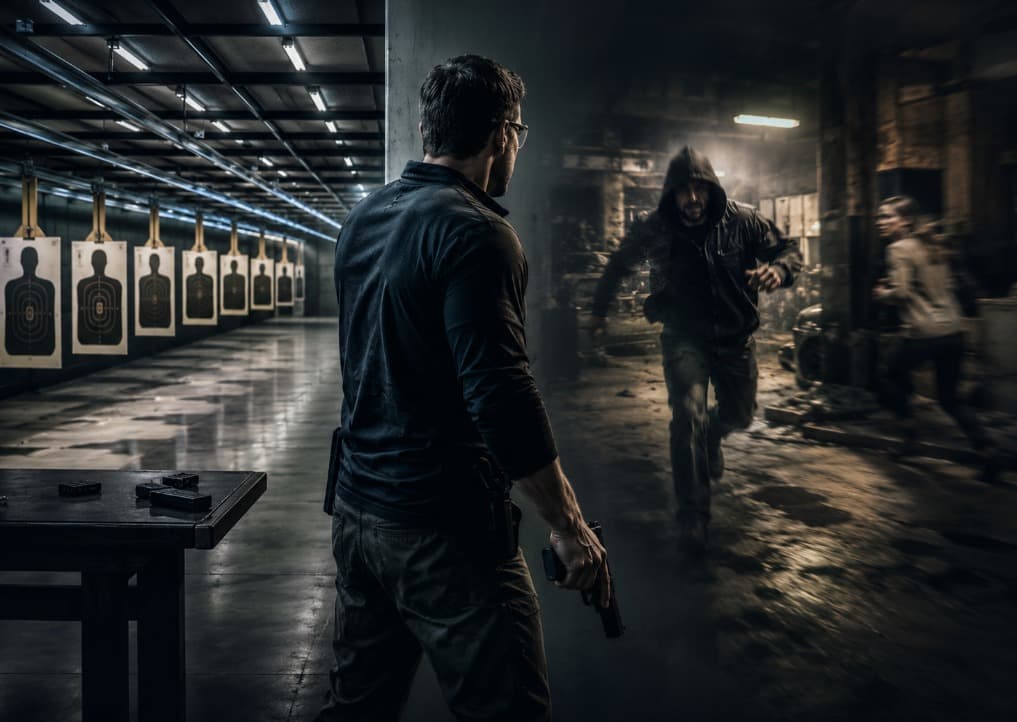
I have watched decorated competitive shooters freeze in force-on-force scenarios. Not hesitate. Freeze. Men with tight groups and fast splits, motionless, while a role player closed distance and ended the drill. Nobody in the debrief wanted to talk about what happened. What happened was simple: sport does not look like violence, and the nervous system knows the difference.
Modern firearms training has real value. Marksmanship, recoil management, weapon handling, rapid acquisition. Competitive shooters in IPSC and USPSA build genuine mechanical capability. Nobody disputes that. This is not an argument against the square range. It is an argument against mistaking the square range for the whole fight. Mechanical capability is one component of survivability, not the whole system. Conflating the two gets people killed.
The range lies about the variables that matter most.
On the square range, the shooter controls the sequence. Targets hold still. Lighting is managed. The drill begins when the shooter decides. Nobody is actively trying to kill you, and everyone in the building knows it.
Real violence is sudden, legally dangerous, and biologically overwhelming. People move unpredictably. Innocent bystanders cross the line of fire. Weapons malfunction at the worst possible moment. Cognition narrows. Footing collapses on ground nobody checked.
The other person gets a vote. He may be faster, more willing to kill, or already moving when you register the threat. One variable changes every calculation built on clean range data.
Distance and duration compress everything.
FBI LEOKA data confirms the pattern across decades: roughly 70% of officers killed with firearms were murdered within ten feet of their attacker, and more than half within five feet. Most of those encounters concluded in under five seconds, a few rounds, no warning.
Under that kind of stress, people do not rise to the occasion. They default downward to their level of conditioned training. If that training happened on a static range with no consequence attached, that is what fires. The body does not reach for what it knows theoretically. It reaches for what it has done repeatedly under pressure.
Square range confidence becomes dangerous at the exact moment it creates an illusion. The range tests marksmanship under comfort. Uncertainty, moral hesitation, target identification when the person in front of you is moving and shouting: none of it gets tested. Neither does the decision of whether to shoot at all.
Stress does not test skill. It exposes the gaps in the architecture underneath it.
I have seen this across force-on-force environments and real incident after-action reports. Tunnel vision locks onto a narrow field. Auditory exclusion drops critical information. Fine motor control degrades fast. The draw that ran clean in training starts to fall apart.
Tachypsychia distorts time. Officers report two-second encounters that felt like twenty. Others report the opposite. Neither perception helps a situation requiring legal judgment and precise mechanics simultaneously.
A timer on a shooting range cannot reproduce the biological reality of knowing another human being is trying to kill you. No instructor yelling. No competition pressure. None of it replicates mortality. The closest approximation is full-contact force-on-force with real consequence, and most programs avoid it because it is hard to run and easy to litigate.
When bullets travel both directions, psychology overtakes mechanics.
Sport shooting is not combat.
Competitive shooting develops real skills. Draw speed, reload efficiency, recoil control, target transitions. Those things matter. They are a foundation worth building.
Combat is not a shooting contest.
Combat is target identification under deception. Fear management under uncertainty. The decision of whether to shoot, made in under a second, with incomplete information, while something in your peripheral vision may or may not be a second threat. Combat marksmanship historically emphasized acceptable accuracy delivered fast under stress. Not perfect accuracy under ideal conditions. At close range, reaction speed matters more than tight groupings. The objective is not a score.
Every bullet has a lawyer attached.
One of the most neglected realities in firearms culture is liability. Every projectile that leaves the muzzle terminates somewhere: the intended target, an innocent bystander, a wall, you. No magical disappearing rounds.
I have spoken with law enforcement officers who stopped shooting accurately after an incident. Not because they lost the mechanical skill. Because the legal aftermath rewired their hesitation threshold. The investigation cost arrives during the process, not after the verdict. The financial cost does not wait either. Range environments rarely force students to confront either reality. The decision architecture matters as much as the mechanical competence, and most training programs never build it.
A person trained only on marksmanship but never on shoot-or-don't decisions is not dangerous to an attacker. To themselves and to bystanders.
The MMA parallel holds.
A skilled grappler dominates inside a controlled sporting environment: referees, weight classes, padded surfaces, medical oversight. The ruleset defines what ends the contest.
A street assault is different. The man who appeared unarmed produces a blade. A second attacker arrives from behind. The ground is concrete, not a mat, and contact with it carries different consequences. The environment itself becomes a weapon.
Sport specialization built inside a ruleset does not transfer completely to a context with no rules. Context matters more than sport specialization. The weapon is secondary. The situation is primary.
The pattern I keep seeing: people train the weapon. Nobody trains the person holding it.
Mechanical skill without mental conditioning collapses under pressure. Situational awareness does not show up in competition scoring. Low-light operations, target discrimination, communication under fire, emergency medicine after the shooting stops: none of it appears on a scorecard. The firearm is one component inside a system that includes the human being, the environment, the legal context, and every variable neither party controls.
One component.
The harsh truth is not complicated.
Owning equipment does not make someone dangerous. Shooting tight groups does not make someone combat capable. History repeatedly shows highly trained professionals dying in close-range encounters. Not because their marksmanship failed. Because violence is fundamentally unpredictable, and preparation is not inoculation.
The encounter will not look like the scenario that was trained. The attacker did not read the curriculum.
When violence arrives, it will not look like a drill.
It will look like chaos.
Chaos does not care about your scorecard.