
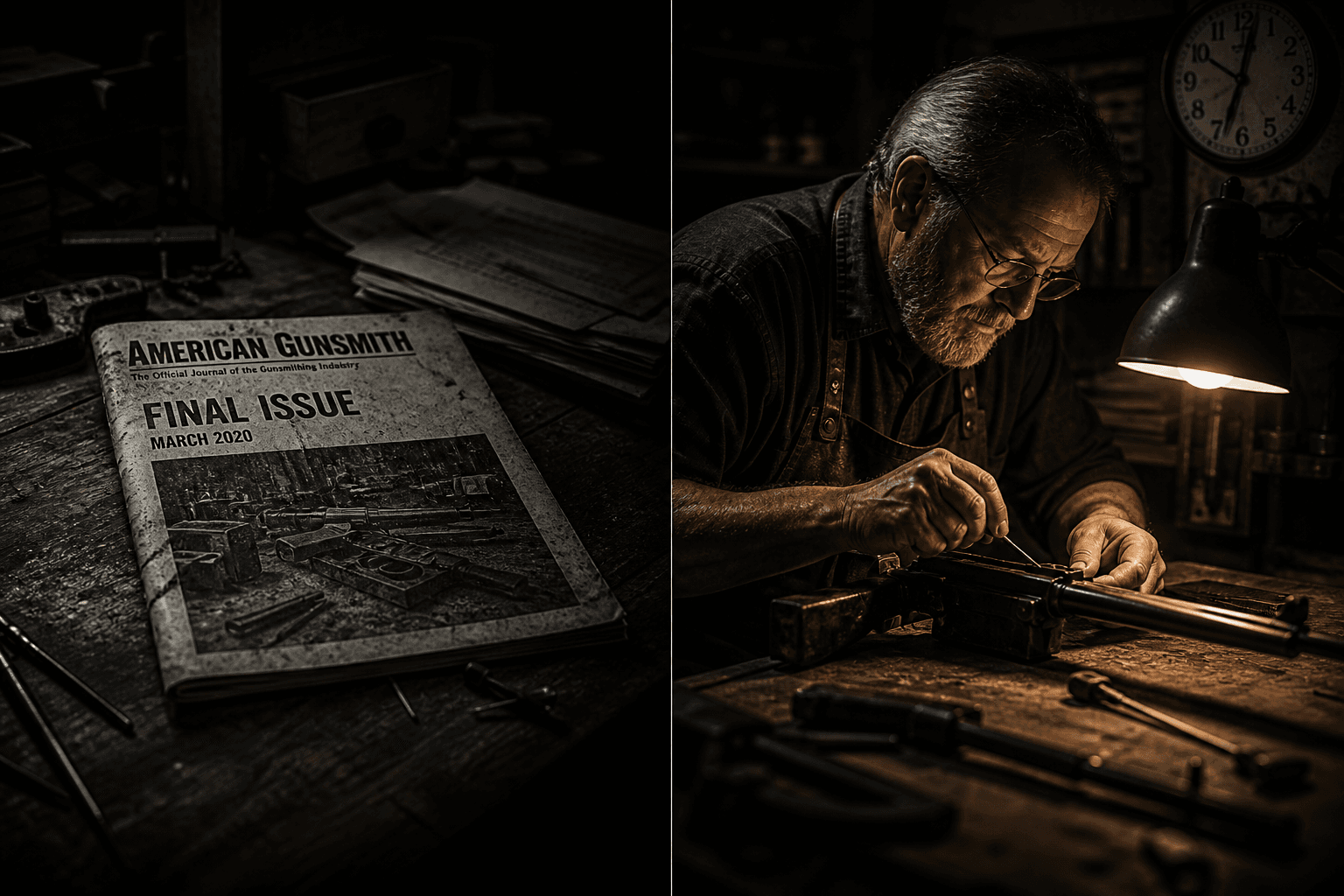
American Gunsmith published its last issue in 2020.
For those outside the trade, that sentence means nothing. For working gunsmiths, it marked the end of the only publication that treated us as the primary audience. Not enthusiasts. Not collectors. Not the buying public. The people at our benches, the ones whose livelihood depended on knowing things that existed nowhere else in print. Chamber work. Stock fitting. Metal finishing. Military arms. Historical platforms. The regulatory landscape as it actually applied to a working shop. American Gunsmith covered it because that was the job. Then it stopped, and nothing came in to fill the space it left.
That was five years ago. The trade has not replaced it.
While the Gunsmithing Club of America is thriving and produces GunTech, a magazine in which I have a legal aspects of gunsmithing column and regularly author articles, is widely distributed but only to its members. The gap exists, nevertheless.
The assumption, when a publication closes, is that the knowledge migrates. It finds YouTube. It finds forums. It finds the next outlet. The ecosystem self-corrects because knowledge wants to move and the internet provides infinite surface area for it to land on. That assumption is reasonable in most industries. In a trade this specific, this credentialed, and this legally constrained, it did not hold.
In the last several weeks I spoke with three senior practitioners, independently, without coordinating their responses. All three had contributed to American Gunsmith. All three are still active. All three are at the top of their craft, the kind of people whose names get spoken of in rooms full of people who know what those names mean. And all three said, in different words, the same thing.
They still have things to say, and they have been waiting for somewhere to say them. Five years later, they are still waiting.
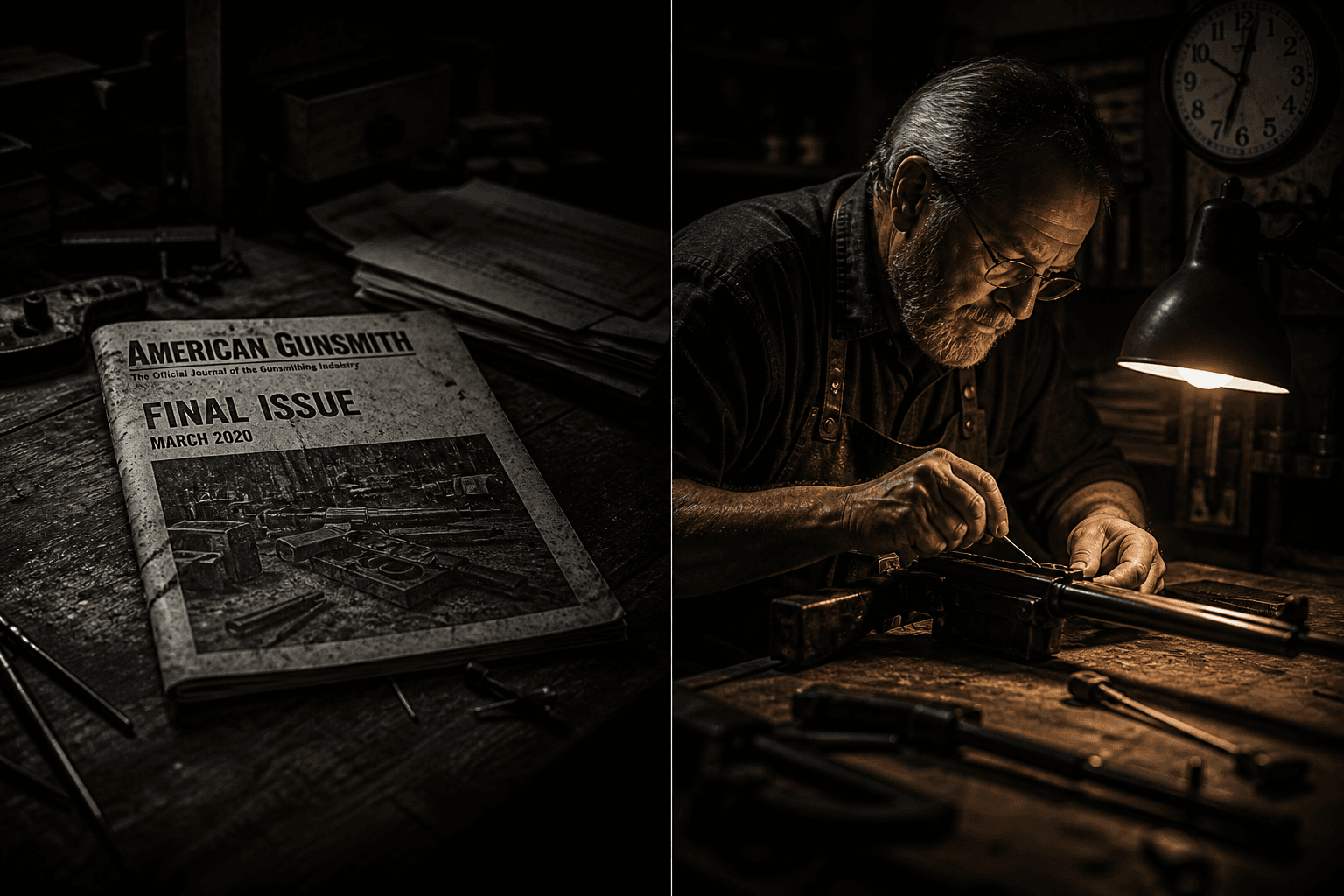
One of them framed it with a directness that is difficult to ignore. He wanted his knowledge shared, rather than dying with him. He was not being overly dramatic. He was being precise. He has been at his bench for three decades. He watched his publication close and his shop close under federal pressure, and he is now doing work, historical reconstruction, artillery carriage building, blacksmithing, that has not been seriously practiced in two centuries. He is doing it without an audience. He is doing it because the alternative is to let it stop with him.
That is what five years without a trade publication looks like on the ground.
The willingness was never the issue. These are not secretive people protecting competitive advantage. They are craftsmen who understand, with increasing urgency, that what they know is finite.
The knowledge did not migrate. It stayed exactly where it was, inside the practitioners who developed it, because the infrastructure that moved knowledge from inside their heads to inside the permanent record of the trade had closed and nobody had rebuilt it. The willingness was never the issue. These are not secretive people protecting competitive advantage. They are craftsmen who understand, with increasing urgency, that what they know is finite and the mechanism that was supposed to catch it before it disappeared has been gone for five years.
This is an industry knowledge crisis. It is not being described as one, which is part of what makes it a crisis.
The gunsmithing trade has a documented apprenticeship problem. The conversation around it tends to focus on recruitment, on young people not entering the trade, on shop owners not taking on apprentices, on the pipeline narrowing at the entry point. Those things are real. But they are downstream of something that receives less attention. You cannot pass down what you do not have time to practice. You cannot build an apprenticeship infrastructure when the working gunsmith is spending the majority of his hours on compliance work, transfer paperwork, warranty jobs, the administrative weight of operating a federally licensed business in a regulatory environment that has grown consistently heavier for two decades.
The craft knowledge sits under a tarp in the back of the shop. The forty-hour project that pays for twenty does not get touched. The senior practitioner who could be teaching is instead managing paperwork.
And the publication that was supposed to be capturing the knowledge anyway, as a backstop, as the mechanism that preserved what the shop economy could not, closed in 2020 and left nothing behind.
What we are describing is a compound failure. Working conditions that prevent knowledge from being practiced at depth. Regulatory pressure that closes shops and ends careers before the knowledge transfers. The absence of publication infrastructure that would have caught it regardless. Each of these is a serious problem alone. Together they describe a trade that is losing institutional memory faster than it is building new knowledge to replace it.
The three practitioners I spoke with are not anomalies. They are confirmation of a pattern that has not been examined seriously because the people best positioned to examine it are the ones living inside it. The gunsmiths who wrote for American Gunsmith did not stop having things to say when the publication closed. They stopped having somewhere to say them. That distinction matters more than the industry has acknowledged.
Knowledge that is not recorded does not survive its holder. That has always been true of every skilled trade. What changes is whether the infrastructure exists to record it before the holder is gone. In gunsmithing, for five years, that infrastructure has largely not existed.
The practitioners are still there, and the knowledge is still there. What has been missing is a publication willing to treat working gunsmiths as the primary audience again, to build the editorial relationships that make contribution feel natural rather than burdensome, and to take seriously the obligation of the trade press, which is not to cover the industry from the outside but to serve as its institutional memory from within.
The gunsmiths who wrote for American Gunsmith did not stop having things to say when the publication closed. They stopped having somewhere to say them.
That is what Firearms Insight Magazine and The Bench exist to do. Not to fill a gap for its own sake, but because the gap has a cost that compounds every year it remains open. The practitioners who were waiting for somewhere to put what they know are not getting younger. Neither is the knowledge.
The work of rebuilding that infrastructure starts with understanding what was lost when the last one closed. Five years in, the picture is clear enough.
The craft noticed. It is past time the industry did too.