
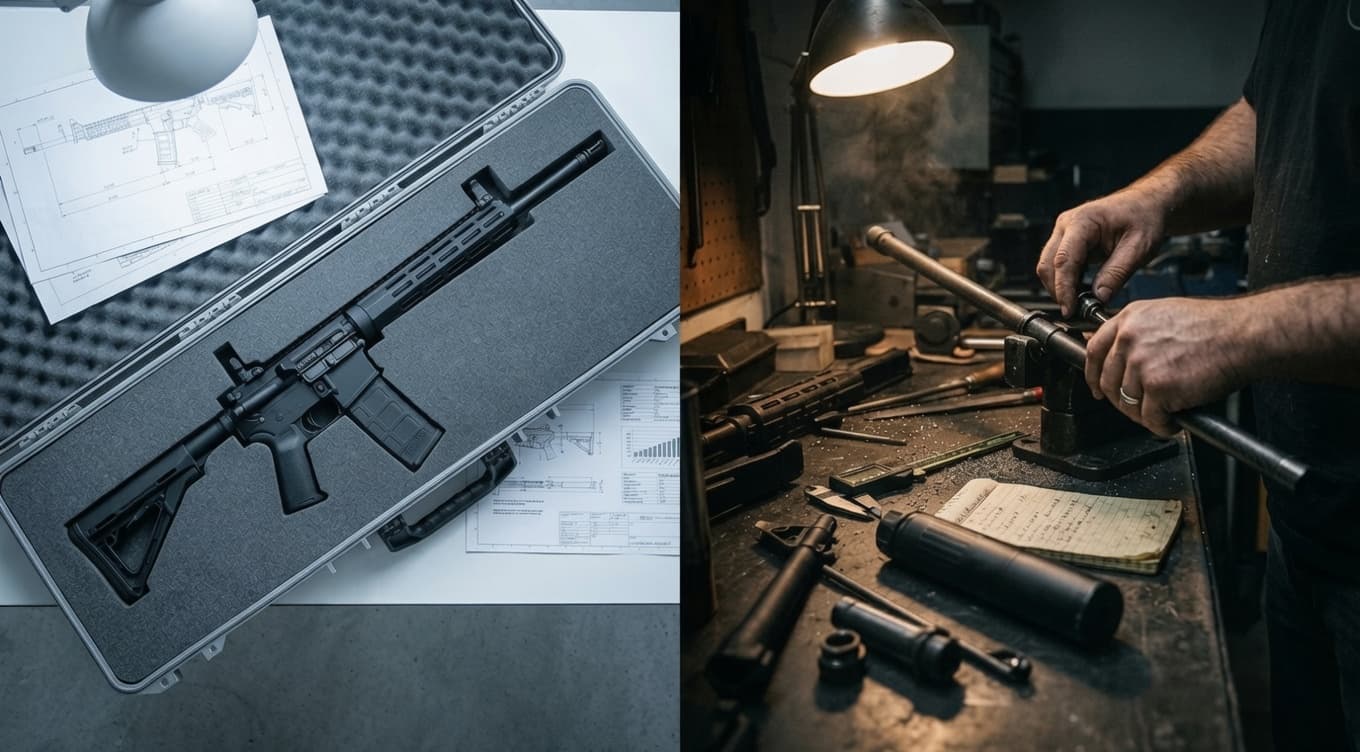
Most of this stuff doesn't go anywhere beyond the people who need it. There's no release, no announcement. It just gets built and used. Then somebody else sees it and wants one, and it spreads from there. That's how a lot of ideas move in this trade. Not because they were marketed, but because they worked.
That's the part most people outside the trade don't understand. They think progress comes from manufacturers deciding what's next, running it through a product cycle, and putting it on a shelf. In my experience, a lot of it comes from guys at the bench working through real problems and not worrying about whether it's already been done. You've got the tools and a situation in front of you. That's enough to get started.
Most of what I build doesn't start with a request that fits into a category. It starts with somebody asking if something can be done, or me looking at a setup and thinking there's no reason it shouldn't work. I'm not chasing a product line or trying to come up with something new for the sake of it. If there's a practical use and the parts make sense, I'll figure out a way to put it together and see what happens.
One of my specialties has always been what I'd call off-the-wall custom guns, but that doesn't mean they're random. It usually comes down to suppressed setups, oddball calibers, or something that solves a specific problem better than what's already out there. I do a lot of suppressed work, pistols and rifles both, and most of it is built around real use. People aren't coming in asking for something to sit in a safe. They want something that works, does a job, and doesn't create another problem in the process.
People aren't coming in asking for something to sit in a safe. They want something that works, does a job, and doesn't create another problem in the process.
I don't spend much time explaining theory. I'd rather just build it and see what it does. When I talk about a setup, I'm going to tell you exactly what's in it: bullet weight, barrel, can, mount. Because that's what matters. I had a .338 ARC build not long ago, 285-grain Hornady ELD running through an XCaliber 30 can. I had no business being confident about it until it shot. We ran it, it grouped, and the suppression was where it needed to be. That's what made it repeatable. Not the concept, the result. Either it performs or it doesn't.
Everything I build is tied back to use. Deer getting into a garden, someone needing a quieter rifle around neighbors, a carry setup that actually gets carried instead of left at home. I'm not building to fit into a category like "precision" or "tactical." I'm building something that works for the person using it. If it gets the job done without creating a new problem, that's a good build.
Most customers come in knowing what they're dealing with, not what they want. Maybe it's noise. Maybe it's a platform they like that doesn't do what they need. I'm not going to tell them it's not possible until I've looked at it. Sometimes the answer is obvious once you're holding the parts. Sometimes it takes a few iterations. Either way, you don't find out by sitting on your hands.
Not every idea works out. I've had builds that looked right on paper and didn't cooperate once I was in the metal. Sometimes the geometry is close enough that you think it'll run and it won't. You put it back, figure out where it fought you, and either fix it or tell the customer it's not the right path. The difference between a bad idea and a good one isn't always obvious until you're cutting.
Manufacturers release what's safe to release. That's how they operate. Safe to manufacture, safe to market, safe for liability. That's not the same thing as what a specific person needs for a specific problem. The gap between those two things is where most of the real work happens. Nobody's going to build a suppressed 9mm bolt gun out of a .22 TCM platform and put it in a catalog. But somebody needed one. So I built it.
Everyone who looked at that rifle saw a .22 TCM. The magazine geometry said something different. That was the only thing that mattered. Re-barreling, threading, opening the bolt face slightly, reworking the feed ramp. All standard work. What wasn't standard was being willing to ask whether the platform could do something it was never marketed to do. Most people assume an untried thing is an impossible thing. That assumption is where a lot of useful builds stop before they start.
What makes a build unusual isn't the technique, it's the combination.
I've sent builds out across the country that started as a single conversation. Other smiths saw them and started doing their own versions. Nobody asked for permission. Nobody announced it. It just moved because it worked and people could see that it worked.
That's how this trade actually operates when it's functioning the way it should. No committee, no waiting for somebody upstream to decide it's time. You work through a problem with real parts and the result either holds up or it doesn't. If it holds up, it gets used. If it gets used, someone else notices. That's the whole cycle.
There are smiths all over the country doing the same thing, working through problems that don't have a catalog solution and coming out the other side with something that functions. Most of them aren't writing about it. They're just building. The ones who've been at it long enough have stopped needing validation from outside the shop. The work either holds up or it doesn't. That's the only scorecard that matters.
I'd rather be one of those guys. But if putting this down gets somebody else to stop waiting for permission to try the thing they've been thinking about, then it's worth saying.
Most of the builds that matter started as a conversation that could have gone nowhere. The ones that worked didn't announce themselves ahead of time. You only know looking back. The ones that didn't get built because someone was waiting for a manufacturer to do it first you don't hear about those at all.