
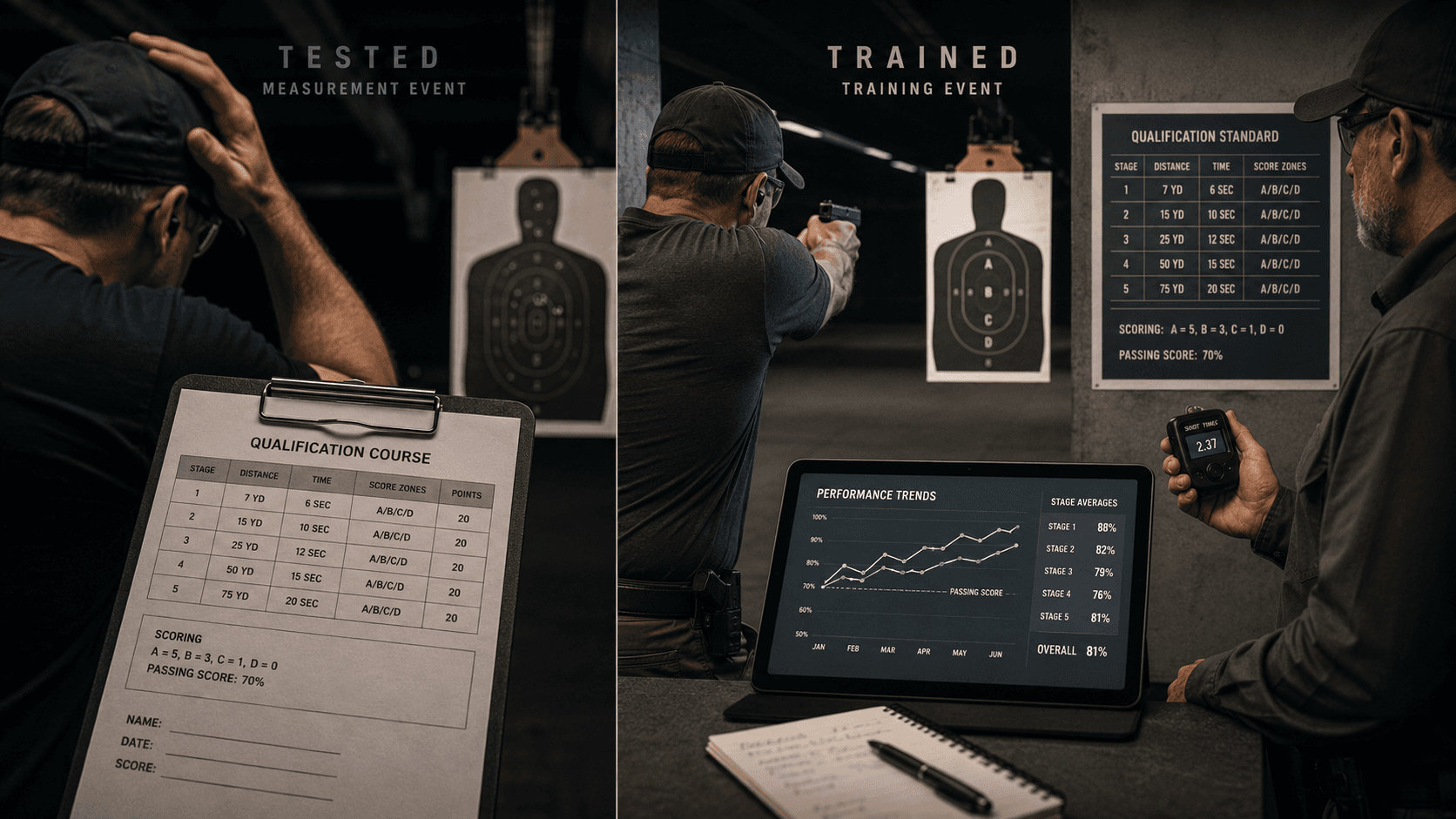
In almost every high-performance discipline, the standard is visible before the test. Athletes train against specific benchmarks. Pilots practice against known procedures. Business teams measure against defined targets. Feedback is continuous. The evaluation confirms what the data already showed.
Firearms qualification, in many programs, works differently.
The standard exists somewhere in a policy document. It gets administered once or twice a year. And for much of the time in between, the shooter has no regular exposure to the specific criteria they will eventually be tested against. Distance stages. Time constraints. Scoring zones. They know a qualification is coming. They may not know, in precise terms, what it will look like.
Qualification is not a training event. It is a measurement event.
That is the problem I kept returning to as I entered the firearms training world. And it is the shift I believe the industry needs to make.
The Measurement Event vs. the Training Event
The distinction sounds simple, but its implications run deep.
A training event is designed to build skill. A measurement event is designed to confirm it. These are not the same thing, and treating them as interchangeable creates predictable problems.
If qualification day is also the first time a shooter is exposed to the precise requirements of the standard, it is functioning as both a training event and a measurement event simultaneously. That creates a fundamentally reactive system. Instructors prepare students in general terms. Students arrive on qualification day and discover whether their general preparation was sufficient.
The better model is simpler: qualification confirms what training already established. The result should be predictable. If it is a surprise, the system has already failed, before anyone steps onto the line.
Skill Degradation Is an Information Problem
When someone struggles on qualification day, the immediate response is usually to focus on what happened in that moment. A shooting problem. A technique issue. A bad day.
What often goes unexamined is the system that produced the outcome.
If performance is only measured annually or semi-annually, skill degradation can develop unnoticed for months. An officer who qualified cleanly eight months ago and has not trained against the standard since is carrying a credential that reflects a past state. The credential has not changed. The shooter has.
The qualification score is a data point. The training trend is intelligence.
Instructors and training directors who look at performance as a series of data points rather than a single annual result gain something the periodic model cannot provide: early warning. They can see where performance is stable, where it is improving, and where it is beginning to drift, before the drift becomes a failure.
A shooter who scores 90 percent today may satisfy the policy requirement. But if that same shooter was consistently at 97 percent, then 94 percent, then 90 percent, the issue is no longer qualification. The issue is drift. Without trend visibility, the agency only sees the pass. With trend visibility, the instructor sees the warning, weeks or months before it becomes a failure on the line.
Visibility Changes Everything
The intervention that I believe has the most leverage is also the most straightforward: make the standard visible year-round.
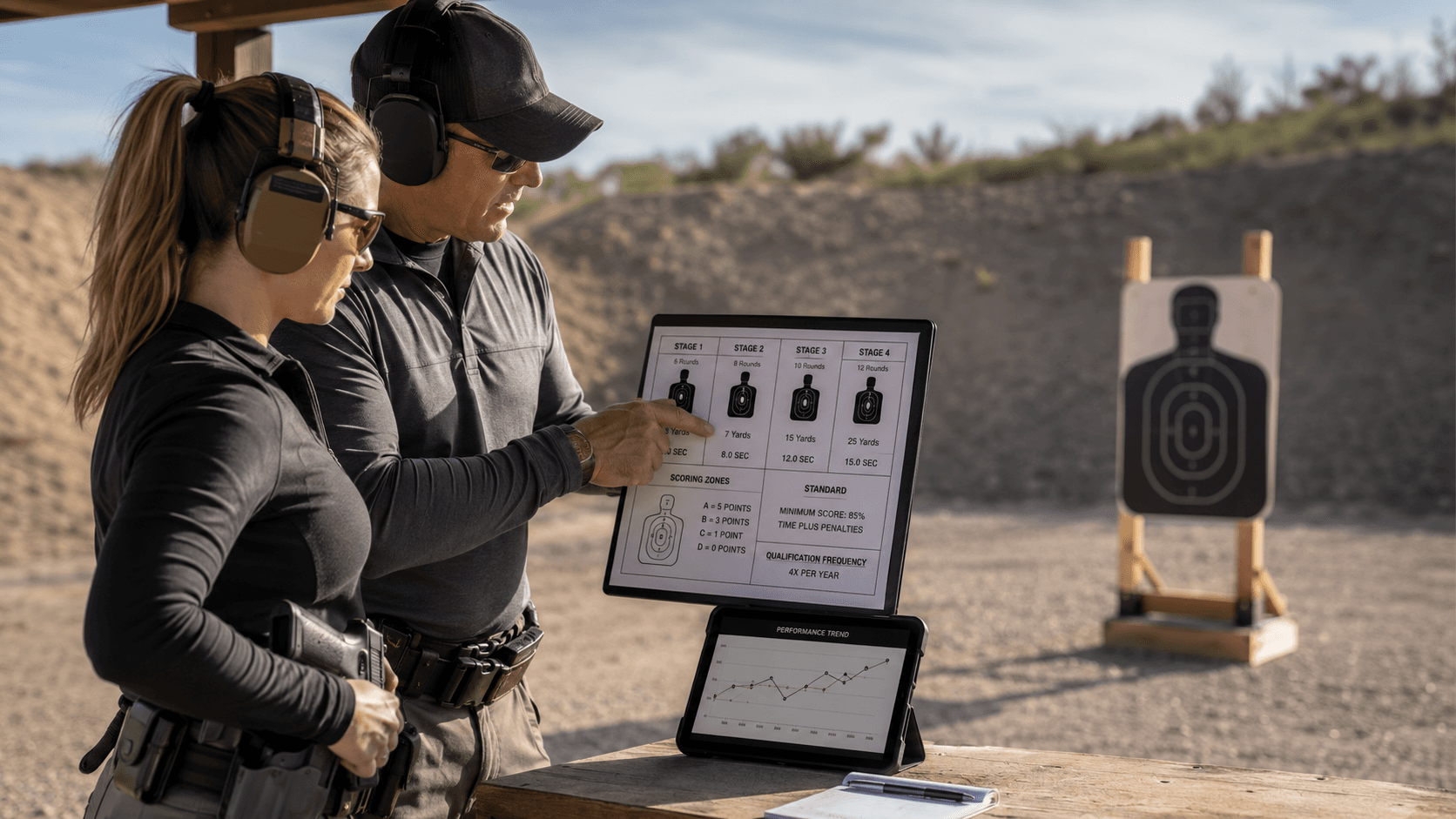
Not as a study guide. Not as a reminder that a qualification is approaching. As a training tool, accessible any day of the year, against which a shooter can measure their own performance on their own timeline.
When the standard is visible consistently, several things follow. Shooters understand what is actually required. Instructors can design training around specific criteria rather than general proficiency. Training directors can track performance trends between qualification events. And the qualification result, when it comes, is the confirmation of a story the data has already told.
The goal is to make qualification day the least interesting data point in the system.
Volume Is Not the Answer. Alignment Is.
One piece of conventional wisdom that deserves scrutiny is the assumption that more training time automatically produces better qualification performance.
Volume and effectiveness are not the same thing. A shooter who trains extensively without regular exposure to the qualification standard may be investing significant time and effort without knowing whether they are improving against the specific criteria they will be measured on. They are active, but they may not be progressing against the right target.
The most valuable training is training that is aligned to a clearly understood standard with consistent feedback against that standard. That is what makes improvement predictable rather than accidental.
In business operations, athletics, aviation, and manufacturing, the same pattern appears consistently. Performance improves when standards are visible, measurement is continuous, and feedback occurs before evaluation. The discipline changes. The principle does not.
What the Data Should Tell You
When performance is measured consistently over time, the conversation changes. Instead of asking what drill to run after a qualification failure, instructors can ask what the data shows needs attention before the next qualification.
That is a different question, and it produces different results. Targeted reinforcement rather than broad remediation. Proactive coaching rather than reactive repair. A training program that improves intentionally rather than reacting to periodic surprises.
The organizations that will lead in this space are not necessarily the ones with the most training hours. They are the ones with the clearest picture of where their people actually stand, and the systems to act on that information before it shows up as a failure.
A Note for New Instructors
If there is one thing I would want a new instructor to take from this perspective, it is not a specific drill or technique. It is this:
Do not limit your education to the discipline you are teaching.
Learn about performance systems. Learn about coaching. Learn about data. Learn about how organizations improve over time. Your technical proficiency matters. Your certifications matter. But many of the challenges you will encounter as an instructor are not shooting problems alone. They are communication problems, training design problems, measurement problems, and performance management problems.
The instructors who create the greatest impact are often the ones who can pull lessons from outside the discipline and apply them to the people they serve. The question worth asking throughout an entire career is simple: what can I learn outside of firearms that will make me a better firearms instructor?
This is not really an argument about qualifications. It is an argument about performance systems. About building environments where improvement is intentional, standards are visible, and results are predictable.
Qualification day should not reveal the truth for the first time. It should confirm what the training system already knew.
The standard is worth testing against. It should also be worth training against, measuring against, and improving against every week of the year. Not just when the calendar says so.