
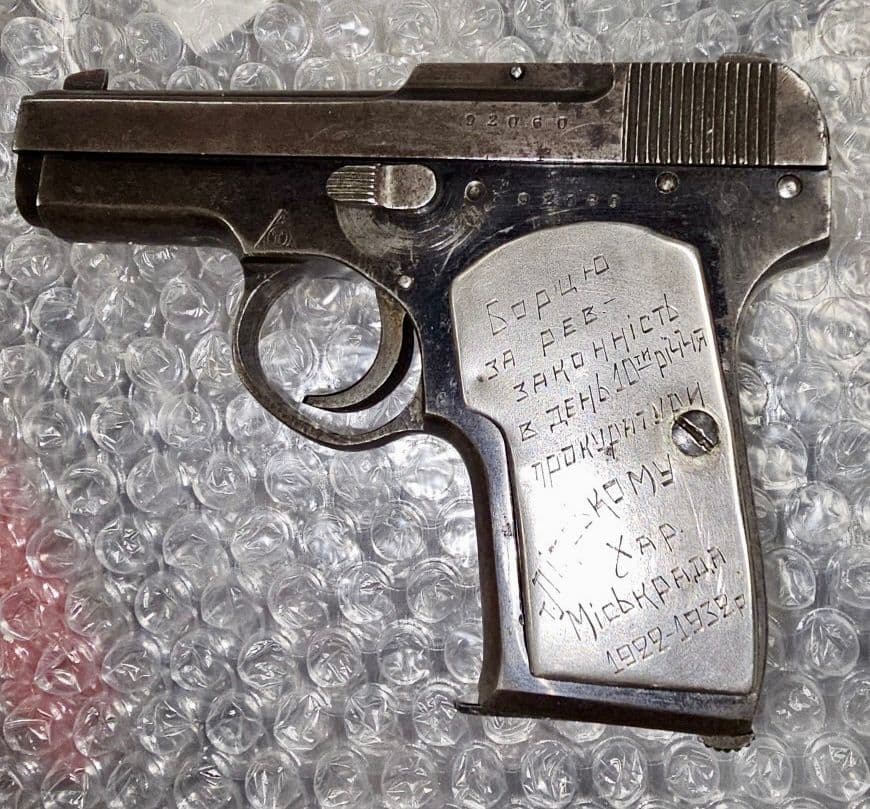
The customer standing at my counter had no idea what he was carrying. He thought it was a Russian pistol from the 1940s. He knew it was old. He knew it was not cycling correctly. That was the full extent of what he knew about the firearm in his hands.
The first thing I noticed was a small stamp above the trigger. It does not look like a marking at first. It could pass for a pin hole, a machining artifact, a place where a screw should be. The customer thought the name on the pistol might have been something like "Tuka." He was not close.
What he had was a Tula-Korovin. And that changes everything about how you approach the job.
The Tula-Korovin was designed by Sergei Aleksandrovich Korovin, who had trained under John Moses Browning at FN's factory in Belgium before returning to Russia. What Korovin took back with him eventually became one of the earliest Russian semi-automatic pistols, chambered in 6.35 mm Browning, the cartridge Americans call .25 ACP. The pistol served as a sidearm for Soviet officers and was carried by agents of the NKVD, the feared state security apparatus that operated under Stalin. It predates the better-known TT33 Tokarev, and when that pistol displaced it as the dominant Soviet sidearm, many Tula-Korovins were rounded up and destroyed.
Surviving examples are not common. They are not easy to research. Most gun owners will never encounter one. This particular pistol appeared to be a T2, the second of three known model variations, which places it among the rarer survivors of a firearm that was never produced in large numbers for civilian hands.
The man standing at my counter had no idea.
A firearm can be rare, historically significant, and nearly impossible to support with parts. That does not mean the owner will understand what that means until something breaks.
Once I got into the pistol, the mechanical problems were straightforward to read. Someone had already been inside it before it reached my bench. The magazine feed lips had plier marks on them, evidence of an amateur attempt to correct a feeding problem. The feed ramp showed signs of hand-filing, which is almost never the right approach. The mainspring had been replaced with one several pounds heavier than factory spec, which was driving the slide to short-cycle and slam back into battery too fast. Combined with the damaged feed lips, the result was a pistol stovepiping nearly every round.
I adjusted the feed lips until both sides matched. I polished the feed ramp correctly, using a Foredom rotary tool rather than a file. Then I addressed the spring, removing small amounts of material, test-firing, checking the result, and adjusting again. With a firearm like this, patience is not optional. The margin for error is narrow and the parts supply is essentially nonexistent. Take too much off the spring and you trade one problem for another that may be harder to solve.
After several careful cycles, the pistol functioned correctly.
Then I told the customer not to shoot it again.
That is a harder conversation than it sounds. I was not telling him the gun was dangerous. I was telling him that a firearm can be functional and still be the wrong candidate for regular use. A spare magazine for a Tula-Korovin, when you can find one at all, can run close to three hundred dollars. A firing pin is a different problem entirely. These are not parts you call a distributor for. They do not exist in any catalog. The pistol had survived from the Stalin era to an Iowa gun shop, and it had arrived in decent enough condition to be repaired. That is not an invitation to put five hundred rounds through it. That is a reason to understand what you have.
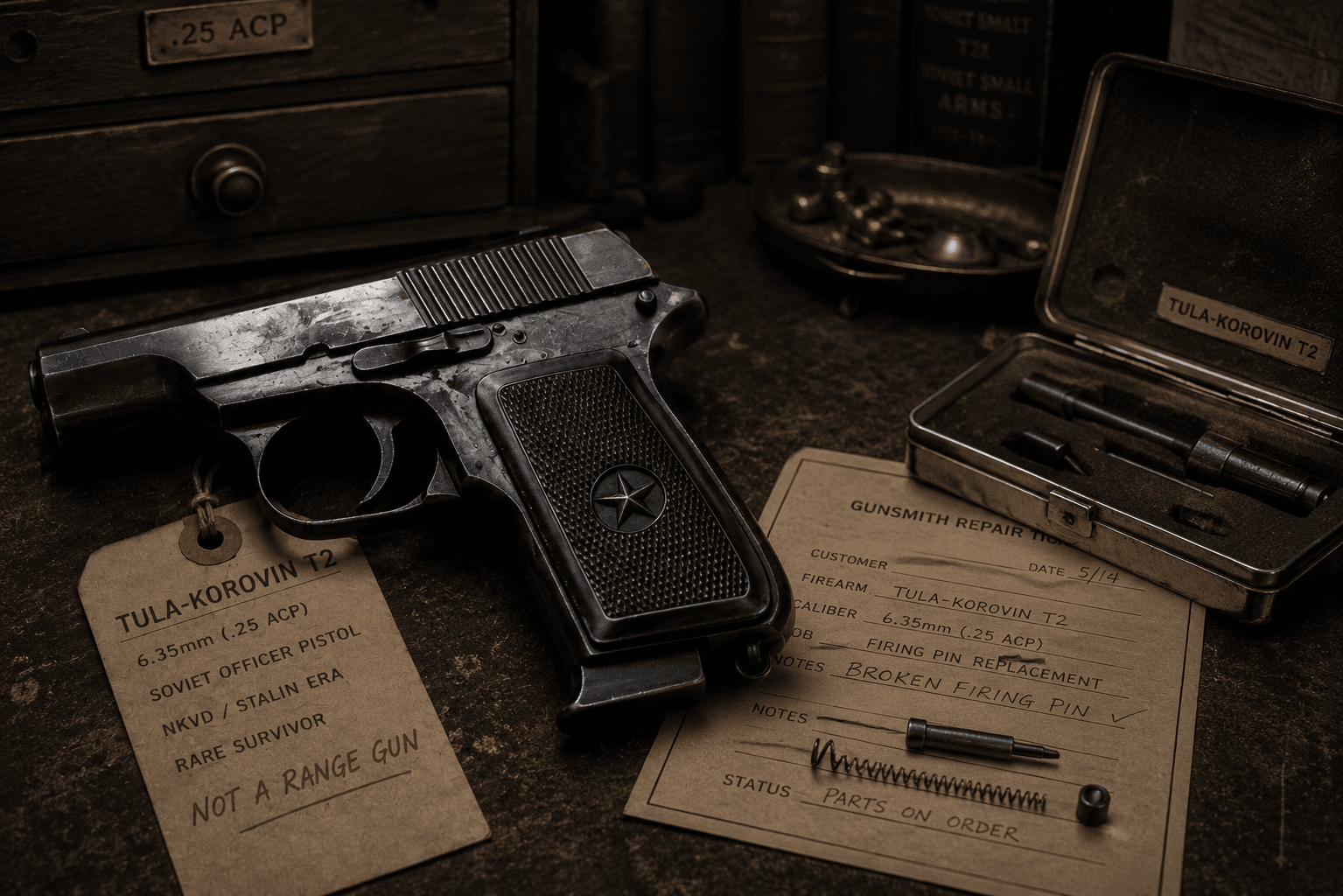
Some guns reach a point where function is no longer permission.
Not every old firearm should be treated as a range toy. Some are historical artifacts that still happen to be capable of firing. That capability is not an argument for using them.
The customer took the pistol to the range anyway. He fired a full box of ammunition through it. Then he returned to my shop and asked why it would not fire.
The firing pin had snapped.
I have been looking for a replacement since. At this point the most realistic path may be locating another Tula-Korovin and purchasing it for parts. That is not a normal repair situation. That is the consequence of ignoring the history of what you own.
I have had this conversation more times than I want to count. A customer asks for an expert opinion and then goes home and does the opposite. Some come back embarrassed. Some take the gun to another gunsmith in town, leave my repair ticket in the case, and that smith calls me to ask what I had done. Then we both have the same conversation every gunsmith eventually has: the repair was done correctly, the advice was clear, and the firearm failed because the owner ignored the one instruction that mattered.
I once had a customer bring in a World War II German Luger with SS markings and ask why it was not performing the way he expected. My first question was why he was shooting it in the first place. That is not a rhetorical question. It is the question that has to come before any conversation about repairs.
The problem is not that gun owners are careless. Most of them are not. The problem is that the history of a firearm is invisible unless you already know what to look for. A stamp above the trigger that looks like a machining mark. A variation designation that places the pistol among a few dozen survivors of a purge. A mainspring that was replaced by someone who did not understand what they were changing. None of that is obvious from the outside. None of it announces itself. And none of it stops a customer from loading a magazine and heading to the range.
That is one of the quieter jobs of a gunsmith. Not just diagnosing what is broken and fixing it, but understanding what a firearm is before deciding what should be done with it. Some repairs are mechanical. Some are historical. And sometimes the most important service you can provide is telling an owner to put the pistol back in the safe and leave it there.
Sometimes the most valuable thing a gunsmith can do is explain why a firearm should not be repaired for use. The customer will not always listen. But the advice is still the right advice.
It survived the Soviet Union, the Cold War, and decades of storage. It did not survive one box of ammunition after the owner ignored the only instruction that mattered.
The search for a replacement firing pin continues. If anyone reading this knows where one might be found, I am interested.