
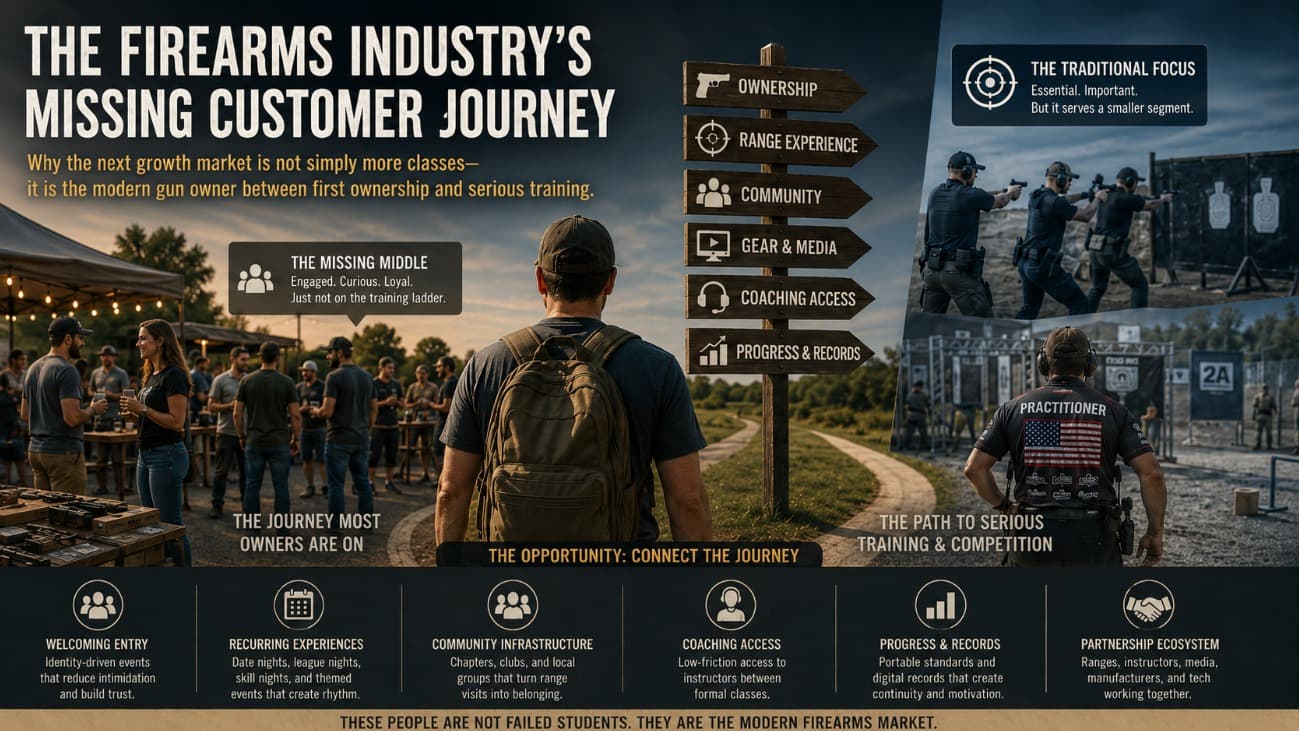
For years, one of the most frequently discussed topics in firearms training has been what instructor Karl Rehn famously described as the "1%" problem.
The question is simple: why do so few people continue training beyond their initial firearms class, concealed carry course, or state minimum requirement?
It is a fair question. It is also an important one. But the firearms industry may be asking it from the wrong side of the counter.
Not because the "1%" observation is wrong. It highlights a real challenge that instructors across the country have seen for years. The problem is that the discussion often begins inside the training industry rather than inside the broader firearms market.
From the instructor's perspective, the ideal journey looks obvious: buy a firearm, take a basic class, take another class, continue training, improve skill, perhaps enter competition, become a more capable and responsible shooter.
That path makes perfect sense inside a training business. But does it describe the behavior of most gun owners? Evidence suggests it does not.
Millions of Americans own firearms. Tens of millions participate in sport and target shooting. Many buy additional firearms, optics, ammunition, accessories, holsters, safes, memberships, and range time. They watch firearms media, follow instructors and influencers, ask questions online, bring friends to the range, and participate in the culture in informal ways.
They are not necessarily disengaged. They are engaged differently.
That distinction matters because the training journey and the customer journey are not the same thing.
Businesses often optimize for the customers they see. Instructors see students. Ranges see lane rentals. Retailers see purchases. Manufacturers see product demand. But the market contains far more than any one of those categories.
The modern gun owner is not always moving toward becoming a serious student, competitor, tactical practitioner, or instructor. Many never will. The industry has built many pieces for them: memberships, media, programs, and products. What it has not built is the connective tissue that connects those pieces into a durable customer journey.
The Missing Middle
The firearms industry tends to focus on two groups.
At one end are new gun owners: first purchase, first class, first range visit, first safety lesson. At the other end are serious students, competitors, law enforcement officers, military professionals, armed security, instructors, armorers, and high-commitment enthusiasts.
Between those two groups is a large middle market.
These are firearm owners who may shoot occasionally or regularly. They may own multiple firearms. They may spend heavily on equipment. They may follow firearms media every week. They may visit indoor ranges, take family members shooting, ask questions about red dots and holsters, or debate calibers and accessories online.
But they do not necessarily see themselves as "students."
They may not want to spend a weekend in a tactical pistol course. They may not want to be evaluated by a timer. They may not want to enter competition. They may not want a hard-edged training culture that feels built for someone else.
For many of them, the enthusiast stage is not a waypoint on the way to something more serious. It is the destination.
That is not failure. That is a market.
The industry's mistake is treating everyone outside the small recurring-training segment as failed students instead of different customers.
The opportunity is not merely philosophical. It is operational: ranges need better entry points, instructors need continuity after class, and gun owners need visible next steps. The industry has built excellent products, excellent instructors, excellent ranges, and excellent training programs. What it has not built is the connective tissue between them.
The Firearms Participant Spectrum
A more accurate view of the market is not a straight ladder. It is a branching spectrum.
Utility Owners — Own for practical reasons, often protection. May think of the firearm like a fire extinguisher or household tool: important to have, not something to build an identity around.
Participants — Visit ranges, consume media, buy gear, and occasionally seek advice. Engaged, but informally.
Recreational Enthusiasts — Enjoy firearms as a hobby, culture, collection, or social activity. May be loyal customers without becoming formal students.
Aspirational Students — Open to instruction, improvement, coaching, and progress tracking if the path feels accessible.
Practitioners — Apply shooting skill seriously: law enforcement, armed professionals, competitors, defensive-minded citizens, and advanced hobbyists.
Professionals — Teach, research, design, train, evaluate, manufacture, and influence the industry.
Most firearms businesses are built for the two ends: the beginner and the serious practitioner. The middle receives far less intentional infrastructure. That is where the opportunity is.
The Gun Owner Who Does Not Want to Become a Student
One of the most important realities the industry must accept is that not every gun owner wants more instruction.
Some owners bought a firearm for home defense. They took a basic class. They fired a few magazines. They stored the firearm safely. In their mind, the task is complete.
They do not join a community for their microwave, their security system, or their cordless drill. They may view a firearm the same way: a serious tool, not a lifestyle.
No amount of clever branding will turn every utility owner into a weekly range customer. That does not invalidate the customer journey thesis. It clarifies it.
The goal is not to force every gun owner into the instructor's ladder. The goal is to build different pathways for different types of owners.
The utility owner may need one annual confidence check, a safe storage reminder, a maintenance session, or a simple way to ask a trusted question. The recreational owner may want events, range games, gear education, social outings, and a low-pressure way to improve. The aspirational student may want structured progress, coaching access, records, milestones, and eventually formal training. The serious practitioner already knows what they want.
The industry has spent decades building for the serious practitioner. The next growth opportunity may come from building for everyone else without pretending they are all trying to become the same person.
The Rise of Firearms Media Reveals the Point
One of the clearest signs that the firearms market extends beyond formal training is the growth of firearms media.
Channels, podcasts, creators, reviewers, historians, armorers, competitive shooters, defensive instructors, and entertainment personalities have built audiences larger than many formal training organizations by orders of magnitude.
Firearms media does not prove that every viewer wants training. It proves that many gun owners remain curious and engaged outside formal instruction. People want to understand firearms, compare equipment, learn how platforms differ, and hear stories, opinions, and arguments.
This is learning, even when it does not look like training.
The industry's challenge is recognizing that education does not only happen in a classroom and skill development does not only begin when someone registers for a course. Many gun owners are already learning. They are simply learning in places the formal training industry does not control.
The Question With Nowhere to Go
Consider when many gun-owner questions actually arise.
Not during the class. Not while standing next to the instructor. Not when the answer is conveniently available.
The question arises on Tuesday night after a Saturday range session. Something happened. A pistol jammed. A group opened up unexpectedly. A new red dot felt confusing. A holster did not sit right. A new owner realized they did not know how to clean a firearm properly. A parent wondered how to talk about safe storage with teenagers. A shooter wondered whether their target pattern meant anticipation, grip pressure, sight alignment, or something else.
At that moment, their options are usually poor.
They can search YouTube and receive twenty answers, some excellent and some dangerously wrong. They can post in an online forum and get contradictory advice from strangers. They can ask a friend who may not know much more than they do. They can wait until they book another class, which may never happen.
What they often need is not another full class. They need thirty seconds with someone they trust.
That is the missing relationship layer.
The gap is not access to information. The internet contains more firearms information than any individual could absorb in a lifetime. The gap is access to a trusted advisor who can apply that information to a specific person, a specific firearm, a specific problem, and a specific goal.
That relationship largely disappears when the class ends. For many students, the entire post-class connection to the instructor is a business card, a phone number, or a vague invitation to "reach out if you have questions."
That is not infrastructure. That is hope.
Coaching Access: The Overlooked Business Model
The instructor who could answer five or ten student questions per week through a structured asynchronous channel is providing something valuable. Not a full class. Not legal advice. Not tactical certification. Not a replacement for range time. But continuity.
A student might submit a target photo and ask whether the pattern suggests a grip issue. A new owner might ask whether a certain malfunction is ammunition-related, maintenance-related, or user-induced. A concealed carry student might ask what kind of practice session to run next. A recreational shooter might ask whether they are ready for a beginner match. A parent might ask how to introduce a family member safely to range etiquette.
The instructor answers at leisure. The student receives trusted guidance. The relationship persists between formal engagements.
This model already exists in many other fields. Patients message doctors between appointments. Athletes send training logs to coaches. Golfers send swing videos. Students email tutors. Business owners retain advisors. Firearms training has not built this at scale.
That is surprising because instructors already do the work informally. Many answer texts, DMs, and emails for free. The opportunity is to organize that relationship into a professional service that supports students, generates recurring revenue, and keeps people connected to safe, competent guidance.
Online coaching should not become casual use-of-force advice, legal interpretation, tactical fantasy, or remote certification. Its safest and most useful early role is equipment questions, safe handling reinforcement, maintenance guidance, practice planning, target review, range preparation, next-step guidance, and referral into in-person training when appropriate. This model also requires clear scope, disclaimers, and a simple rule: when the question crosses into live gun handling, legal judgment, or defensive tactics, the answer should move the student back to in-person instruction.
Done correctly, it does not replace instruction. It extends instruction.
What Ladies' Night Actually Proves
In many local markets, one recurring proof point stands out when range owners and instructors are asked what produces strong attendance, repeat visits, and word-of-mouth referrals: Ladies' Night.
Ladies' Night works because it is not merely a class. It is an entry point. It tells a specific group of people: this was designed for you. You are welcome here. You will not be judged against a culture built for someone else.
When the entry point is performance, the implicit message is: you will be assessed. When the entry point is community, the message is: you are welcome here. Those two messages produce very different first experiences.
This does not mean skill is unimportant. It means the emotional doorway matters. People often decide whether they belong before they decide whether they want to improve.
The Chapter Model: What A Girl & A Gun Got Right
A Girl & A Gun Women's Shooting League demonstrates what happens when identity, recurring touchpoints, local chapters, shared values, and community infrastructure come together.
The deeper lesson is structural. The chapter model solves a problem individual instructors cannot easily solve alone: continuity. A member who moves from one state to another can find another chapter. The identity travels. The community is not trapped inside one range or one instructor's business.
This is how national fitness chains, martial arts organizations, running clubs, youth sports leagues, and professional associations create durability. The individual location is a node in a larger network. The network becomes part of the product.
Most firearms training businesses are still built around the individual instructor as the brand. That can work, but it is fragile. When the instructor retires, relocates, burns out, or changes direction, the community often dissolves.
The chapter model shows another possibility: distributed belonging.
Identity Is an Entry Point, Not a Business Plan
There is a danger in overlearning the Ladies' Night lesson.
For a local indoor range or independent instructor, fragmenting the calendar into highly granular niches can become exhausting and unprofitable. Each niche requires distinct messaging, outreach, trust-building, and sometimes cultural or language competence.
Ladies' Night works partly because the audience is broad, visible, and socially understood. A hyper-specific identity night may require far more effort to fill far fewer lanes.
The lesson is not that every identity deserves its own standalone event. The lesson is that people respond when the entry point feels designed for them.
A practical model is layered. Broad recurring programs carry the main business load: Ladies' Night, New Shooter Night, Date Night, Family Range Day, First-Time Gun Owner Clinic, and Intro to Range Confidence. Occasional themed events test demand: Red Dot Basics, Home Defense Readiness, New Parent Firearm Safety, First Responder Range Night, Beginner Match Prep. Highly specific programs should usually be partner-driven, built through a local community organization, bilingual instructor, church group, business association, veterans group, or cultural network.
Identity programming should be tested, not assumed. The question is not "Can we name a group?" The question is "Can we reach this group profitably, serve it safely, and retain it meaningfully?"
Immigrants and First-Generation Americans: An Underserved Entry Point
One of the most emotionally powerful underserved entry points is immigrants, naturalized citizens, first-generation families, and people who came from countries where civilian firearm ownership was heavily restricted, culturally taboo, or associated mainly with state power.
For someone raised in that environment, the American relationship with firearms can be disorienting. The Second Amendment is not an abstraction to them. It is a right they did not have before.
A program designed for this audience should not be a standard beginner class with translated flyers. It should be culturally thoughtful. It should make room for people who may be curious, nervous, skeptical, or emotionally conflicted. Different immigrant communities approach firearms differently: some are motivated by self-defense and past experience with vulnerable environments; others arrive with deep distrust of armed culture shaped by authoritarian contexts.
The difference between a program that builds bridges and one that becomes shallow marketing is whether the organizer has real trust inside the community.
Done well, this kind of program does not merely teach beginners. It helps people understand a right, a responsibility, and a culture they may not have grown up with.
Welcoming Cannot Mean Casual About Safety
The phrase "welcoming environment" can make some traditional firearms instructors uneasy, and for good reason.
Firearms training is not a yoga class. It is not a wine tasting. It is not a casual hobby meetup where the worst outcome is embarrassment.
A firearm range is a live-risk environment. Muzzle direction, trigger discipline, loading, unloading, movement, holstering, malfunction clearing, and line commands are not matters of vibe. They are matters of life safety and liability.
New shooters who do not want to feel judged still must be watched closely. Their gun handling must be assessed continuously. An instructor cannot ignore unsafe behavior because the event is supposed to feel friendly.
Welcoming does not mean casual about safety. Welcoming means the participant is treated with dignity while the safety structure remains absolute.
A good instructor can be warm in tone and uncompromising in command. A range can be beginner-friendly and still strict. A class can feel inclusive without lowering standards.
The participant should not feel judged as a person. Their gun handling must still be evaluated every moment.
What Front Sight Proved, and What It Warned Us About
For years, Front Sight Firearms Training Institute represented one of the largest civilian firearms training operations in the country. Its founder, Dr. Ignatius Piazza, was not a traditional law enforcement or military figure. He was a chiropractor. He did not build Front Sight by being the most credentialed tactical instructor in America. He built it by understanding something many instructors missed: customers were not only buying curriculum. They were buying transformation, recognition, experience, identity, and belonging.
That is an important lesson. But Front Sight should not be treated as a hero story. It should be treated as a case study.
Its rise proved that civilian firearms customers would buy far more than a class. They would buy an experience. They would travel. They would join. They would refer friends. They would attach identity to a training organization.
Its collapse proved something else: experience marketing without sustainable economics, transparent promises, operational discipline, and trust can become dangerous.
The mature lesson is not "build hype." The mature lesson is that experience and belonging can dramatically expand the market, but they must be supported by sound business structure, real instructional quality, credible promises, and long-term financial discipline.
The experience model creates the entry point. Substance and trust create retention. Neither alone is enough.
Progress, Memory, and Recognition
Most people do not stay engaged because they are experts. They stay engaged because they can see progress.
This is true in fitness, golf, martial arts, running, gaming, education, and professional development. People return when they can see improvement, compare where they started with where they are now, and feel that their effort is accumulating into something.
Firearms participation often fails to preserve that experience.
A shooter may have a great range session, shoot a personal-best group, take a meaningful class, complete a first qualification, or bring a family member shooting for the first time. Then the target is thrown away, the memory fades, and the next visit starts from zero. That is a missed retention opportunity.
People value their own story. They value evidence of improvement. They value milestones. They value recognition, even modest recognition.
A documented first range session matters. A logged personal best matters. A preserved target matters. A clean record of progress matters. A student note from an instructor matters. A beginner-level achievement can motivate someone toward the next step more effectively than a lecture about why they should train harder.
The firearms industry has built many products that measure equipment performance. It has built fewer systems that help ordinary gun owners remember their own development. That is the missing emotional infrastructure.
The Portability Problem
Most firearms training records do not travel well.
A student completes a course at a local range. They receive a certificate. It may mean something inside that range or to that instructor's community. Outside that context, the credential often carries limited meaning. Another instructor may not know what was taught. A range may not recognize it. A peer may not understand the standard.
The credential becomes an island. Every new training relationship starts from zero.
The stronger solution is to anchor progress to public, recognizable, objective standards. Targets. Distances. Times. Scores. Courses of fire. Documented results.
A B-27 run at a known distance under a known time standard means something. An FBI-style pistol qualification means something. A USPSA classifier-style run means something. These formats are not perfect, and they do not measure everything. But they provide a common language.
A target and timer create a more objective foundation than most participation certificates, if the course, distance, time, shooter identity, scoring method, and record integrity are preserved. That "if" matters. The target does not lie only when the process around it is honest. An unofficial run should not be presented as an official certification; its value is that the format is recognizable and repeatable.
With the right structure, performance records can become portable in a way most training certificates are not. Automatic scoring, annotated target images, session records, instructor verification, and standardized progress tracks can turn isolated range moments into durable records.
The instructor remains essential. The record becomes portable.
The Practical Framework
The industry's next customer-journey model should include at least six layers.
The problem is not that ranges lack offerings. Most have memberships, lane rentals, retail, private lessons, leagues, and events. The problem is that too many of those offerings sit as separate transactions instead of feeding a visible next step. The framework below addresses that gap.
1. Entry Points Beginner nights, family events, women's programs, new shooter clinics, range confidence sessions, and partner-driven identity events.
2. Safety Structure Clear commands, strict gun handling standards, instructor oversight, risk management, and liability-aware program design.
3. Relationship Continuity Instructor access between classes, student groups, asynchronous Q&A, practice recommendations, and post-session follow-up.
4. Progress Records Targets, scores, notes, drills, session history, equipment used, distances, times, and instructor feedback.
5. Recognition and Milestones First qualification, personal bests, completed drills, improvement levels, public-standard achievements, and shareable records.
6. Discovery and Next Steps Recommended classes, matches, drills, events, equipment education, clubs, leagues, and pathways suited to each owner type.
This is not exotic. Other industries have already built versions of it. Fitness sells progress. Martial arts sells advancement. Golf sells coaching and improvement. Video games sell levels and achievements. Professional education sells credentials. Social platforms sell identity and belonging.
The firearms industry has built excellent products, excellent instructors, excellent ranges, and excellent training programs. What it has not built is the connective tissue between them.
The Real Opportunity
The future growth opportunity for the firearms industry may not be creating more elite shooters. It may be creating more lifelong firearms participants.
That does not mean lowering standards. It does not mean abandoning serious training. It does not mean pretending safety is secondary to customer experience.
It means understanding that the serious student is only one part of the market.
Many gun owners will never become tactical practitioners, competitors, or instructors. Yet they may remain firearm owners for decades. They may buy products, visit ranges, ask questions, bring friends, introduce family members, influence purchases, and participate in the culture in ways that matter commercially and socially.
The person who owns a firearm but is nervous to ask basic questions. The person who enjoys range time but does not want a tactical identity. The parent who bought a home-defense gun and needs confidence. The immigrant trying to understand a right they did not grow up with. The woman who wants community before competition. The couple looking for a safe first shared experience. The casual shooter who might become a student if the next step were obvious. The enthusiast who spends money everywhere except formal instruction because no one has built a real relationship with them.
These people are not failed students.
They are the modern firearms market.
The question is no longer how to push every owner up the same ladder. The question is how to keep more owners connected, confident, and progressing on the path that fits them.
The industry has spent decades building for the shooter it wanted. The next generation of growth will belong to the businesses that build for the gun owner who is already there.