
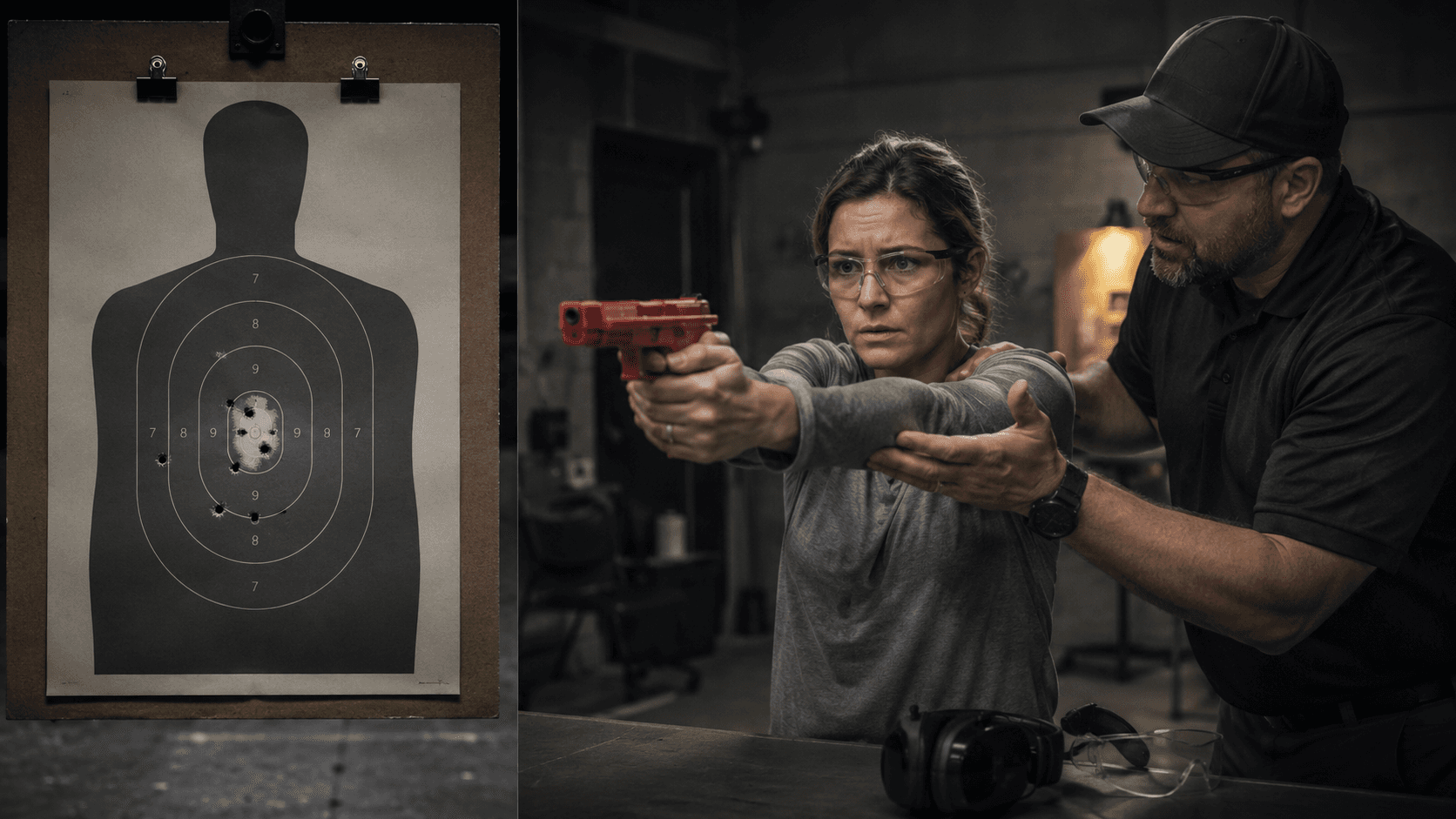
She held the pistol low and stiff, arms already braced for something she hadn’t fired yet. Before we stepped onto the live-fire range, she had already decided she was going to fail.
I start there. Not with the target. Not with the groups. I start with what I can see in the classroom before anyone touches a live round.
A lot of students walk in convinced the problem is them. Some are afraid of the sound. Some are afraid of embarrassing themselves in front of others. If an instructor misses that, training hasn’t really started.
With this student, I kept the live fire away entirely at first. We worked with a SIRT pistol under the classroom lights. Hand grip, stance, sight alignment, front sight focus. Nothing rushed. No pressure. Red SIRT training pistol, paper target, cardboard backer.
New shooters usually assume accuracy is about strength or natural talent. Rarely. Most problems come from grip pressure, body position, anticipation, or simply not knowing what to look at. One small correction can change everything within minutes.
After ten or twelve minutes, she was hitting the target consistently. You could see it happening: confidence building shot by shot, posture changing, the stiffness leaving her arms. When I traded the SIRT pistol for her actual handgun, she looked hesitant. The situation felt real now.
Same fundamentals, same slow progression. She started shooting accurately with live ammunition. The expression on her face changed completely. She went from braced and doubtful to genuinely amazed. Not just that she had hit the paper. That she had done it.
She was no longer trying to survive the experience. She was learning.
Many students aren’t fighting recoil. They’re fighting embarrassment.
A lot of instructors focus only on technical corrections. Those matter. But sometimes a student needs to believe they are capable before the fundamentals have anywhere to land.
Visual Learn is built around that recognition. The classroom is not a waiting room before the range. Instruction begins there.
The second lesson cost me more to learn.
A student was constantly readjusting her grip after every single shot. Fire, pause, reposition, continue. Standard doctrine says stop the unnecessary movement. Maintain a strong, consistent grip through the entire string of fire. Sounds reasonable. Grip consistency matters.
But I kept watching the same pattern. Instead of correcting her again, I asked what she was feeling.
That conversation changed the entire session.
She explained that she suffered from acute arthritis. Holding a solid grip for extended periods was not a habit problem. Pain. Her fingers would loosen between shots not because she had poor mechanics, but because she had to.
The issue was not about technique at all. It was about understanding what was actually in front of me.
Some instructors correct faster than they observe. That gap is where students get lost.
The standard advice, hold the grip through all ten rounds, stop readjusting, was not realistic for her. Applying it exactly as written would have increased her frustration and her pain without improving anything. So I changed the approach.
I told her to use her own cadence. If she needed to pause between shots or briefly reset her hands, acceptable. If she needed thirty seconds before continuing, she could take it. The ten-round evaluation was still the ten-round evaluation. The clock was hers to manage.
Once the pressure came off, her shots became more controlled. She was no longer forcing herself into a rhythm her body could not hold. She finished performing well by any standard, not despite the pauses, but working around them.
She left feeling successful instead of defeated. That distinction matters more than the score.
A shooter can pass a qualification and still leave the range unconvinced they belong there.
Ten years and more than five hundred students have shown me the same thing in different forms. Veterans. First-time gun owners. EMTs still in uniform after a shift. Students apologizing before they ever fire the first round.
The SIRT pistol exists in my classroom for exactly that reason. Slow the process down, work through fundamentals before students are also managing recoil, noise, and anticipation. Observe grip mechanics, trigger control, body posture in an environment where honest feedback is easier to give and easier to receive.
But listening matters as much as correcting.
If a student is afraid to mention the pain in their hands, or the fear they walked in with, or the confusion they are too embarrassed to admit, the instructor loses information they cannot afford to lose. The classroom environment has to be one where students feel safe saying what they are actually experiencing.
Not every student will shoot, learn, or progress the same way. Fundamentals still matter. Flexibility matters too. The goal is not identical behavior from every shooter. The goal is that each student leaves safe and capable within their own abilities.
Paper targets only show where the rounds landed. They don’t show the fear someone walked in with, the hesitation behind each trigger press, or the moment a student realizes they are more capable than they believed.
Good instructors see those things before the target ever does. Most don’t look.