
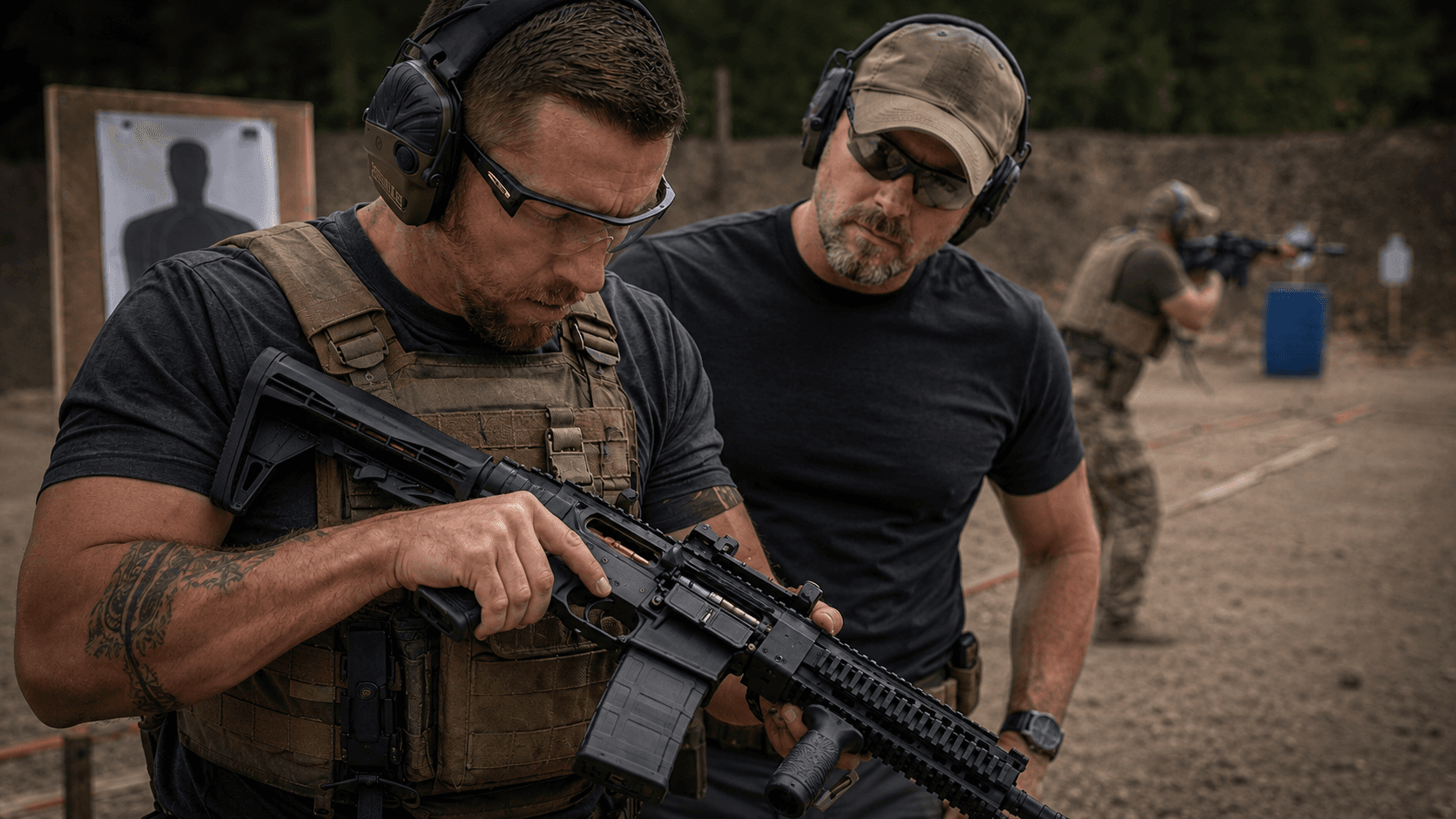
The command was simple: "Threat."
One shooter turned and engaged immediately.
The other didn't move.
From the outside, it looked like hesitation.
It wasn't.
Most instructors watch the shot. The best instructors watch everything before it.
The Drill
The exercise was a large-scale variation of the Box Drill, designed to push shooters past the static range mentality and into something closer to real performance. Two shooters. Mirrored courses of fire. Backs to the targets at the fifty-yard line.
At "Threat," both had to turn, locate their assigned steel, and make a standing hit. Speed counted. Accuracy counted equally. Neither was negotiable.
From there, the course drove forward: fifty yards to twenty-five, twenty-five to ten, each stage demanding a hit before advancing. At the ten-yard line, a paper target waited. After engaging it, both shooters conducted an emergency reload while moving diagonally across the range, exchanging positions as they crossed. Muzzle discipline, situational awareness, footwork, and weapon handling all happening simultaneously, under elevated heart rate, while preparing to re-engage from the opposite side.
That was the point. Real performance requires the ability to think, move, and safely manage a weapon system under physical and mental stress. Standing still and shooting accurately is a foundation. It is not the ceiling.
What Looked Like Hesitation
When the command came, one shooter didn't move.
The immediate read, from everyone watching, was the obvious one: performance anxiety, the weight of competition freezing the student at the moment of execution. It happens. It is one of the things instructors expect to see.
That read was wrong.
As we stopped the drill and inspected the rifle, the cause became clear. The rifle was locked up with a double-feed that had occurred during the load-and-make-ready phase. Focused on the drill, on the setup, on the competitive pressure, the student had assumed the rifle was ready and moved to the starting position without recognizing the problem. The hesitation after "Threat" was not a crisis of confidence. It was a loaded rifle that could not fire.
The failure did not happen when the drill started. The failure happened before it.
Preparation failures disguised as performance failures look identical from the outside. The diagnosis requires going back to where the problem actually began.
When the Problem Is the Process
That distinction matters more than most instructors realize.
A student who appears slow, hesitant, or indecisive may not be suffering from a marksmanship problem. The actual issue may be equipment status, a loading error, malfunction recognition, or simple unfamiliarity with a condition the student has never encountered before. The visible symptom is almost never the root cause. Instructors who only watch the shot miss the story.
What changes when you look earlier in the sequence is that you start seeing preparation failures disguised as performance failures. They look identical from the outside. The diagnosis requires going back to where the problem actually began.
Repetition as the Cure
After identifying the double-feed, we didn't move on. We stopped and worked it.
The student repeatedly practiced the clearing procedure under direct supervision. Diagnosis. Control of the rifle. Return to service. Over and over, until the mechanics stopped requiring conscious thought. Until the hands knew what to do before the mind finished processing the problem.
What repetition actually does operates on three levels, and instructors who understand all three teach it differently.
Mechanically, it refines the physical steps required to clear a malfunction with speed and consistency. That is the obvious layer.
Psychologically, it replaces uncertainty with confidence by converting an unexpected problem into a familiar task. A shooter who has encountered a double-feed a hundred times in training does not panic when one appears in a qualifier. They solve it. The difference between those two responses is not talent. It is exposure.
At the automatic-response level, repetition reduces cognitive load. When the brain no longer has to consciously work through a clearing procedure, it frees resources for the environment: the target, the clock, the threat. The shooter acts without deliberating, because deliberation has already been done thousands of times in training.
By the end of that session, the student was clearing double-feeds with controlled, deliberate action. Hesitation had been replaced by response. That shift happened in a single afternoon.
A shooter who has never solved a malfunction under pressure is often less prepared than a shooter with a mediocre group size who has cleared every type of stoppage a dozen times.
What Instructors Should Watch For
The lesson is not about double-feeds specifically. It is about where instructors direct their attention.
Confidence does not come primarily from shooting tight groups. It comes from successfully handling the things that go wrong. Exposure to failure, in a controlled and corrective environment, is one of the most valuable things an instructor can provide.
Students often arrive believing that perfection is the goal. That everything must be on point, every time, or the session was a failure. I try to reframe that before it becomes a limiting belief. Multiple factors affect performance on any given day. The goal is not to eliminate those factors. The goal is to build a foundation that holds when they show up.
As Vince Lombardi said: "Perfection is not attainable, but if we chase perfection we can catch excellence."
Chase it through the malfunction drills. Chase it through the conditions that do not go according to plan.
One Thing to Remember
Skill is memory under stress.
When things go wrong, shooters rarely rise to the occasion. They fall back on their level of training. Build that foundation through repetition, and hesitation has less room to exist.