
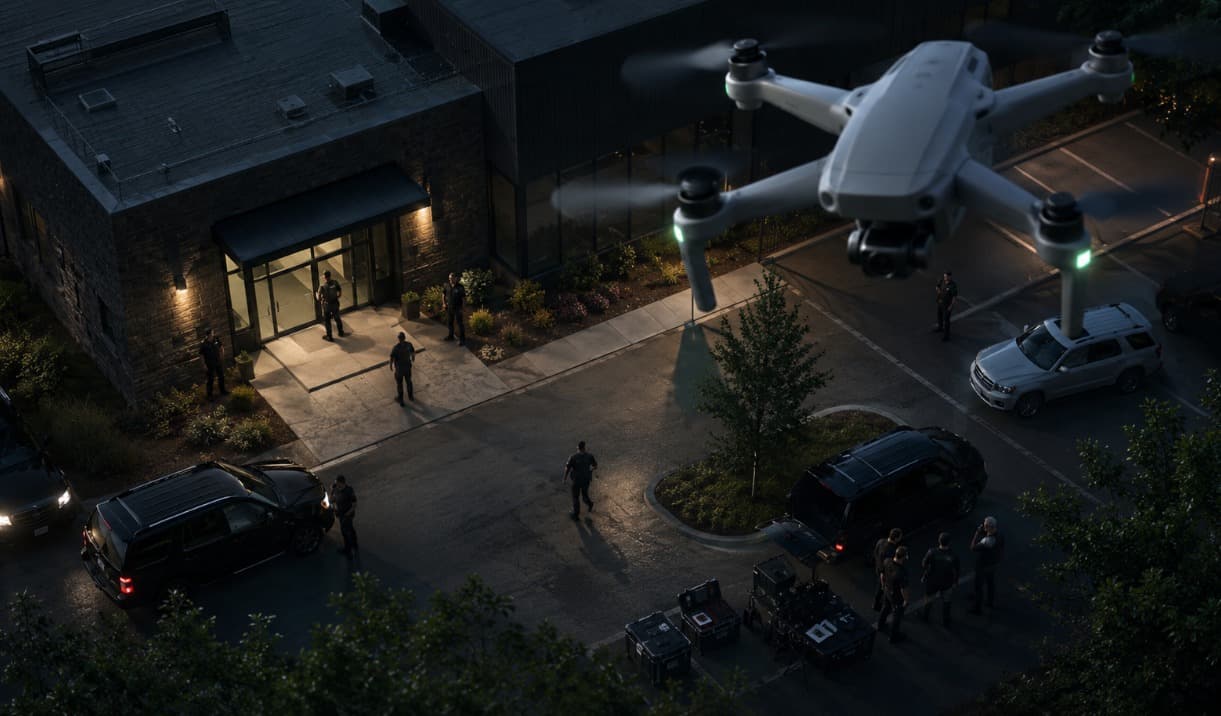
At a mid-sized venue, I watched a security team run a clean operation. Posts assigned, radios working, vehicle staging that made sense from ground level. The lead supervisor moved with confidence. His people knew their areas.
From above, the operation told a different story.
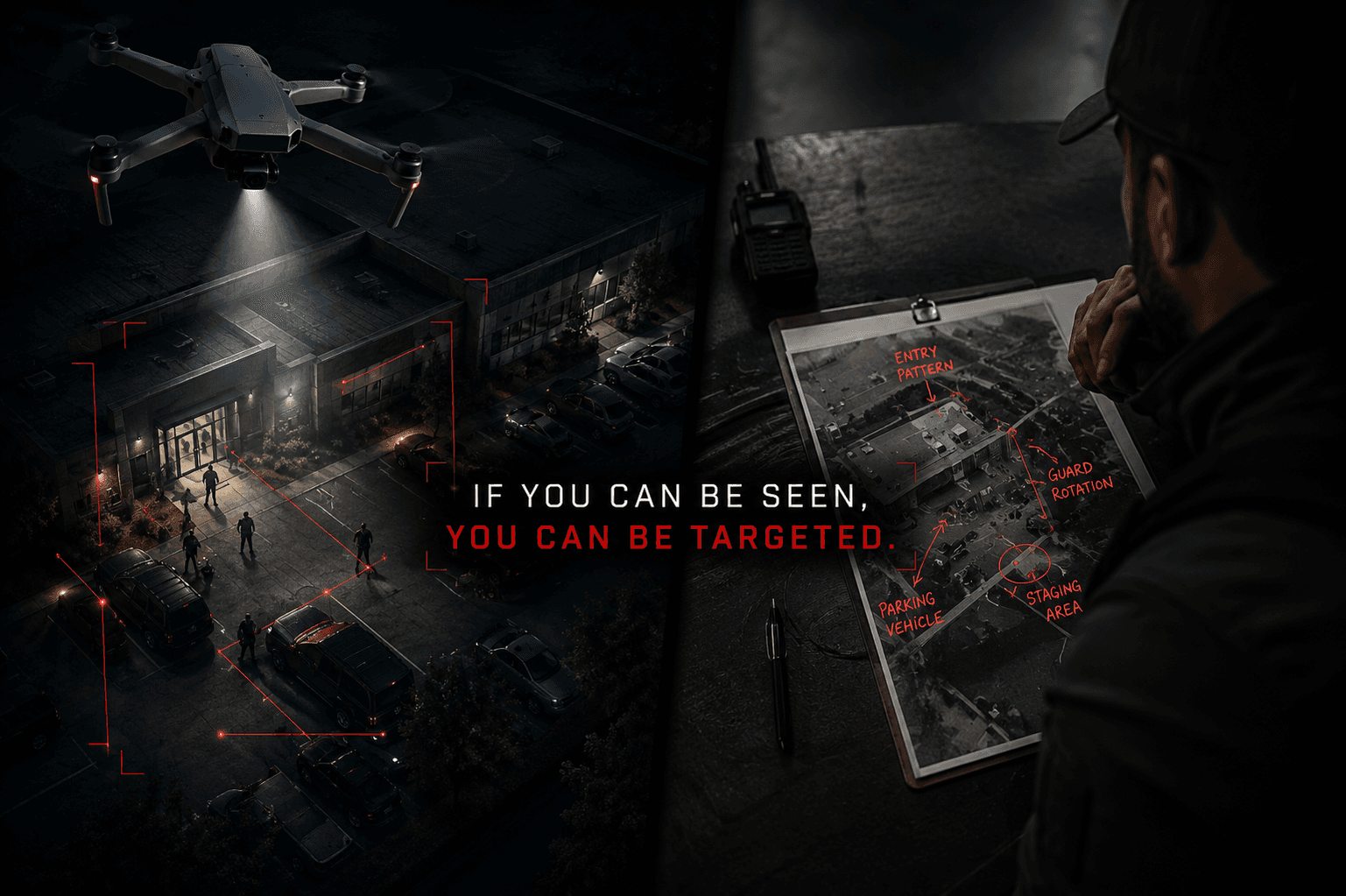
Entry pattern. Guard rotation. Staging area. All of it visible, readable, and consistent enough that someone watching over two or three events could build a reliable map of how that team operated without ever stepping past the perimeter.
Nobody on that team had thought about it. Their training never asked them to.
THE OBSERVATION PROBLEM
Low-light training teaches a specific lesson: light does not only help you see. It also tells others where you are, where you are looking, and where you are about to move. The shooter running a weapon light on continuous illumination believes he is clearing a space. He has announced himself.
Drones create the same problem at a different scale.
A professional responsible for a facility thinks: there is no one nearby. That may be accurate at ground level. It says nothing about what is happening forty feet overhead. A consumer quadcopter with a stabilized camera costs less than many rifle optics. It can observe entry points, staff schedules, guard positions, and response patterns without triggering an alarm or crossing a fence line.
If you can be observed, you can be studied. If you can be studied, patterns can be built.
Surveillance used to require proximity. Someone had to sit in a vehicle, walk a perimeter, find a sightline. That exposure created risk for the watcher. Drones reduce that risk dramatically. They allow observation from outside the perimeter, from above the sightline, for extended periods, without anyone on the ground registering it.
Most security operations have not absorbed that shift.
WHAT UKRAINE IS ACTUALLY TEACHING
The public image of drone warfare is the Predator or the Reaper expensive platforms operated by major military powers from hardened locations. That version exists. It is not the version relevant here.
In Ukraine, small commercial and improvised drones collapsed the distance between observation and action. A position spotted from above got passed to artillery within minutes, followed by an FPV drone carrying a charge, or simply watched long enough to reveal a pattern. Thermal-equipped drones changed nighttime movement. Fighters who trained for concealment from ground-level observers got compromised by cameras they never saw. The side that sees first acts first, and the cost of seeing has dropped faster than most security doctrine has moved.
The point is not that a school, house of worship, range, or private venue is a battlefield. The tools are similar enough. The principle is the same. The adaptation required begins with recognizing the exposure.
Ukraine is no longer just a warning about future warfare. It is a demonstration of what happens when observation becomes cheap, persistent, and hard to escape.
THE OVERHEAD EXPOSURE PROBLEM
Cover and concealment now have a dimension most training does not account for.
A wall that stops ground-level observation does not stop a camera twenty feet overhead. A vehicle that blocks a sightline across a parking lot does not tell you what is visible from above. A dark corner protects against a flashlight. It may offer little against thermal imaging. Dark clothing and deliberate movement are effective against eyes at the same elevation.
The same failure mode applies to the shooter who believes the threat is only in front of him. The threat axis has expanded. Training that does not account for overhead exposure trains people for an incomplete picture.
The goal is not to treat every drone as hostile. The goal is to stop treating overhead observation as irrelevant.
TRAINING AGAINST OBSERVATION
Every technique in low-light work expresses a single operating logic: activate with intent, confirm, deactivate, move. The loop exists because the failure mode is predictable, and because drilling it under the right conditions is the only thing that makes it hold.
Drone awareness requires the same structured discipline. Four changes in how security teams plan and debrief:
Four Questions for the Next Site Walk
1. Can a drone observe the main entrance without being detected?
2. Can it identify where armed personnel stage during an event?
3. Can it watch the same location across multiple days to build a pattern?
4. Where do vehicles park, where does staff cluster, and where are the gaps?
None of this requires counter-drone hardware. It requires teams that have thought through the problem before they are inside it.
WHAT FAILS UNDER STRESS
In training, people solve the problem they rehearsed. If the drill rewards muzzle discipline, they show muzzle discipline. If it rewards clean communication, they communicate. If no drill ever penalized them for being visible from above, overhead exposure stays invisible, until someone else uses it.
The equipment conversation about drones sensor resolution, flight time, jamming frequencies matters at the selection stage. The more urgent question is what breaks when the scenario does not unfold as rehearsed.
What consistently fails is awareness of exposure timing. Security teams drill perimeter checks and response patterns at low arousal, in familiar environments. Under stress, or across a long event day, those patterns compress and become predictable. The vehicle always parks in the same spot. The shift change happens at the same time. The supervisor checks the same corner every rotation.
The skill was built without ever accounting for observation from above. It only holds where it was built.
A CAUTION AGAINST THE WRONG RESPONSE
Not every drone over a parking lot is a threat. Most are not.
Professional security cannot ignore a surveillance platform simply because it is small, common, and familiar. A consumer drone is familiar the way a camera phone is familiar. Familiarity does not limit what it can be used for.
The tools are within reach. Criminal organizations, extremist groups, and hostile actors have shown consistent interest in drone observation precisely because the barrier is low. One drone. One battery. A few minutes of flight. Enough to study a facility, map a guard rotation, or watch how a response team deploys.
The issue is not the drone itself. The issue is the training assumption it exposes.
THE GAP BETWEEN CREDENTIAL AND CAPABILITY
The security supervisor I watched had qualified personnel, clear procedures, and real experience managing events. What he lacked was enough repetition under conditions that forced him to think about overhead exposure. His training never penalized him for being visible from above. So his team had never been asked to care about it.
That gap between credential and capability is where threats find their opening. The credential says the operation was planned. The capability says whether it accounted for every axis the threat can use.
The sky is no longer empty. Every serious security plan must now account for observation from above. The threat picture has changed. Training has to catch up.