
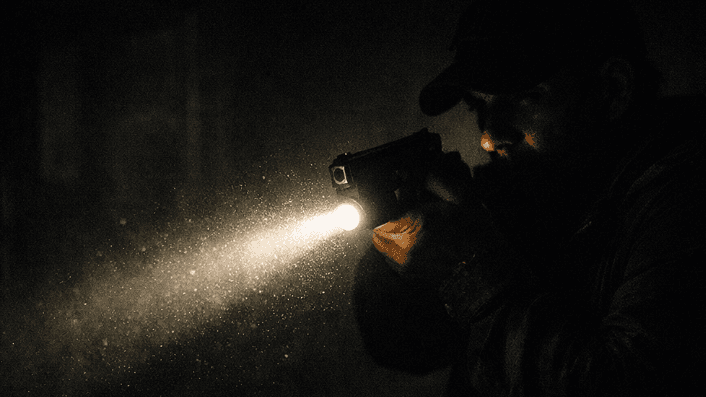
A trainee I worked with not long ago was one of the most technically sound shooters in his group. Clean draws. Tight groups. He checked every box on the range during daylight qualifications. In a low-light scenario—hallway, backlit doorframe, simulated suspect—he engaged a no-shoot. The silhouette looked right. The shape, the movement, the angle. He fired before he confirmed.
He is not an outlier. In my experience running low-light evolutions with law enforcement and armed security personnel, the majority of failures don’t come from poor marksmanship. They come from a fundamental misunderstanding of what light actually is in a tactical environment.
Light is not your ally. It is a liability you activate—deliberately, briefly, and only when the cost of revealing yourself is worth the confirmation you need.
That idea changes everything about how you train. And most armed professionals have never been taught to think about it that way.
The Broadcast Problem
The standard framing in low-light training is: you need light to identify the threat. That’s true. But it’s dangerously incomplete. The moment you activate a light source in a dark environment, you are transmitting your position to anyone in that space who may already be oriented to you.
The failure I see most often: a trainee moves down a corridor with their weapon light running continuously. They believe they are clearing the space. What they have actually done is broadcast their position, their direction, and their pace in real time. They’ve handed the initiative to whoever is waiting.
The trainee with the weapon light on continuous illumination isn’t conducting a search. He’s conducting a broadcast.
Weapon-mounted lights are excellent tools. I carry one. I recommend them. But treating a weapon light like a household flashlight—always on, scanning freely—is a specific and dangerous misuse. When light discipline breaks down under stress, and it always does in the first live scenario if it hasn’t been drilled, that light becomes the problem.
What Confirmation Actually Requires
Why the Brain Lies in Low Light
Every mistaken shooting I’ve studied starts the same way: someone thought they knew what they were looking at. Low light doesn’t cause bad decisions—it accelerates them. The cognitive shortcuts that work at noon in a well-lit environment become lethal assumptions at 2am in a parking structure.
The brain pattern-matches aggressively under stress and reduced visibility. Shape, movement, posture—it assembles these fragments into a picture and declares it sufficient. It often isn’t. The trainee in my opening engaged a no-shoot because his brain supplied the confirmation his eyes hadn’t actually earned. He saw a silhouette. He never confirmed hands. He never confirmed an actual threat indicator. He confirmed what he expected to see.
What You Think You See vs. What You Actually See
Confirmation in low light requires three specific checks, in sequence: hands, then object, then intent. Hands tell you whether a weapon is present. Object tells you what it is. Intent—positioning, movement toward you, verbal behavior—tells you whether the threat is active. Most trainees collapse all three into a single instinctive read. That compression is exactly what training has to interrupt.
The photonic barrier compounds this in ways that aren’t intuitive until you’ve encountered one. When your light source strikes a flat surface at the wrong angle, it creates a wall of reflected glare that obscures the target while partially blinding you. What you see is wash and shadow—not a person, not a weapon, not an answer. Trainees who hit a photonic barrier for the first time in a live scenario either freeze or engage without clarity. Both outcomes can be fatal.
Training the photonic barrier response means building it deliberately into scenarios—forcing trainees to recognize the barrier, reposition to a new angle, and reacquire confirmation before deciding. The skill is not avoiding the problem. The skill is recognizing it instantly and moving without losing situational awareness in the transition.
What most trainees think they saw and what they actually saw are two different things. The gap between them is where people get killed—and where training has to live.
The Light Discipline Loop
After years of running these evolutions, I’ve reduced the operating logic to a single repeatable cycle. It’s not a checklist—it’s a mental model. Every technique in the toolkit is an expression of this loop applied to a specific situation. If the loop isn’t automatic, the techniques are just choreography.
This is also the framework that exposes whether your Three Rules are internalized. If you’re illuminating without intent—comfort, habit, reflex—you’ve already broken the loop before the confirmation step.
Three Rules. No Exceptions.
Rule 1: Light is a signal. Not illumination.
Every activation transmits your position. If you wouldn’t fire a flare to announce your location, don’t run continuous light while moving. Treat activation as a tactical decision, not a comfort reflex.
Rule 2: If you don’t know why you’re activating, you shouldn’t be.
Activation without a confirmation objective is exposure without benefit. You turn the light on to answer a specific question. When the question is answered, the light goes off.
Rule 3: Light on means move. Always.
Stationary and illuminated is the most dangerous position you can occupy. If your light is on and you haven’t moved, you’ve already made your last mistake.
Every technique—Harries, FBI method, weapon-mounted activation—is an expression of these rules applied to a specific situation. Learn the rules first. The techniques follow.
What Actually Fails Under Stress
The equipment conversation in low-light training—lumens versus candela, weapon-mounted versus handheld—matters at the selection stage. The more urgent question is what fails when adrenaline is elevated and the scenario doesn’t unfold the way you rehearsed.
What I consistently see break down is activation timing. Trainees drill draw-and-activate in smooth sequence at low arousal. Under stress, the sequence compresses, reverses, or falls apart entirely. The light comes on too early—before reaching a position of advantage. It stays on when it should go off. The problem is not the equipment. The skill was only built at low arousal, and it only holds there.
Sight systems follow the same pattern. Iron sights are nearly useless in true low-light conditions. Night sights help, but require alignment that takes time many engagements don’t afford. Red dot optics offer a real advantage in low light—the illuminated reticle doesn’t depend on traditional alignment. But I’ve watched officers with red dots perform worse than counterparts using night sights, because they bought the optic and never trained it in the conditions where the advantage is realized.
The optic on your slide is worthless if you’ve never run it in the dark under pressure. Gear doesn’t transfer skill. Reps do.
How We Build the Skill
At Fox2Sierra, low-light training is progressive by design. We start with technique isolation: static position, single light source, instructor-controlled environment. The goal at this stage isn’t tactical proficiency—it’s building the correct neural pathway for activation timing and the confirmation sequence. Harries, FBI method, and weapon-mounted activation are drilled separately before combining. Each technique has a context. Trainees who skip isolation go straight to dynamic scenarios and never build clean fundamentals under pressure.
The core drill for exposing broadcast behavior: search a space with the light on, transition to moving without it, reactivate only at the moment of engagement. The discipline to move in darkness without continuous illumination runs against instinct. That discomfort is the point. The gap between what a trainee can do in a controlled environment and what they’ll actually do when control is gone—that gap is what training closes.
Dry fire extends this outside the range. An unloaded, verified-clear firearm lets any professional build light activation, draw, and reload patterns at home. The professionals who train consistently between formal sessions aren’t marginally better in low-light evolutions. They’re categorically better. The skill either lives in the muscle or it doesn’t.
The Choice You Make Before the Moment
The schools, houses of worship, and community centers we protect aren’t hardened facilities. They’re spaces built for gathering. Lighting is ambient. Corridors are unfamiliar. The scenario an armed volunteer faces there will not look like a daylight range qualification.
The trainee who shot the no-shoot had every credential. What he lacked was enough repetitions under conditions that forced him to run the full loop—activate with intent, confirm all three checks, deactivate, move. He skipped confirmation because his training had never penalized him for skipping it. That gap between credential and capability is where people get hurt.
Run the loop. Know the rules. Build the reps before you need them.
If your light is on and you haven’t moved, you’ve already made your last mistake.Most people won’t get to choose the lighting conditions of the moment that matters. The only choice they get is whether they trained for it.