
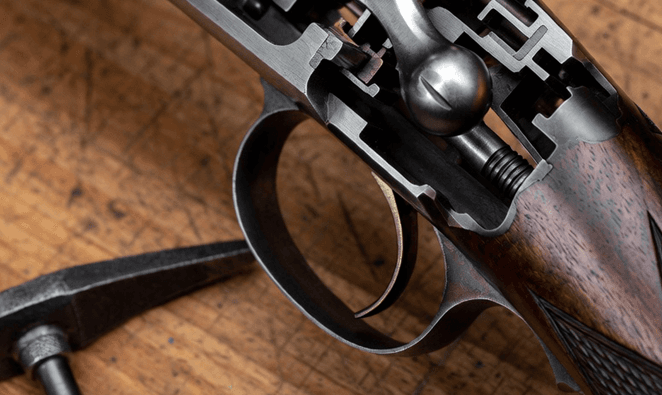
I open the action and already know. Before the customer finishes explaining what they think is wrong, before any test firing, before a single measurement, the condition of the lockwork tells the story. Either this rifle has been left alone, or someone has been inside it. Those are not the same situation, and they do not cost the same to resolve.
I have spent forty years at the bench in Campbell, New York building, restoring, and engraving these rifles. The jobs I describe in most detail are the ones that arrived already damaged by good intentions.
My specialty is the American single-shot rifle: the Sharps 1874, the Remington Hepburn, the Winchester 1885, the Stevens 44 1/2. These actions were designed during a specific window of engineering pressure, when American gunmakers were solving a real problem under real constraint. Black powder to smokeless. Low pressure to high. Generous tolerances to precise ones. Each manufacturer arrived at a different solution, and the solution is embedded in the geometry of the action itself. The safety features are not add-ons. They are built into the lockwork. The strength is not in the steel alone. It is in the design of how the steel is loaded.
That is what most owners do not know. And not knowing it is what creates the problem.
“The thought process behind the action, and all it took to make it durable and strong enough to bridge the gap between black powder and smokeless powder. Most customers have never considered it.”
The customer arrives with a theory. The theory is usually wrong, not because the customer is careless, but because these actions are not common bench work. Most gunsmiths do not see enough of them to recognize what is actually wrong. The customer sees even less. So they describe symptoms — what they noticed, what they tried, what a friend suggested. I listen, and then I open the action and read the actual condition.
When the rifle is clean, the diagnosis and the repair follow a clear line. I explain the design, identify the actual fault, and address it correctly. The customer learns something about the rifle they own. Those jobs move efficiently. The work goes out right, the customer understands what they have, and the rifle does not come back with the same complaint.
The harder case is the rifle that has been worked on before it arrived. Not by a gunsmith. By an owner, or a neighbor, or someone whose confidence exceeded their knowledge. I have found safety notches on hammers that have been altered. Components that have been welded. Modifications carried out by someone who had no business within fifty feet of a welder. The result is not a rifle with a repaired problem. It is a rifle with the original problem still present, plus new damage layered on top of it, and a design that has been compromised at the exact points where it was engineered to hold.
“Taking one of these classics apart and finding the safety notch on the hammer altered, or something welded up by someone that shouldn't have been near a welder, rendering a beautiful classic rifle a pile of scrap metal.”
The cost of that remediation is real, and it falls on the customer. There is no mechanism to absorb it. The prior work has to be undone before the correct work can begin, and undoing bad work on a precision action is not fast. I use modern steel and quality materials. I work to a standard that is as strong or stronger than the original specification. That applies whether the job is a clean build, a restoration, or a repair on a rifle that arrived with someone else's mistakes already inside it. The standard does not change based on what I inherited.
My preparation before any of that work is the same regardless of condition: study the design, understand the function, understand what the original engineers were solving for. Only then do I pick up a tool. It is the same discipline that carries into my engraving work, where a Grand Masters course under Italian masters Giacomo Fausti, Ugo Talenti, and Giovanni Steduto added range to what was already a deep practice. You do not rush the read. That discipline applied consistently over forty years is what separates the work that holds from the work that creates the next repair job downstream.
“If you or your buddy worked it over before you took it to a professional, it will likely cost you more to get everything that was tinkered with replaced or repaired properly.”
The one thing I most want gun owners to understand before they bring a rifle in: if it has already been worked on informally, say so. Not because I will turn the job down, but because knowing the prior history changes the diagnostic sequence and the estimate. A rifle that has not been touched is one kind of job. A rifle that went through someone's kitchen table is another. Both are fixable. They are not the same price.
I am equally direct about the cases that are not fixable for what the owner expects to pay. Not everything can be restored at a cost that makes sense relative to the rifle's value or the owner's budget. That is not a failure of craftsmanship. It is an honest assessment, and it belongs at the start of the conversation, not the end.
The standard does not bend. A professional charges more. You get more. And if the job cannot be done properly and safely, you leave it alone.