
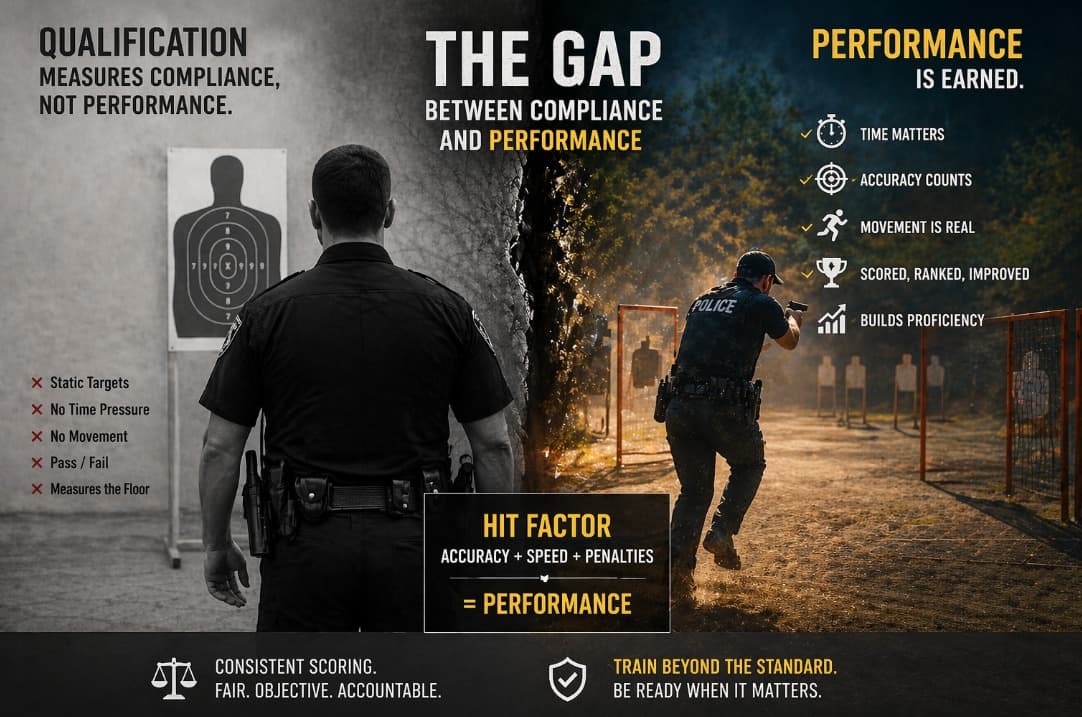
Most law enforcement officers qualify twice a year. They pass, they re-holster, and they don’t pick up a firearm again until the next cycle. The agency marks the box, the officer stays compliant, and everyone moves on.
That system has a name. It’s called a minimum standard. What it is not, and was never designed to be, is a performance standard.
The distinction matters. A qualification course tells you whether an officer can hit a static target. No time pressure. No movement. No stakes. It tells you nothing about what happens when all three of those conditions are present at once, which is the only condition that actually matters.
I’ve been a USPSA competitor and Range Officer long enough to have a different frame for this. USPSA is a sport, and I’m not pretending otherwise. But its scoring system was built around a problem that qualification systems do not solve: how do you measure whether someone can deliver effective fire efficiently, under pressure, without sacrificing one for the other?
The answer is hit factor.
A qualification course tells you whether an officer meets the floor. Hit factor tells you whether they’ve built anything above it.
Hit factor is calculated by taking the points earned on a stage, scored hits minus penalties, and dividing by the total time taken to complete the course of fire (USPSA Rule 9.2.2.1). The competitor with the highest hit factor wins the stage. Everyone else is ranked below them proportionally.
What that formula enforces is a balance that qualification courses ignore. Accuracy without speed produces a low hit factor. Speed without accuracy produces a low hit factor. Penalties for missed targets or procedural errors are calculated into the denominator alongside time. The only way to score well is to put quality hits on the right targets, efficiently, under match pressure.
That is not a sport abstraction. That is a description of what effectiveness with a firearm actually requires.
Qualification measures accuracy alone on a forgiving timeline. Pass or fail. No speed component. No penalty structure that reflects real consequences. It answers one question: can this officer hit a static target? It does not ask whether they can do it fast enough to matter.
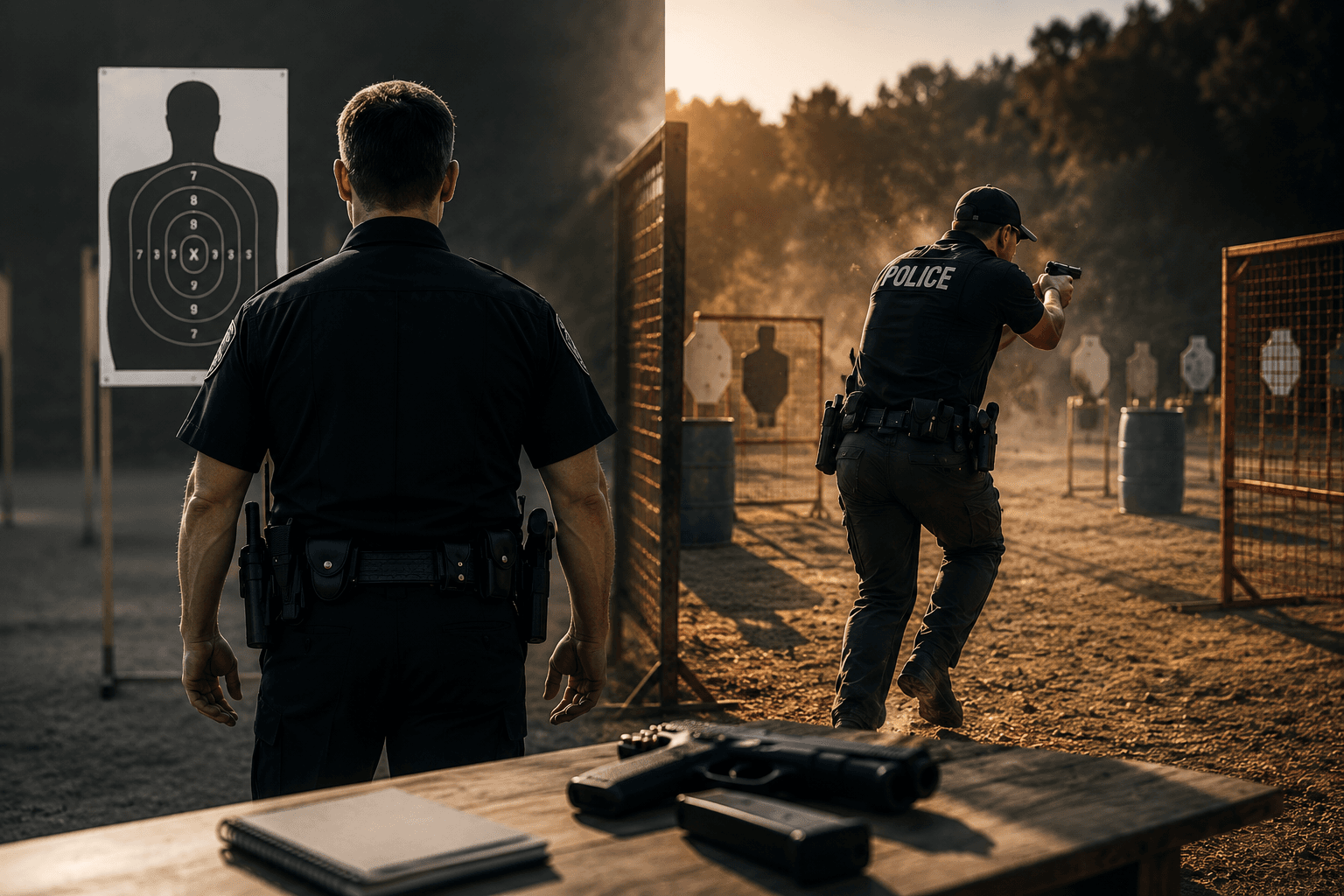
The high-value scoring zones on a USPSA target, the “A” zones, map to the areas that end engagements. Competitors train to those zones because the scoring system rewards it. That matters less as anatomy and more as measurement design: the target reinforces the right habit, and the hit factor formula makes sure that habit gets practiced under time pressure. An officer who has run a few hundred USPSA stages has rehearsed that priority far more than one who qualifies twice a year on a B-27 with no clock running.
What the Scoring System Actually Teaches
There is also the appeals process, which I think teaches something that static qualification never does. When a competitor disputes a target score in USPSA, there is a defined chain: Stage Range Officer, then Chief Range Officer, then Range Master, whose decision is final (Rules 9.6.2 through 9.6.7). Overlays exist to settle ambiguous hits objectively. The system is built around one principle: if a shooter earned a score, they receive it. The accountability is structural, not left to whoever is scoring that day.
Contrast that with a qualification line where two instructors can look at the same target and score it differently, and no formal appeals process exists. If we are serious about measurement, the scoring methodology matters as much as the course of fire. Inconsistent scoring does not just affect individual outcomes. It erodes the integrity of the standard itself.
This is a problem most qualification programs have not solved because they were not designed to solve it. They were designed to produce a documented result. That is a different goal, and it shows in how ambiguous hits get handled: informally, inconsistently, and without a mechanism for the officer to contest the call.
I came to this as a competitor first. Every experienced shooter told me the same thing when I started: do not chase speed. Be safe. Be accurate. The speed develops. I followed that and eventually reached the point where certain stages go into autopilot, accurate hits, fast times, without actively managing either. My classification record reflects it. More to the point, my relationship with the firearm under stress reflects it in ways that a twice-yearly qualification never built.
The implication for agencies and instructors is not that qualification should be abolished. It serves a legal and administrative function that is not going away. The implication is that qualification alone is not a training program. Officers who only qualify are not building proficiency. They are maintaining compliance. Those are different things, and the gap between them has real consequences when a situation demands performance instead of paperwork.
Think about what that gap looks like in practice. An officer who qualifies in March and again in September has fired their duty weapon twice in a year under controlled, low-pressure conditions. They have never been timed in a way that penalizes slowness. They have never been scored in a way that penalizes a miss beyond a marginal point deduction. Their experience with the weapon, every repetition of it, has been optimized for passing a test rather than building a skill. That is not a failure of the individual officer. That is the predictable output of a system designed around documentation rather than development.
Competition, USPSA or otherwise, is not the only way to close that gap. But it is a structured, repeatable environment that enforces the balance qualification ignores: hits and time, together, under pressure, on a regular schedule. For officers willing to show up to a local match, the barrier is lower than most expect. The equipment is usually already on their hip.
Agencies that want officers who perform above the floor should look hard at what they are actually measuring. Qualification tells you who passed. It does not tell you who is ready. That distinction belongs to someone, and right now, most agencies have decided it belongs to no one.