
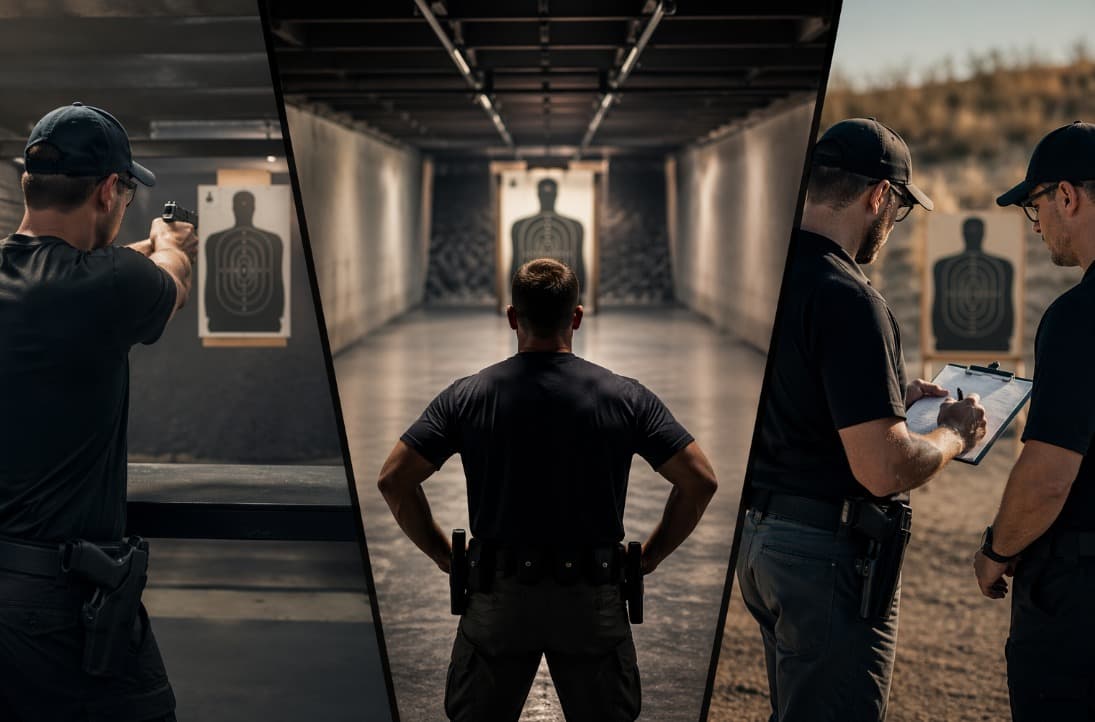
Every year, officers across the country pass their firearms qualification. Every year, some of those same officers arrive at the qualification range not knowing whether they can pass it.
That is not a contradiction. It is a system design failure.
The qualification standard exists for a reason. It sets a floor, a minimum threshold below which an officer should not be carrying a firearm in the line of duty. But a floor is only useful if people know where it is before they step on it. When the qualification is also the first real feedback an officer gets about where their skills actually stand, it stops being a standard and becomes a lottery.
The qual is not supposed to be the discovery. It is supposed to be the confirmation.
That distinction is the core of the problem. And it points directly toward the solution.
The Cycle That Doesn't Close
A veteran LE instructor with nearly two decades of range experience described a pattern that will be familiar to anyone who has administered qualifications at scale. Officers show up unprepared — sometimes never having fired the specific firearm they are attempting to qualify with. When they fail, they don't seek instruction. They re-register. They pay for another attempt at the same result without addressing what produced the first one.
The instructor's observation cuts to the center of it: they don't know what they don't know.
Without a feedback mechanism that makes the gap visible, before the stakes are official, the cycle has no interruption point. The officer who fails three qualifications and the officer who barely passes on the first attempt may have the same underlying problem: they have never trained against the standard in an environment that gave them honest data about their performance.
Re-qualifying without training is not preparation. It is optimism with a fee attached.
The Stress Test Principle
Consider how physical performance is developed in any serious athletic or tactical context. You do not train to the weight you intend to lift. You train above it. A powerlifter preparing for a 200-pound clean does not practice exclusively at 200 pounds. The training load is deliberately set higher — 240, 260 — so that the competition weight feels like a confirmation rather than a test of the unknown.
The same principle applies to firearms training, and its absence explains much of the failure pattern at the qualification line.
Train to 40 pounds when the standard is 20. Even if you only reach 35, you arrive at the standard stronger than someone who trained to exactly 20 — and with a body that knows the difference.
What this requires is a training environment that mirrors the qualification environment exactly — same target, same distances, same scoring logic — but with enough challenge built in that the qual, by the time the officer faces it officially, already feels familiar. The evaluation should be the easiest version of what the officer has already done repeatedly.
When that is the baseline, failing a qualification becomes genuinely surprising rather than statistically predictable.
Three Stakeholders, One Standard
The training-to-qualification gap is not experienced the same way by everyone it affects. Understanding how each stakeholder relates to it is essential to understanding why the problem persists and what conditions would allow it to close.
The Instructor and Range Master
The instructor is currently the single accountability node in the system. They carry the standard, often alone, often against institutional pressure from management that would rather not deal with officers who feel they were treated unfairly.
When an officer fails, the instructor's judgment becomes the thing under dispute. The instructor who holds the line without supporting data is vulnerable. The instructor who can point to a training record showing that the gap was known, visible, and unaddressed is in a fundamentally different position. They are not making a subjective call. They are confirming an objective pattern.
A training environment built on the same scoring logic as the qualification gives instructors the evidence base they are currently expected to operate without.
The Chief and Command Staff
Departmental leadership lives with two distinct risks. The first is the legal and operational risk of officers who are qualified on paper but unprepared in practice. The second is the political risk of a qualification process perceived as punitive or arbitrary.
A stress-test training framework addresses both simultaneously. Officers who train against a higher standard than the qual are more genuinely prepared, not just compliant. And a department that can demonstrate its training environment deliberately exceeds the qualification threshold has a defensible position in any review — legal, administrative, or public.
Qualified and ready are not the same word.
The Officer
The officer who fails a qualification is not always the officer who lacks ability. More often, they are the officer who lacked a private mirror before the public evaluation.
There is a dignity argument here that gets lost in conversations about standards and accountability. An officer who can train against the qualification standard repeatedly — in solo sessions or with a partner functioning as an objective observer — can discover their own gaps on their own terms. They can close those gaps. They can arrive at the official qualification having already passed it, in every practical sense, multiple times.
That is not a lower bar. That is a higher one. The officer who trains this way does not fear the qualification. They confirm it.
What the System Needs
The qualification standard is not the problem. The absence of a structured path to meet it — a path that uses the same environment, same tool, same targets, same scoring, and same objective feedback — but available before the official record, is the problem.
Three training modes serve three different purposes along that path.Training alone builds baseline and allows private calibration. Training with a peer functioning as an objective observer approximates the rigor of instructor oversight without the weight of official evaluation. The official qualification, monitored by the instructor and producing a formal record, becomes the third and final data point in a sequence the officer has already completed.
By the time the qual is official, it should feel like the most familiar version of something the officer has already done.
Each level adds accountability. Each level uses the same environment. The only variable is who is watching and what the record means.
That is not a radical redesign of how qualification works. It is a recognition that the qualification, as currently structured in most departments, asks officers to perform at a standard they have had no structured mechanism for rehearsing. Fixing that is not coddling. It is system design.
The qualification sets the floor. Training determines whether anyone actually lives above it.