
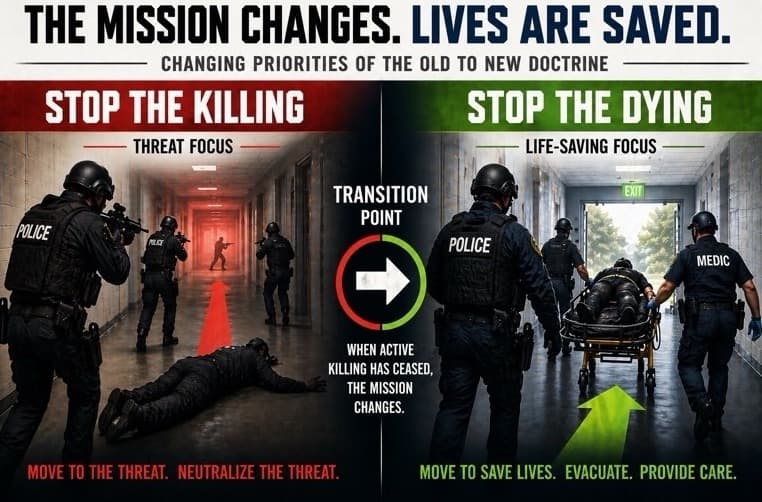
In 2010, the doctrine was clear. While active killing is occurring, bypass the wounded and neutralize the threat. Move fast. Push through. Stop the killing first.
That principle is still correct.
What came after it was the problem.
Once the threat was down, officers were trained to keep clearing. Room to room. Floor to floor. Searching for additional suspects who, in nearly every case, did not exist. Just a trained reflex that said keep going until you are certain.
Certainty has a cost. In these situations, it is paid in minutes. And minutes are paid in lives.
Every minute spent searching for a non-existent secondary suspect is a minute lost for victims who could survive with immediate intervention.
The numbers have been clear for years. Approximately 97.5 percent of active shooter events involve a single assailant. When multiple attackers are present, they are typically co-located, not dispersed. The threat model that justified extended post-threat clearance was built on a scenario that almost never materializes.
The argument for continued clearing is familiar. Complex attacks exist. Mumbai happened. But clearing without stimulus, without gunfire, without new victims, without actionable intelligence, does two things simultaneously. It exposes officers to ambush. And it keeps medical resources out of the building while known casualties bleed.
That is not caution. That is a decision.
The correction is a two-part framework that is now reshaping how departments train and respond. If active killing is ongoing: Stop the Killing. If active killing has ceased: Stop the Dying. Those are not sequential steps in a single process. They are separate missions, and recognizing the transition between them is a command decision that has to be made in real time, under pressure, with imperfect information.
Most commanders have never rehearsed making it.
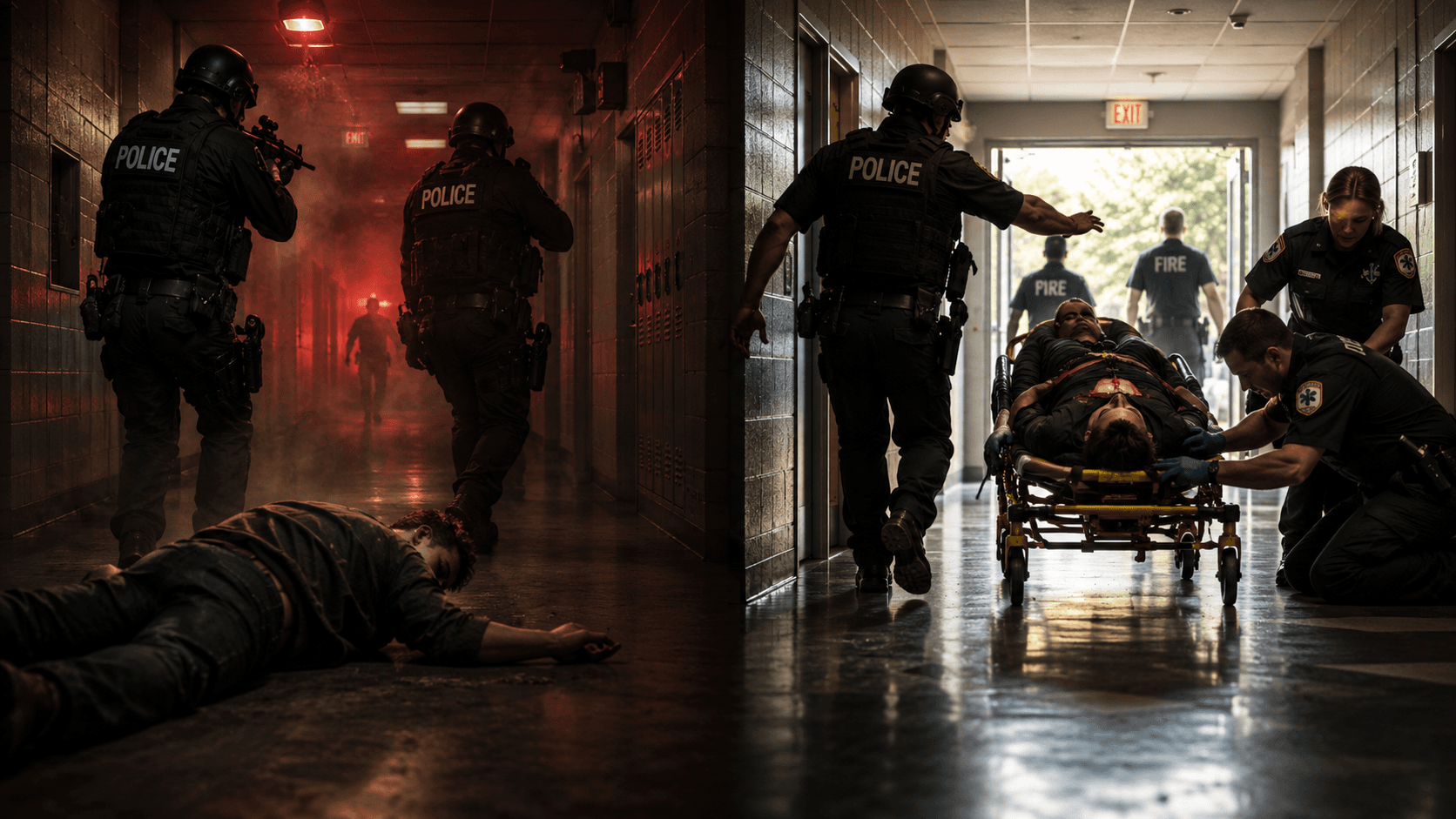
What that decision actually demands is worth naming. The commander has to read an environment that is still chaotic, with incomplete information, potential secondary threats unconfirmed, officers still moving, casualties still down, and make a call that shifts the entire resource posture of the response. Not after the scene is fully controlled. In the transition, while uncertainty is still present. That is not a tactical decision. It is a judgment call built through repetition. The commanders who make it well are the ones who have been put in that moment before, under controlled conditions, and forced to decide.
Recognizing that transition point is what saves lives. It does not happen automatically. It has to be trained.
Here is what the medical reality looks like when that decision is delayed. I am a practicing anesthesiologist. I have worked in major trauma centers. Penetrating trauma is survivable in a window that closes faster than most people understand. Hemorrhage that is controllable with early intervention becomes irreversible shock in minutes. A victim with a compressible wound who receives tourniquet application within the first few minutes has a dramatically different outcome than one who receives it ten minutes later. We are not talking about the difference between fast and slow. We are talking about the difference between alive and not. The difference between a victim who lives and one who does not is not measured by what happens in the OR. It is measured by how long it took a first responder to reach them.
The Rescue Task Force model exists because someone did that math. Law enforcement secures a corridor. Fire and EMS enters the warm zone. Casualties reach care faster. But the RTF model only works if both sides have rehearsed the handoff. Law enforcement has to know when a corridor is secure enough to introduce medical personnel. Fire and EMS has to know how to move and operate in an environment that is not fully cleared. The communication between an interior law enforcement element and an incoming RTF is not instinctive. It is a practiced exchange, with defined language, clear thresholds, and accountability on both sides. The interagency coordination that once felt operationally complex has become standard in departments that have done the work, because every alternative produces worse outcomes.
The problem is that not every department has done the work.
That training is happening. Adoption is not.
There are still departments running the 2010 playbook. Not because they have not heard the argument. Because hearing the argument and embedding it into training culture, standard operating procedures, and interagency rehearsals are different things. Officers who understand the Stop the Killing, Stop the Dying framework conceptually but have never drilled the command transition under stress will revert when the stakes are real. That is not a character failure. That is how training works.
The doctrine changed. Whether your department's training culture changed with it is a question worth asking out loud.
The work now is not persuasion. The case has been made. The work is rehearsal, measurement, and accountability. Running exercises where commanders make the Stop the Dying call under pressure with imperfect information. Building unified command handoffs between law enforcement, fire, and EMS until the communication is automatic. Putting officers in scenarios where the threat is neutralized, the clock is running, and someone has to say 'Stop the Dying' and act on it. Creating a feedback loop that tells you whether the doctrine transferred, not just whether the class was attended.
The transition point between Stop the Killing and Stop the Dying is the most consequential decision in an active shooter response. Right now, in too many departments, it is also the least rehearsed one.
That is the gap. It can be closed. But only if the command decision is treated as a skill, not a concept.