
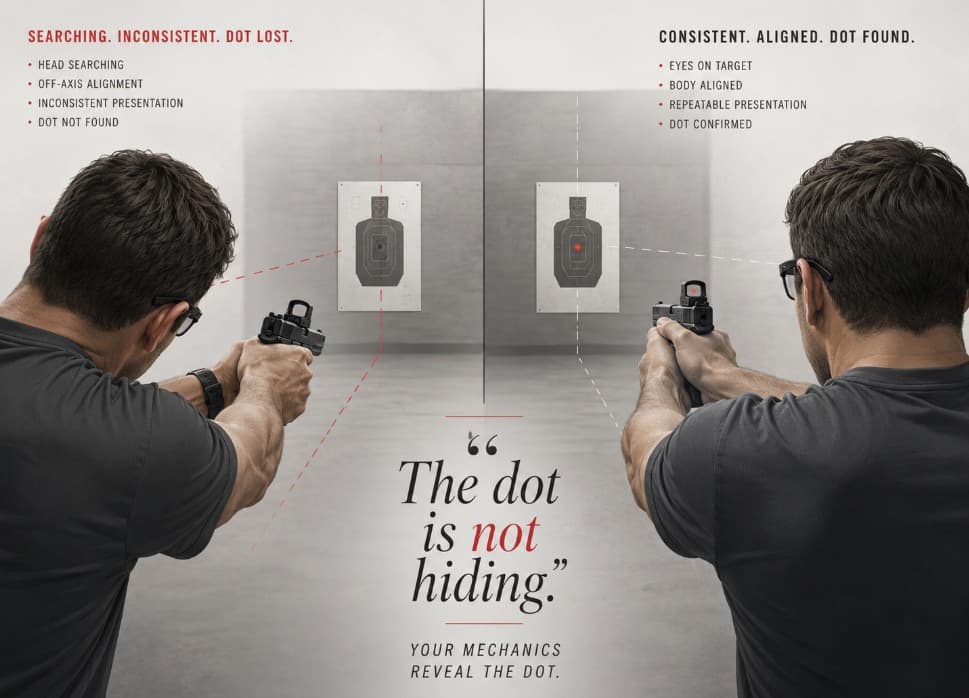
The student had both hands on the pistol, both eyes open, and a red dot mounted on the slide. He had already decided he was bad with dots before the first magazine was empty. You could see it in how he paused before each draw, like he was bracing for the dot to be somewhere wrong again. Every time the gun came up, his head moved first, then the muzzle, then the wrists. He was not aiming the gun. He was looking for the dot.
The dot was not the problem
The dot is not hiding. The gun is not arriving in the same place twice.
Pistol-mounted red dots are everywhere now. The gun came with one, or someone at a gun store recommended the upgrade, or the shooter saw enough experienced people running dots that they assumed the optic would close the gap. Then they show up with a sight that may not be mounted correctly, may not be zeroed, and may not be understood at all. They fish. They move the gun around, shift the head, change position. If the optic is mounted correctly and zeroed, this isn’t an optic problem.
It is a body problem.
THE BODY ALREADY KNOWS WHERE TO POINT
Before any shooter worries about a dot, or even worries much about iron sights, there is something more basic to establish: the firearm should arrive where the body is already pointed. We learn to point before we can read. Someone asks you to indicate an object across a room and your hand goes there without instruction. Your eyes find it, your body aligns, your arm follows. Shooting is more controlled than pointing, more accountable, and carries consequences pointing does not. But the body already understands the first part. Most instructors skip past it without ever building it.
I have students focus on the target before they think about the sights. Extend the gun naturally and see how close you can get before precision aiming enters the equation. The goal is not to bypass the sights. The goal is to show the shooter that the gun can arrive in a useful place through body mechanics alone. Confidence first. Refinement second.
This is often missed by most firearms instructors. There is too much emphasis on breathing, stance, trigger press, and finger placement. The process is often over-complicated, and the student becomes a checklist instead of a shooter. Realistically one can shoot sitting or standing, with the tip of the pad or first index joint of their finger, and still learn to be consistent and accurate.
MISDIAGNOSED AS A TRIGGER PROBLEM
After every round, the student wants to see where it went. They move the head, chase the hole, adjust the aim point, and fire again. The gun drops, or drifts to even slightly to one side, the sight picture changes and sometimes even the grip as well. This may be a subconscious micro change by the shooter, but it will affect grouping. The shooter is interrupting what should be a consistent system on every single shot.
Sometimes it is anticipation. Sometimes it is grip. Often, the shooter is simply trying to watch the bullet. They are changing the relationship between their eyes, the gun, and the target on every shot.
No amount of trigger coaching fixes that.
RED DOTS DID NOT CREATE THE PRESENTATION PROBLEM. THEY REVEALED IT
On iron sights, a shooter can compensate for an inconsistent index with subconscious head movement and still find a rough sight picture, but this will slow the time for rounds on target. Assuming the optic is mounted securely and zeroed, the bullet should go where the dot does. It appears, or it does not. Every shooter who struggles to find the dot is showing you something that was already broken.
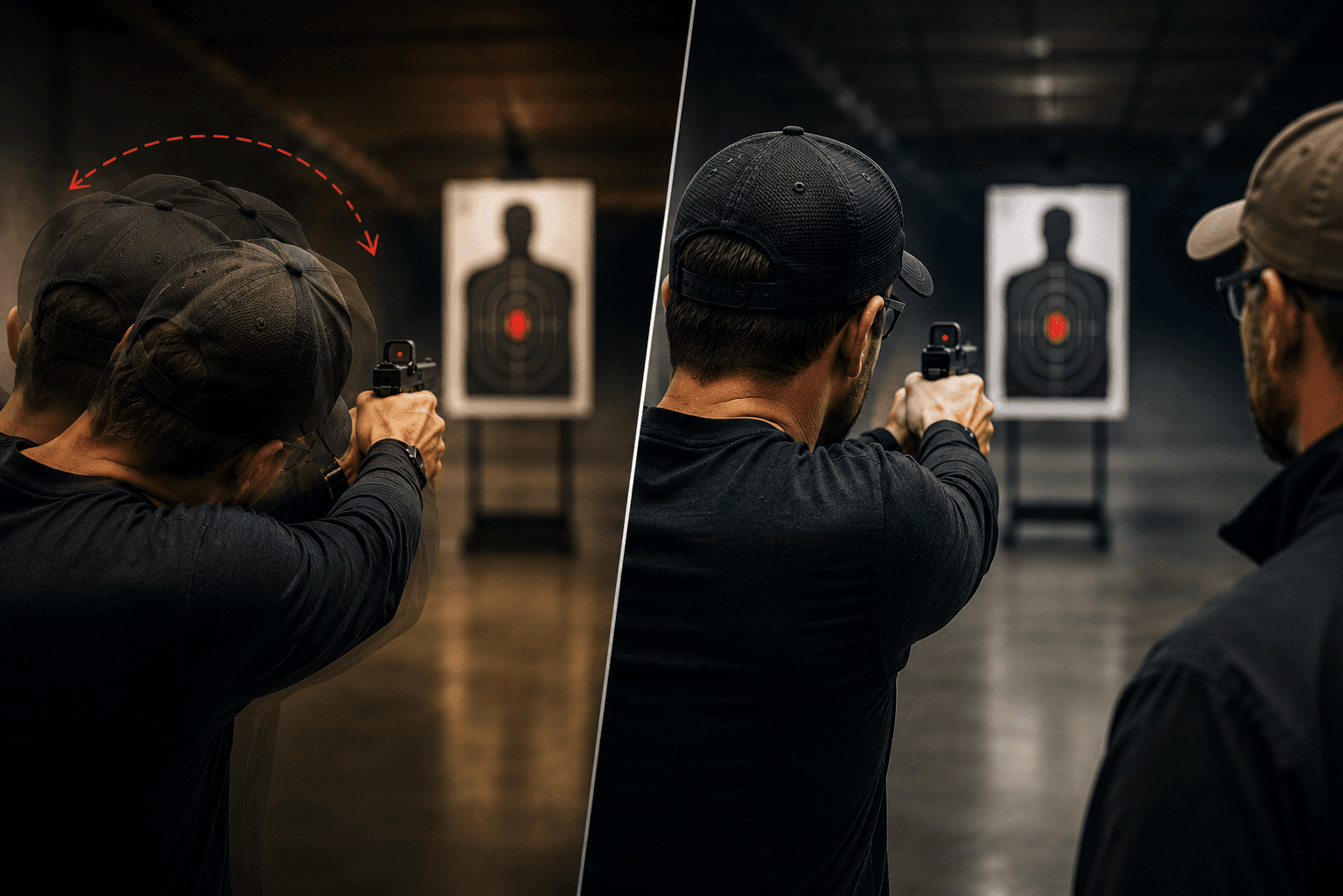
The dot is not just an optic. Used correctly, it is a diagnostic instrument.
NATURAL POINT OF AIM STOPS THE INTERRUPTION
When a shooter targets first, presents naturally, and trusts the body's alignment before confirming with the sights, the group comes in. Then you add the sights or the dot for more precise shooting. The sequence becomes: target focus, presentation, find the sights, confirm, press. A student can follow that. A student cannot follow seven simultaneous corrections from a static firing line.
Once the presentation is consistent, the dot appears. Not because the optic changed, but because the gun is arriving in the same place. The shooter stops searching. The confidence improvement is real because it is grounded in something the body now understands.
THIS MATTERS MORE UNDER STRESS, NOT LESS
In a defensive situation, the shooter is not thinking about perfect breathing. They need a body position that already makes sense under pressure. Stand like someone is about to throw a basketball at you. Relaxed, balanced, ready to move. Not locked into a range stance. A ready human posture that can adapt to a push, a draw, a repositioning.
DIAGNOSIS IS NOT LEARNED FROM A CERTIFICATE ALONE
Static range fundamentals have value. They are not the whole subject
A short course can teach terminology, safety protocol, and class structure. It cannot give an instructor enough range-side repetitions to see the difference between a trigger problem, a presentation problem, and a student who is simply chasing the last hole in the paper. That gap closes over time, or it does not close at all.
The other side of that: experience from ten years ago is not a permanent advantage. Red dots became standard handgun configuration before most instructor curricula caught up. The optic is on the gun. The lesson plan is still iron-sight era. That gap is not the shooter's fault.
The job is not to protect what you learned. The job is to make the student better.
MONDAY MORNING
Before correcting the trigger. Before explaining the dot. Before building another static stance. Watch where the gun arrives when the student looks at the target and extends naturally. If it does not arrive in the same place twice, the next lesson is not marksmanship.
It is presentation. A great tool even before going to the range can be using a dry fire laser training aid. I often have my students focus on something as small as a light switch and present and fire without use of any sighting system. Often the laser-aid is a self-correcting tool and students suddenly can hit the intended “target” as the concept and body mechanics come together for them.
The sights can only confirm what the body can repeat.