
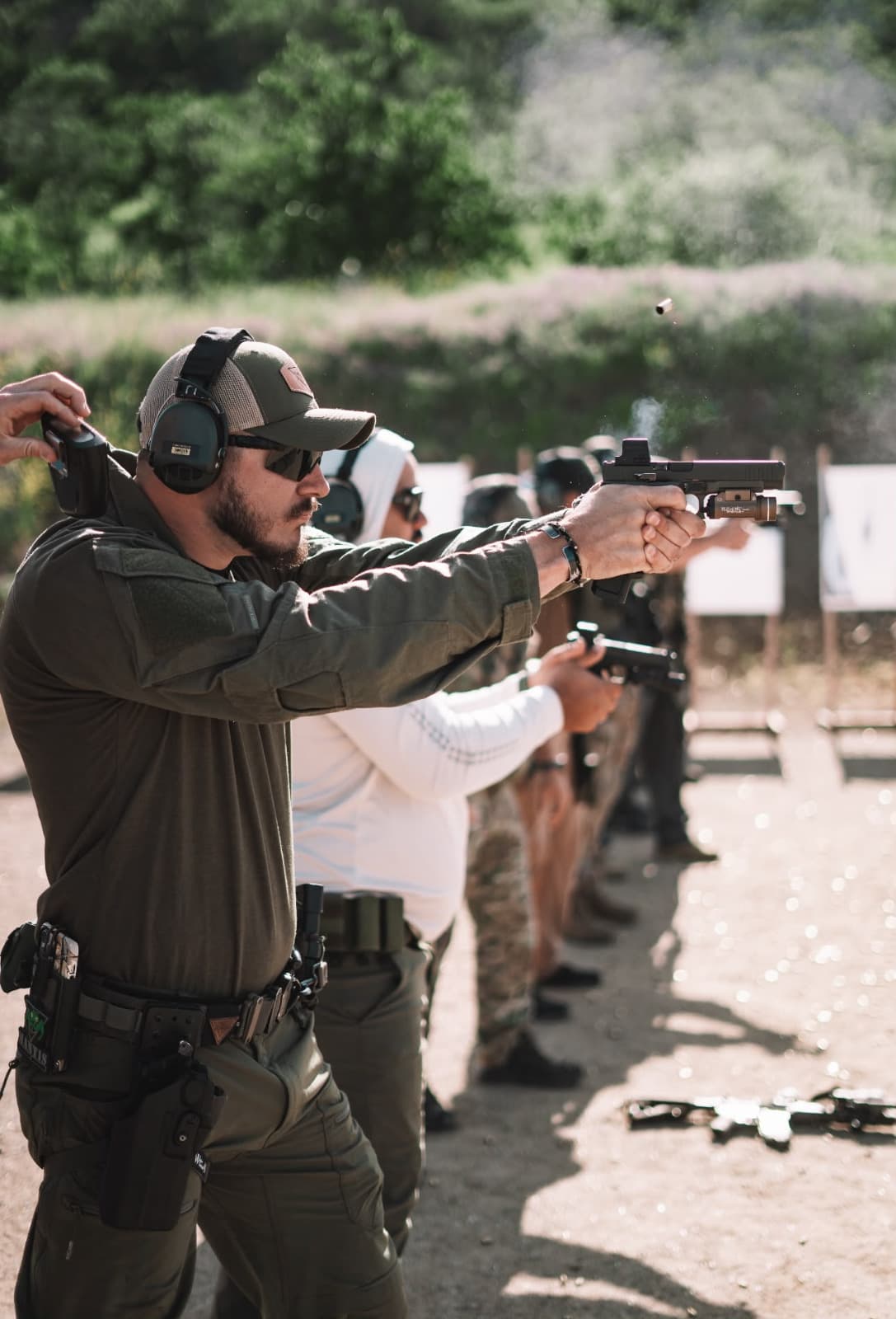
I walked into my first major instructor event expecting to pick up new drills. I left with something I did not budget for: friendships and mentors I still call on. Instructors like Rick Crawley of Achilles Heel Tactical, Billy Barton of SpecTrain, and the team at Khimaira treated a small veteran-owned company like ours as peers from day one. No gatekeeping. No sizing us up as the new guys in the room.
That week reset what I thought the job was. The best instructors do not just teach marksmanship. They build people. Our mission at Mantis Strategic Defense stopped being about running a clean class schedule. It became about handing every student the same environment those men handed us: professionalism, humility, and a relationship that outlasts the range day.
We budget to attend that event every year for the education. We keep going back for the people. That distinction runs through everything else in how I coach.
READ THE EYES, NOT THE GRIP
Many instructors watch the gun. I watch the student's eyes before the shot ever breaks. Anticipation shows up there. So does uncertainty, and so does information overload, well before a bad hit lands on the target. A student trying hard to perform stops processing what he is actually feeling, and the gun just reports the damage after the fact.
A low-left hit is often blamed on trigger control. I had a student who three other instructors had already worked on. New grip. New trigger finger placement. Nothing moved. I sat back for a few strings and watched him instead of the target. He was shifting his eyes off the sight just before the break, because he wanted to see the hit land. His firing hand tightened the second his focus left the front sight.
The target tells you what happened. The shooter tells you why it happened.
We never touched his grip. We worked visual discipline, calling shots before he looked for them, and accepting recoil instead of predicting it. His groups centered inside a few magazines. If you only coach the symptom on the paper, you miss the reason it printed that way.
TAKE THE GUN OFF THE TABLE
Telling a student to relax, or to just do what I do, fixes nothing. It names the problem without finding it, and it usually leaves a frustrated shooter standing at the line. At Mantis we run without ego. Where a student has been does not interest us. Where he is going does.
The real breakthrough with that student came from pulling live fire off the table entirely. Dry-fire reps, laser training pistols, Grip Keeper tools, structured draw strokes. Each one isolated a single skill with no recoil and no timer masking what was actually broken. We stopped telling him to go faster. Once his grip was consistent, the draw repeated itself, the sight arrived where it belonged, and trigger control caught up on its own. Once the mechanics became consistent, speed followed on its own.
Confidence is built through competence, not talked into someone.
Dry fire strips out noise and time pressure, and that gives the brain room to lay down a correct pathway instead of grinding a bad one deeper. Laser feedback let him self-correct instead of waiting on me to catch every rep. Live fire, when we finally returned to it, just confirmed what dry practice had already built.
THE RESULT WAS NEVER THE GROUP SIZE
The tightest groups were not the headline. The headline was a student who stopped doubting himself. Once we quit trying to force him into a template and coached to how he actually learned, the mechanics followed. He went on to an Executive Protection course in Colorado and finished among the top shooters in the class. That belongs to him, not to me. My job was to clear what was in his way and hand him the tools.
I see the same pattern among military personnel, law-enforcement officers, and competitive shooters. A passing qualification score is often mistaken for mastery. It is a floor, not a finish line. The instructors who keep improving are the ones who chase discomfort on purpose, who sign up for classes where they are not the best shooter in the room, and who take correction without flinching. Ego can keep instructors circling their own comfort zones.
Great instructors don't reach for one answer. They carry several.
The misdiagnosis I run into most is instructors fixing the gun instead of the shooter. New optic, new trigger, new stance, before anyone has asked how the student actually processes information. Students do the same thing to themselves, buying gear to solve what is a mindset or a visual processing problem. Many of the issues I see trace back to confidence, visual habits, or an inefficient movement pattern rather than a lack of effort.
THREE PHASES, ONE RULE
If a new instructor takes one thing from me, it is this: going back to fundamentals is never a step backward. I run students through three phases. Programming Mode is slow, deliberate, and built for correct mechanics before speed is ever allowed near the equation. Exploration Mode is where missing is permitted and even expected, because a miss under pressure is feedback, not failure. Execution Mode only opens once the student understands the limits of their own control. By then performance is not a gamble. It is a withdrawal from work already banked.
Do not rush performance. Build the process first, and performance takes care of itself.
WHAT I WON'T TAKE CREDIT FOR
I do not credit my military service, my time in law enforcement, or federal security work for making me the instructor I am. Those years gave me opportunities. They did not give me my purpose. That came from my church and from men who invested in me long before I ever ran a class.
One of them told me something I still carry onto every range: do not look into someone else's cup to make sure you have more. Look into their cup to make sure they have enough. This industry has plenty of people chasing the first version of that. It is short on people doing the second.
Every instructor eventually decides whether to build shooters who copy them or shooters who outgrow them. I want mine walking out taller than I am. That is a choice.