
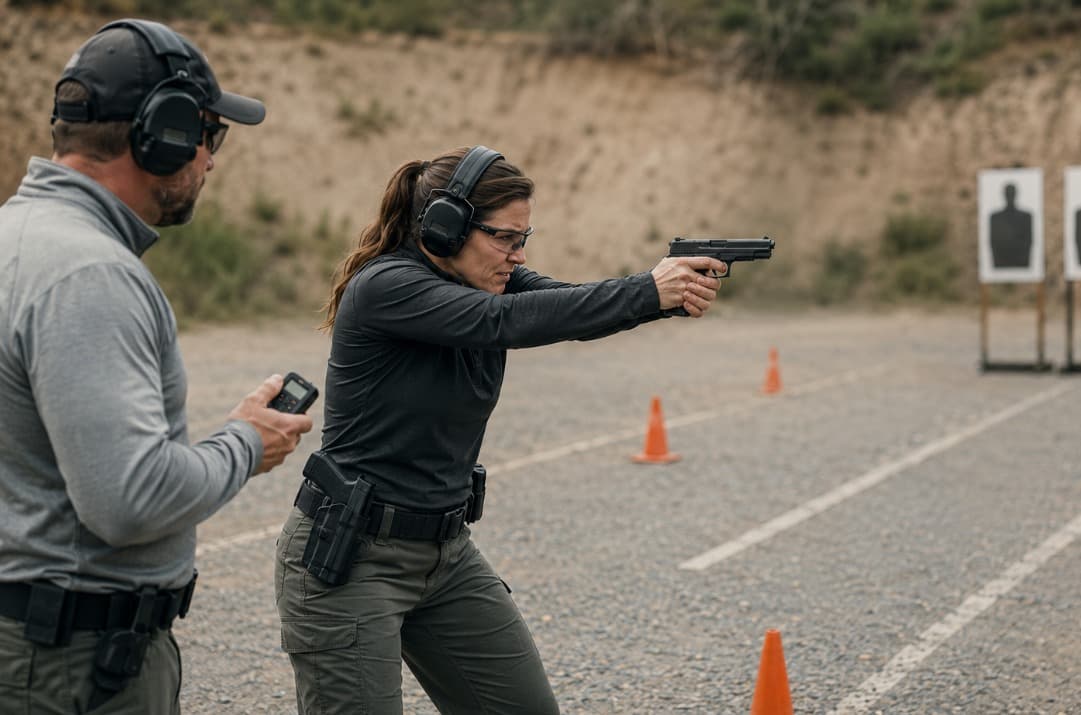
He walked onto the range with the right gear. Quality pistol, solid holster. His attitude was good. On paper, he was prepared.
The timer came out. Movement got added. Decision-making entered the drill.
His draw slowed. Tunnel vision set in. Misses started appearing. Frustration built fast.
We stopped. I asked what was happening. He said: “I thought I was ready. I shoot all the time.”
He was right about one thing. He could shoot. Static lane marksmanship was solid. What he couldn’t do was perform under pressure, with movement, with a decision attached.
Once the timer started, his goal changed. Not executing the shot. Not failing. “Don’t miss. Go faster.” When attention shifts there, visual processing goes first. The gun outruns the eyes.
His brain had shifted from executing a skill to managing failure. Those are not the same state, and no grip correction touches it.
Forget the timer. Your job isn’t to shoot fast. Your job is to see what you need to see.
What Most Instructors Miss
When a student shoots low-left, misses transitions, or falls apart on the timer, the standard response is mechanical. Fix the grip. Correct the trigger. Run more reps.
Sometimes that’s right.
Most of the time, mechanics are only breaking down because something upstream already failed. The student fired before confirming visual information. The trigger became the symptom. Instructors corrected the symptom and left the cause alone.
I’ve watched instructors spend twenty minutes adjusting a student’s foot placement while the student was mentally saturated. Nobody asked why performance dropped when the timer appeared. The feet were not the problem.
Cognitive overload isn’t visible the way grip is visible. You can’t see it in a photograph. You see it in eyes, pace, breathing, hesitation, self-talk, scan behavior. Most instructors are watching the gun. The answer is often in the person.
There’s a language version of this too. Instructors tell a student to stop anticipating. The student doesn’t understand what that means mechanically, so the brain builds a loop around avoiding it. Now they’re generating exactly the pressure they’re trying to escape. The word manufactured the problem. The correction made it worse.
One more version: a student has one bad run and shuts down. The instructor calls it a technique problem. Often the student stopped seeing and started trying. The skill didn’t disappear. Attention shifted. Those don’t get fixed the same way.
More pressure doesn’t fix overload. It confirms it.
What Fixed It
I pulled speed away completely.
One round only. From the holster. No par time. The student had to call the shot before lowering the gun, verbally, where the hit should be, before looking at the target.
The sequence changed from: draw, shoot fast, assess. To: draw, confirm visual information, one accurate hit, reset.
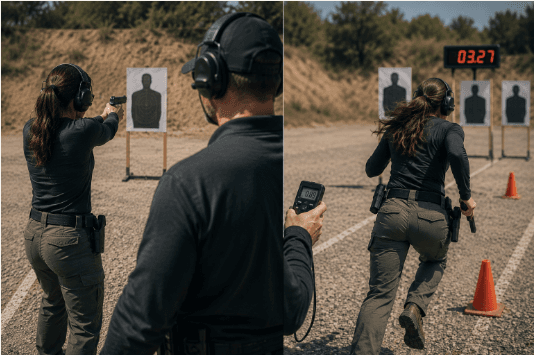
The first thing that changed wasn’t the target. It was his body. Shoulders dropped. Breathing normalized. He stopped rushing the holster.
Accuracy tightened. The wild good-run, bad-run cycle disappeared. Reps started looking the same. Cadence came back, tied to what he saw, not to urgency. He stopped apologizing after runs. He started calling shots correctly.
Fewer decisions meant the brain could process what the eyes were seeing. Controlled reps replaced the spiral. Confidence didn’t come from encouragement. It came from reps that worked.
Speed came back on its own. Once processing recovered, velocity followed. By end of session it looked like a different shooter. Not because we taught a new technique. Because we removed what was blocking the one he already had.
A lot of instructors skip this step and add pressure instead. Timer goes shorter. Targets multiply. Movement gets stacked. The student who was already overloaded gets more to carry. Speed numbers improve on paper. Ask him to call the shot? Still can’t do it.
Speed without confirmation is a faster miss.
The Pattern at Every Level
New shooters are overwhelmed by safety, manipulation, and recoil running simultaneously. Everything feels fast because it is all new at once. Instructors expect this and account for it.
Intermediate shooters are where I see the most misdiagnosis. They look fine in a static lane. Add a timer, movement, or a decision and performance drops hard. Instructors read it as a skill problem. It’s a processing problem. Nobody catches it because the lane never showed it.
Advanced shooters and law enforcement run the same pattern. Mechanics are solid. Then accountability enters, or compressed time, or a live scenario. Visual patience goes first. I’ve seen officers with years on the job freeze in force-on-force because the scenario added a bystander, something they didn’t expect. The skill was there. The capacity to use it wasn’t.
Same misdiagnosis across all three levels. Instructor sees the visible output. Labels it a shooting problem. Applies a mechanical correction. Output shifts briefly. Cause stays.
The point is not to ignore mechanics. The point is to ask why the mechanics changed when pressure appeared.
Students who shoot every weekend still carry significant gaps. Static repetition doesn’t expose deficiencies. It conceals them. Low light, unknown drills, movement, accountability under time: those conditions surface what static lanes hide. A student with a thousand rounds downrange in a lane is not the same as a student with a hundred rounds under real variables.
Static repetition builds confidence. It doesn’t always build capability.
What We’re Actually Teaching
We’re not teaching firearms. The firearm is the tool. We’re teaching people.
Every student walks onto the line carrying something different. Different experience, different confidence, different fears. Some need correction. Some need less from you, not more.
Don’t rush to dump information. Overload kills performance before real conditions ever show up. Deliver in pieces. Teach what they can process.
I see this with students who chase speed standards. They’ve memorized a par time from a YouTube video. They come in trying to hit a number before they can reliably confirm the front sight under any pressure. The number becomes the goal. What they can actually do in a real moment stops mattering to them. The lane never surfaces that problem. Neither does the score sheet.
A clean lane result tells you what a student can do under known conditions. It doesn’t tell you what that student can access when time, uncertainty, and consequence enter the drill.
The question was never only whether they passed the course.
The question is what happens when the timer is real.