
The numbers suggest a golden age. With over 400 million firearms in civilian hands and a generation of new owners who entered the market after 2020, the ’Gunsmith Wanted’ sign should be the most common fixture in the industry. The pandemic-era buying surge was real and unprecedented in scale, and it did not reverse. Background check volumes normalized, but the installed base of guns in American homes did not shrink. By every measure of inventory, the trade should be flush.
Instead, a persistent complaint runs through every shop conversation and trade forum: the craft is disappearing. Experienced smiths are retiring with no one to hand the bench to. Young people are not entering. Good work cannot find good hands.
This is a paradox, but it is not a mystery. The contradiction dissolves the moment you separate the volume of guns from the economics of the craft.
The 400-million figure is a stock, not a flow. Most of those guns sit in safes or see daylight once a year. They are not generating work.
The post-2020 surge created something the trade did not fully anticipate: a massive new owner class with almost no relationship to traditional gunsmithing. These buyers purchased modern polymer-framed pistols and AR-pattern rifles, platforms engineered from the ground up for reliability without professional intervention. A pistol that runs 50,000 rounds on a twelve-dollar recoil spring does not need a gunsmith. It needs an owner who can read a manual. The guns that flooded the market in 2020 and 2021 were not the guns that build service relationships. They were appliances.
The modularity of the AR platform deepened the problem. What began as a military logistics solution became, in the civilian market, a vast permission structure for self-service. Barrels, handguards, triggers, bolts: all of it ships flat-rate and drops in with a punch set and a torque wrench. The middle tier of the trade, the general repair and assembly work that used to keep the lights on, moved to the consumer’s workbench.
But the prosumer has a ceiling. He can assemble. He cannot always diagnose. He can install a match trigger but cannot tell you why his rifle prints three inches high at 100 yards when the zero was perfect last month. He can swap barrels but cannot tell you whether the new one is properly headspaced. The Lego generation is not replacing the gunsmith. It is creating a new and specific demand for expertise that goes beyond parts-swapping. The specialist is busier than ever. The problem is finding him.
The retail model that once cushioned this problem is gone. For decades, the neighborhood gunsmith survived as a retailer first. New gun sales at a modest margin cross-subsidized the labor-heavy repair bench. When national chains moved at pricing that left no room for the local shop, that subsidy disappeared. What remained was a business built on craft labor alone, carrying overhead that retail margins used to absorb and regulatory burdens that have only grown.
The crisis is not a lack of work. It is a routing failure. The right job cannot find the right hands.
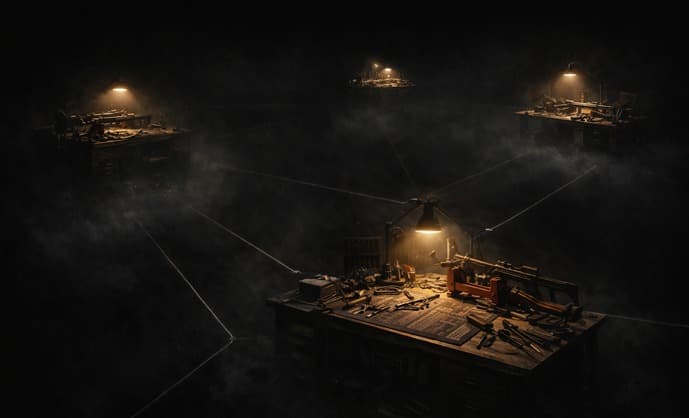
Consider what happens when a customer needs a precision barrel fitting. His local shop does volume work and has no interest in a job that will tie up the bench for two days. The shop cannot point him to a verified specialist two states over because no reliable mechanism exists to do that. The customer searches online, finds nothing trustworthy, and either ships the gun blind to someone on a forum or gives up entirely. The specialist with the six-month backlog never hears about the job. The work evaporates.
This is not an isolated transaction. It is the structural failure of the trade repeating thousands of times a week. Work is trapped in geographic silos. A shop overwhelmed with requests it cannot fulfill has no professional channel to redirect that work to a capable peer. The industry has not built the infrastructure to organize its own capability.
The barrier is not only willingness. Interstate transfer of a firearm between licensed dealers carries its own compliance weight: logging requirements, transfer documentation, questions of liability while the gun is in transit or on a second shop’s bench. Any serious routing solution has to be built around that reality, not despite it. The shops that figure this out first will not just survive the bifurcation. They will own the referral economy the trade has never had.
The craft knowledge of the retiring generation is one of the most valuable and perishable assets in the American firearms industry.
The bifurcation is already visible to anyone paying attention. The generalist who fixes everything is a vanishing breed. The specialist, the engraver with an eighteen-month wait, the NFA-certified machinist turning away work, the accuracy builder whose name travels by word of mouth, is not struggling. He is overwhelmed. The trade is not dying at the high end. It is dying in the middle, and the high end cannot absorb the gap because no one is directing traffic.
Underneath that is a knowledge transfer problem with a hard deadline. The retiring generation carries craft knowledge that is not written down, not credentialed, and not being systematically passed on. A smith working alone at capacity has no room to train someone at reduced productivity for two years. The knowledge is not being lost because no one values it. It is being lost because the structure that would transmit it does not exist.
Medicine solved a version of this problem decades ago. A general practitioner does not attempt every procedure. He refers. The referral network is not informal. It is structured by specialty, credentialed, and trusted by the patient because the system behind it is transparent. The firearms trade has no equivalent. There is no professional layer between ’my local shop’ and ’someone I found on the internet.’ That gap is where work disappears.
What the trade needs is not a directory. Directories exist and they do not solve it. What it needs is a verified professional network with categorized specializations, FFL-confirmed identities, and a mechanism for moving work between nodes with the compliance infrastructure already built in. Think of it as the referral layer the trade has never had: a general practitioner model for gunsmithing, where the smith who cannot do the job knows exactly who can, and the handoff is professional rather than accidental.
The demand is real. The expertise exists. What is missing is the infrastructure to connect them. The future gunsmith is not a generalist in a strip mall waiting for foot traffic to return. He is a node in a network, findable, verified, and reachable by the customer who needs exactly what he does. The shops that understand this first will not merely survive what is coming. They will define what the trade becomes.