
There is not always a clear moment when a student becomes competent.
There may be no certificate, no perfect target, and no instructor standing beside them saying, now you know what you're doing.
Sometimes the moment arrives unexpectedly. For me, it happened on the range about six months ago.
A member of the A Girl & A Gun Buxmont Chapter experienced a stovepipe malfunction with her pistol. She called for me, handed me the firearm, and looked to me for help.
Suddenly, I was the person showing someone else how to clear the malfunction.
That moment stayed with me because clearing my own malfunctions had not come easily. I made it a goal for myself in 2024, to actually get good at it instead of just getting by. Then, six months ago, someone else needed precisely that skill from me.
Then another shooter looked at me as the person who knew what to do.
Sometimes competence becomes visible only when somebody else needs what you have learned.
Sometimes competence becomes visible only when somebody else needs what you have learned.
When shooters struggle, instructors naturally look at mechanics. Grip. Stance. Trigger control. Sight alignment. I do too. And, unfortunately, I keep coming back to grip. A grip problem can show up somewhere else on the target, so correcting it can change more than the student expects.
But mechanics are only part of what I watch. To me, mindset is just as important.
A student can be improving and still believe she is failing. She may focus on the one bad shot, compare herself with someone more experienced, or hear every correction as proof that she is doing something wrong.
Overcoming that negativity and reinforcing the gains is one of the most important parts of instruction for me. A student can put good work on the target and still walk away thinking only about what went wrong. If I focus only on mechanics, I can miss the part that is keeping her from recognizing how much she has already improved.
That does not mean empty praise. It means helping the student notice what really changed: her grip is more consistent, her shots are coming together, she handled a problem safely, or she remembered something she used to need help with. Sometimes the instructor has to see the progress first and help the student see it too.
The Words We Use Matter
One thing I have learned is that the standard explanation does not work for every student. Stance is a good example.
You can show someone precisely where to put her feet, shoulders, arms, and weight, and she can still look uncomfortable. Sometimes the technically correct explanation simply does not click.
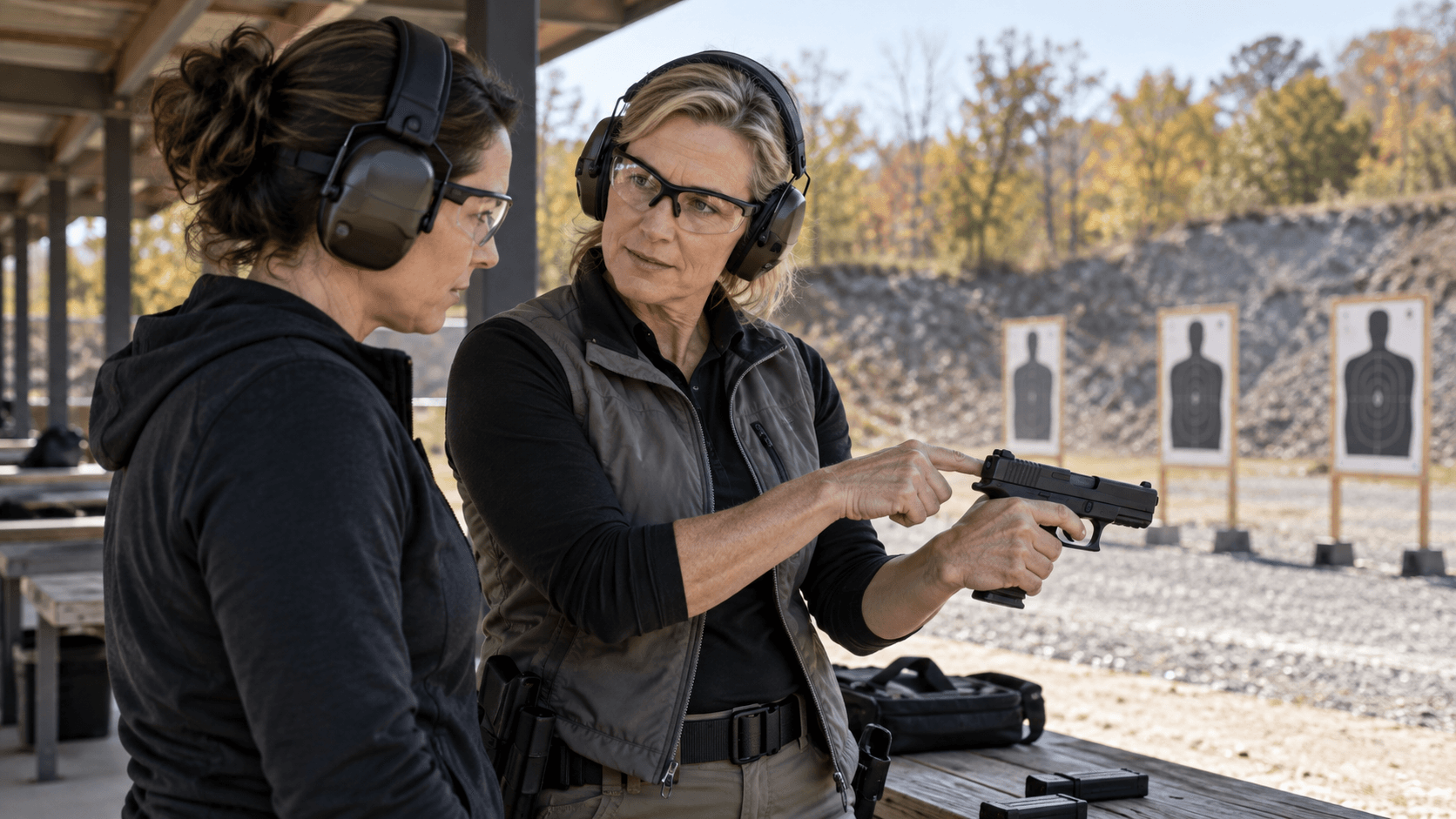
With women who have trouble with stance, I use different phrasing. I have them tuck their core in a specific way, one I walk them through in person. It's a cue women tend to understand right away.
Once they get it, their shoulders and arms relax and the stance starts to feel natural instead of forced. The best part is that they laugh and then just assume the position.
That tells me the cue worked. They are no longer trying to hold a pose. They know what the position is supposed to feel like.
Stance and breathing should feel natural enough that the shooter can focus on shooting, not on remembering a list of body positions. Sometimes the difference is not changing the technique. It is changing the explanation.
Sometimes the difference is not changing the technique. It is changing the explanation.
Whose Technique Is She Using?
There is another pattern I see with women coming into firearms training. Some arrive with habits they did not really choose for themselves.
Too many women have been taught by a husband or significant other and arrive with a grip that does not fit them, an uncomfortable gun choice, or the idea that someone else should dictate what they use. Most of that advice is probably given with good intentions, but what works for one person does not automatically work for another.
A new shooter may assume that if something feels wrong, she is the problem. She may think she just needs to become stronger or try harder. That can make it difficult for her to question a grip, stance, or firearm choice that was never really comfortable for her in the first place.
That is where I think an instructor can do more than correct technique. We can help her ask what actually works for her. Can she control this grip? Does this stance feel stable? Is this firearm comfortable? Can she manipulate it safely and confidently?
Those questions help move the student toward independence. I do not want to replace one person's instructions with mine forever. I want the shooter to understand enough to make informed choices for herself.
I want the shooter to understand enough to make informed choices for herself.
She does not have to reject every piece of advice someone has given her. She needs enough knowledge and confidence to decide what works for her, what does not, and why.
That is why mindset and technique are connected for me. When a student starts to feel accomplished, she carries herself differently. She is more willing to try, less likely to treat every mistake as failure, and more able to recognize what she is learning.
I know that because I had to fight for my own competence. I did not begin this journey already confident. I struggled, and that struggle is part of how I teach now. When I see a student frustrated with herself, I do not look only at the target. Sometimes the bigger problem is the belief that she is not capable of becoming the shooter she wants to be.
The part I want a new instructor to remember is simple: believe that you can help someone feel accomplished and safe, and help her continue on the path to competence.
And perhaps one day, without realizing when the transition happened, somebody else will call her name on the range and ask for help. That may be the moment she realizes just how far she has come.