
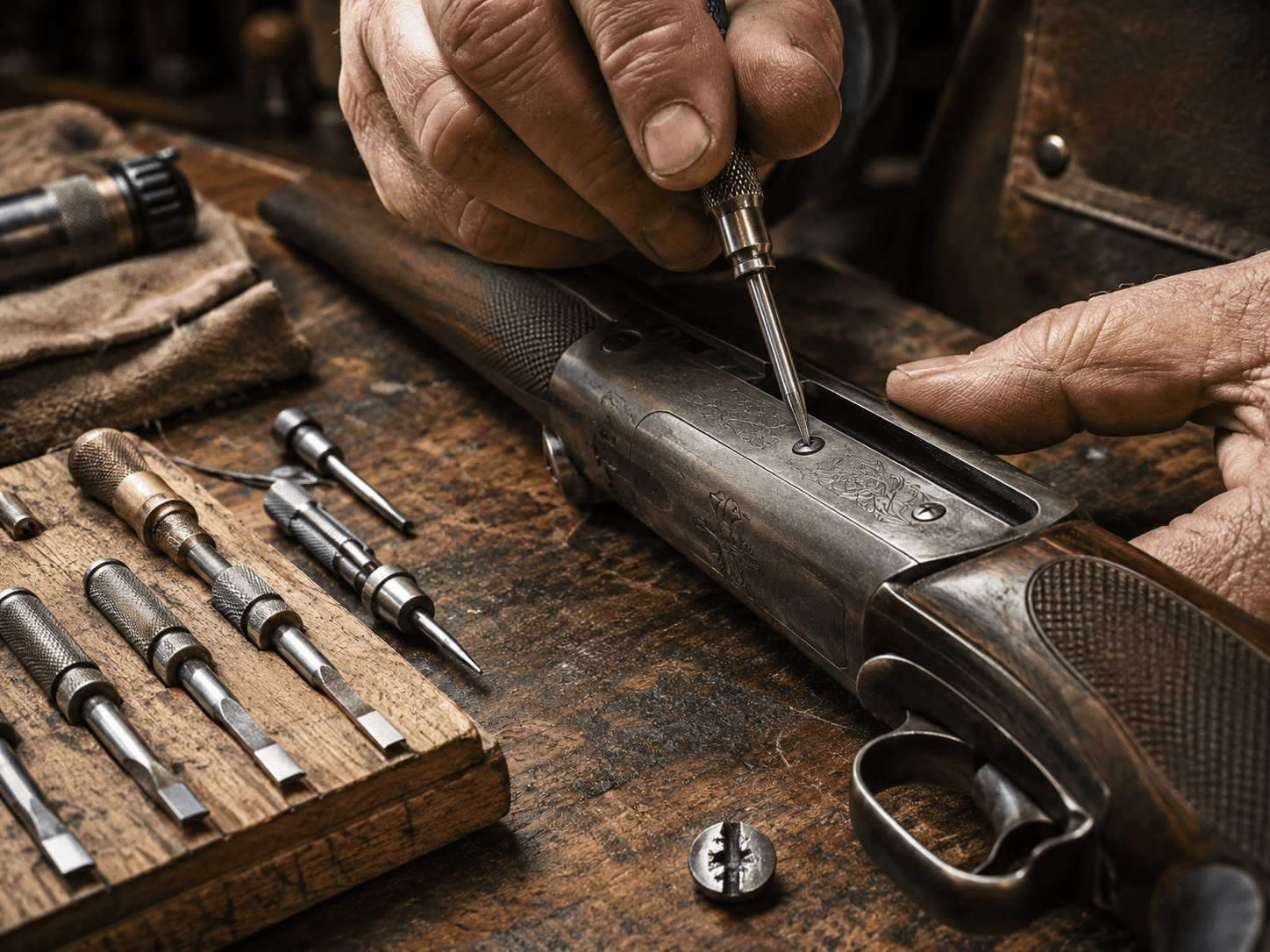
Most people imagine gunsmithing through the larger jobs.
A barrel being fitted. A revolver being timed. A trigger being tuned until it breaks clean at the right weight. That work exists, and it is part of the craft. But it is not most of the craft.
A great deal of gunsmithing comes down to screws.
Old screws. Staked screws. Damaged screws. Screws that were tightened by someone using the wrong tool. Screws on European shotguns with slots so thin that a normal screwdriver will do more harm than good. Scope ring screws rounded out by someone who kept turning long after the tool had already slipped.
That is the part of the trade most people never see.
I have been gunsmithing for 45 years in Albany, New Hampshire, and I will say something that may sound too simple until you have spent enough time at a bench: one of the most important tools in a gunsmith shop is a screwdriver. Not just any screwdriver. A screwdriver that actually fits the screw.
That distinction matters.
A driver that almost fits is not good enough. Almost fit is how slots get widened, heads get scarred, finishes get damaged, and simple jobs become expensive recoveries.
On older guns especially, the screw is often part of the history of the firearm. Once it is damaged, the repair is no longer just mechanical. It becomes cosmetic, historical, and sometimes irreversible.
I use Grace screwdrivers. I also use Brownells Magna-bits. Both are excellent, but no commercial set covers everything a working gunsmith sees. That has always been the problem. The job does not adjust itself to the tool drawer. The tool has to be adjusted to the job.
For most of my career, that meant using the mill.
I would clamp a machinist vee block in the mill vise, chuck up a carbide burr or stone, and reshape the screwdriver tip to fit the slot. With a dividing head, the same approach works for Phillips and Allen bits. It works, and it is accurate. But it is still a setup.
That matters in a one-man shop. A five-minute tool correction can turn into a fifteen-minute setup, and that time has to come from somewhere. It either comes out of the quote, out of the schedule, or out of the gunsmith's pocket.
This is one of the realities people miss when they talk about shop equipment. A mill or lathe is not just the machine. I could not do my work without mine, but the purchase price is only the beginning. I have roughly three times the cost of each machine tied up in tooling, cutters, fixtures, and accessories. Then there are the fixtures I had to make myself because nobody sells exactly what a particular job requires.
The machine is the foundation. The tooling is what makes it useful.
The machine is the foundation. The tooling is what makes it useful. That is why small bench tools matter more than people think. A tool does not have to replace a mill to be valuable. If it keeps the mill from being pulled into every small correction, it has already changed the economics of the bench.
That is the real lesson here, and it extends beyond any single product. The hidden cost in a working gunsmith shop is not the expensive machine that sits in the corner. It is the accumulated time spent working around small problems that never quite got solved. A setup here, a workaround there. Multiply that across a year of bench work and it becomes significant. The jobs that should take twenty minutes take forty. The quote that covers the work stops covering it. The margin disappears before anyone notices where it went.
Screwdrivers are where this shows up most often, because screws are where the work shows up most often. Not trigger jobs. Not barrel fitting. Screws. The ones that were installed by someone without the right tool, or torqued down by someone without a wrench, or left to corrode for fifty years in a gun that nobody touched until now.
Getting those screws out cleanly, without widening the slot or scarring the head or marring the surrounding finish, requires a driver that fits the slot exactly. Not approximately. Exactly.
For older Belgian and German shotguns, some slots run as narrow as ten thousandths. If the driver is off, it will skate before you can correct it. The result is a damaged gun and a job that just became significantly more complicated than it needed to be.
The same principle applies to stripped Allen heads in scope rings. That problem walks into the shop regularly. Someone installs a scope without a torque wrench, overtightens the screws, and rounds the socket until a standard Allen key will no longer bite. There are ways to address it. Extraction bits sometimes work. Drilling is sometimes necessary. But both approaches carry risk that a proper fit would have avoided entirely.
Being able to reshape a bit quickly, at the bench, without pulling the mill into it, changes how those problems get handled. It does not eliminate the problem. It keeps the problem from becoming something larger.
That is what most people miss when they evaluate shop tools. They ask whether a tool can do something the other tools already do. The better question is whether it changes the cost of doing it. Whether it keeps a minor obstacle from becoming a full setup. Whether it puts twenty minutes back into a job that was already priced tight.
In gunsmithing, that arithmetic runs constantly in the background. The shops that stay open are the ones that solve it.