
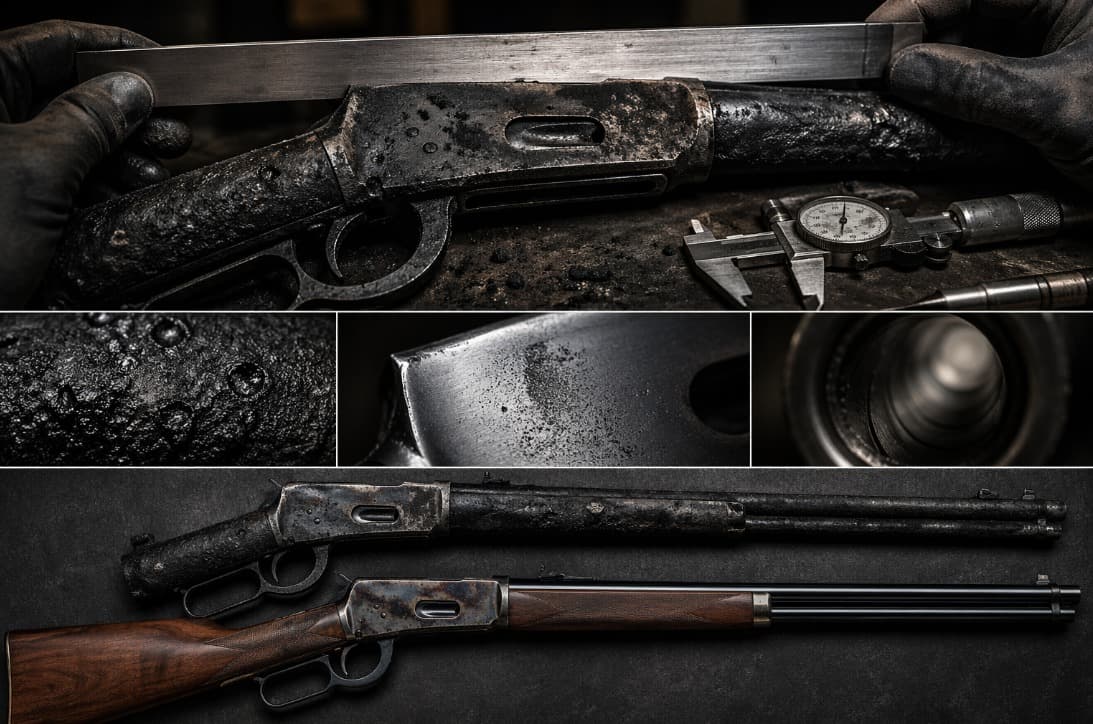
Six shops. Same answer. None of them ran a gauge. Not one.
The customer was in his mid-eighties. Late-1890s Winchester Model 94 Takedown, no stocks, metal black from soot, pulled from beneath a collapsed tin roof in the Blue Ridge Mountains after the house burned down. He had driven it to each shop himself, wrapped in a burlap feed sack. His older brothers had carried that rifle hunting when he was still too young to go along. Seventy years of memory in a sack, and six shops sent it home.
None of them had put a tool on it.
WHAT FIRE ACTUALLY DOES TO METAL
Fire-damage triage is a metallurgical question, not a visual one. Appearance tells you what the fire touched. It does not tell you what it broke.
Three thermal thresholds matter at the bench. Above approximately 400 degrees Fahrenheit, hardened components begin losing temper: sears, disconnectors, bolt faces. Above 600 degrees, dimensional distortion becomes likely in the receiver. Above 800 degrees, structural compromise is probable. These are practical bench indicators, not published metallurgical absolutes. Platform, exposure duration, and heat distribution all affect the actual outcome. But they are readable. A receiver that has crossed 600 degrees shows warping at the critical flats. Action faces past 700 degrees develop a crystalline surface texture that looks nothing like ordinary oxidation under a 10x loupe. The bluing-to-scale conversion on barrel flats is one of the cleaner external indicators.
These signatures require a loupe and a straightedge. The shops turning fire-damage cases away are not reading them. They are reading the soot.
Appearance tells you what the fire touched. It does not tell you what it broke.
THE SEQUENCE: WHY THE INDUSTRY SKIPS IT
There is a fixed diagnostic sequence for fire-damaged firearms. Each step is a gate. Fail it and nothing downstream matters. The sequence is not complicated. What is complicated, apparently, is the willingness to run it.
Receiver geometry comes first. A straightedge across all critical flats. Warping beyond .002 inches at the receiver ring or tang is structural. That finding ends the job honestly, with a measurement behind it. Without that measurement, the shop is not declining the job. It is guessing.
Surface texture is second. Crystalline or granular scaling under soot indicates temperatures above 700 degrees. Smooth soot over an intact surface indicates survivable exposure. A gunsmith who has seen both once will not confuse them again. Most never look.
Bore, bolt face, and headspace follow in sequence. Plug gauge at chamber, mid-barrel, and muzzle. GO/NO-GO on the bolt face. Not estimation. These are the measurements that produce a defensible answer. Everything before them is atmosphere.
The industry has reclassified a measurement problem as a judgment call. That is where most of the damage happens.
The industry has reclassified a measurement problem as a judgment call. That is where most of the damage happens.
WHAT REJECTION WITHOUT ASSESSMENT COSTS
I declined a job recently. Pre-war bolt-action, house fire, customer convinced it could be saved. The receiver ring showed warping of .006 inches across the critical flat, three times the structural threshold. Re-barreling not viable. Headspace not correctable. The job ended at step one, correctly, with a measurement behind the answer.
That is what honest rejection looks like. The customer received an accurate assessment, not a glance. Those are not the same service.
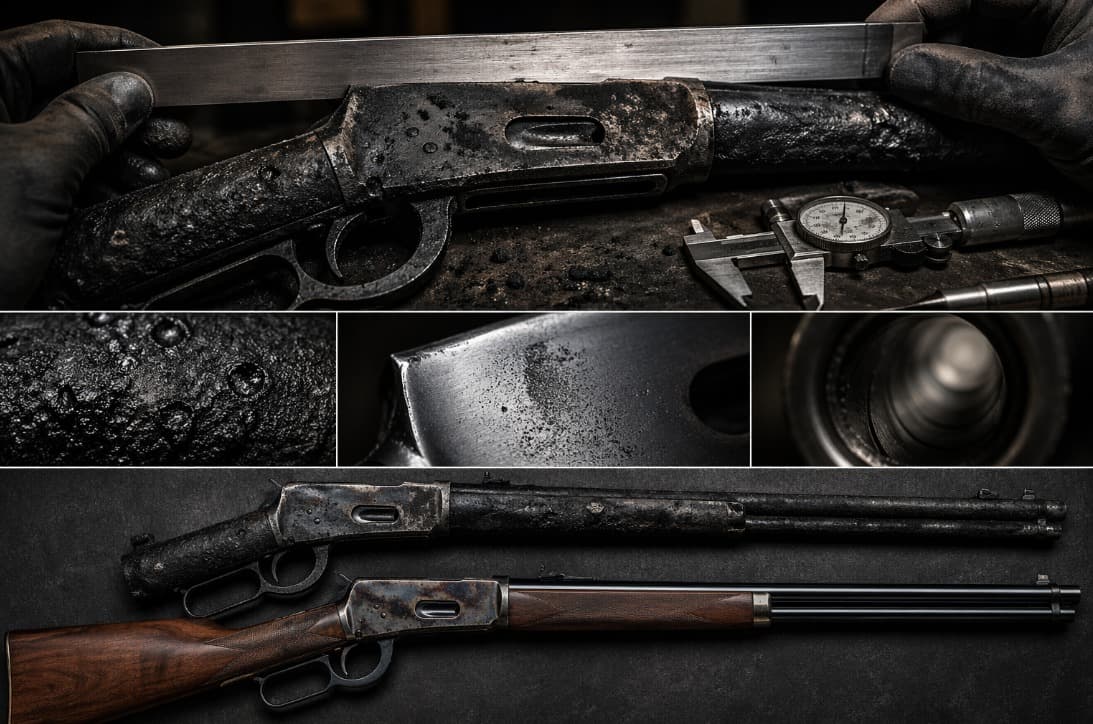
The Winchester had been through six of the other kind. Cosmetically, the two rifles were not far apart coming in. One was structurally compromised. One was not. Appearance could not make that distinction. Only the measurement could. The shops that turned the Winchester away had not made a diagnosis. They had declined to make one, and handed the customer their silence as a verdict.
THE RIFLE THAT SHOULD HAVE BEEN GONE
The rifle gauged clean. Receiver geometry intact. Bore serviceable at chamber, mid-barrel, and muzzle. Bolt face showed cosmetic pitting within headspace tolerance: polished out, re-gauged, within spec. Every thermal indicator on the barrel flats and action faces below structural threshold. The rifle looked ruined. It was not ruined.
The restoration required hand work most shops have stepped away from. Half-octagon, half-round barrel profiles do not tolerate machine work at the transition zone. Octagon flats draw-filed by hand, flatness checked with a straightedge at every fourth pass. Round section worked through progressive grit, each pass perpendicular to the last. Hot caustic bluing at 285 to 295 degrees. New walnut blanks inletted to the receiver by hand. Springs replaced. Brass assessed and fitted to spec.
It took weeks. The capability required is not common. But the decision to attempt it took under an hour to justify. One sequence. One set of gauges. That is the entire threshold between six rejections and a completed restoration.
When I returned the rifle, he set it across his forearms the way you carry something that weighs more than its parts. After a moment he brought out eight more firearms, all Winchesters, all from the same fire. One was a shotgun his father had given him as a teenager, the first time he was trusted with a gun in the field.
Walking back to my truck I could hear him through the door, speaking to it the way a person speaks to someone they thought they had lost.
Fifty cents of tool time against eighty years of a man's life.
A WILLINGNESS PROBLEM
Most customers who walk in with a fire-damaged firearm already believe it is gone. That belief came from somewhere. Usually a shop that did not check.
The industry has been handing out conclusions it has not earned, and the people paying for it are not the shops. They are the men driving rifle after rifle from door to door, looking for someone willing to put it on the bench.
Every measurement in this sequence costs under an hour. The diagnostic tools are not exotic. What the sequence requires is not capability.
It is willingness. And willingness is not a skill gap. It is a choice.