
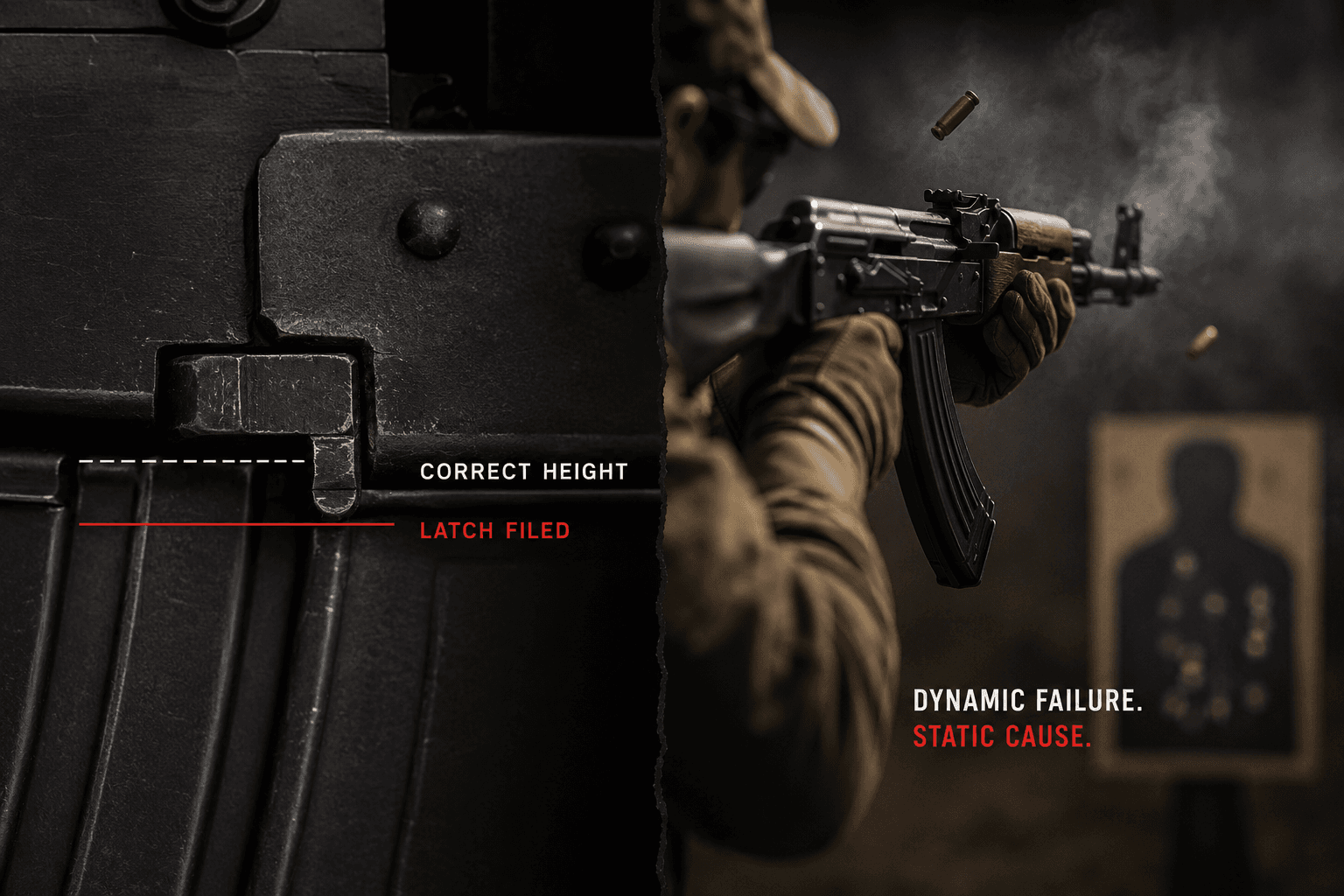
Most AK feeding failures get misread. The bolt overrides a round, or chambers at an angle, and attention goes to the action. The gas system gets checked. The bolt carrier gets inspected. The magazine gets swapped. Sometimes the rifle improves. Often it does not. The actual cause sits at the rear of the magazine well, unchanged and unexamined.
The magazine latch has been filed down.
This modification appears in shops with regularity. The owner encountered tight fitment. A surplus magazine that required force to seat. An imported receiver that did not match the magazine he had been running. The latch looked like the obstruction. He removed material. The problem felt solved.
It was not solved. It was deferred.
The latch on an AK-pattern rifle is not a retention device. It is a positioning component. The magazine must align with the bolt path and feed ramp geometry within a narrow window for reliable feeding.
The front trunnion sets the fixed reference at the front. The latch sets it at the rear. Both have to be right. One of them can be filed down.
When material is removed from the latch, the rear of the magazine drops. The feed angle changes. The cartridge is presented below its designed height.
The failure mode looks dynamic. The cause is static.
The bolt overrides the round, or strikes at an angle, or fails to engage consistently. It looks like a cycling problem because that is where it surfaces. The moving parts behave exactly as designed. They are operating against a starting position that is no longer correct.
The AK platform has a reputation for tolerance. It functions across a range of conditions. This reputation creates a specific failure of reasoning: owners assume that small material removal falls within the system margin. What that reasoning misses is that the tolerance is in how the parts work together, not in one part you can change by itself.
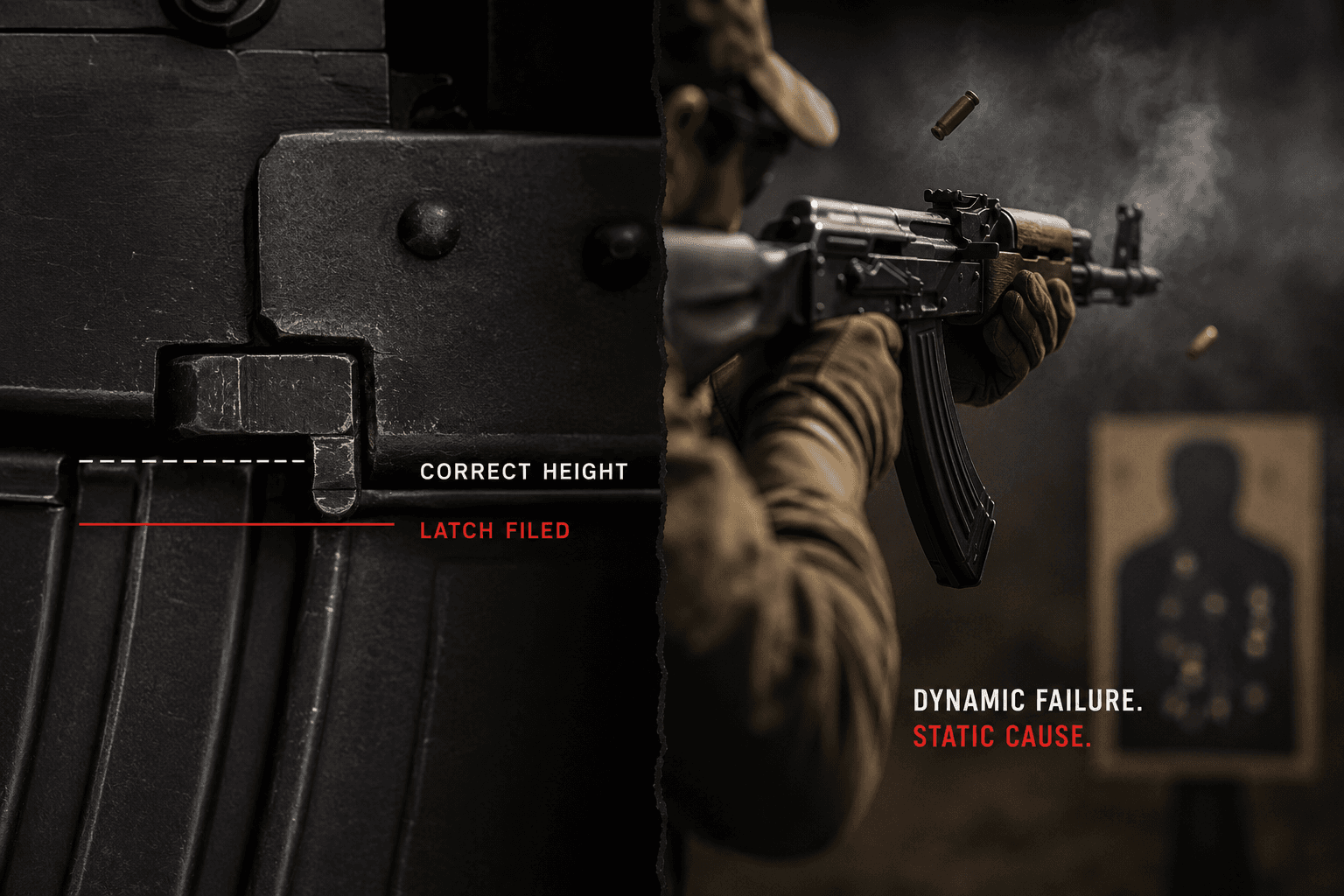
Alter one control point and the margin is not redistributed. It is consumed.
Magazine fitment variation is real. Surplus magazines do not share identical dimensions. Receiver openings vary within acceptable limits. These combinations create tight or loose fitment depending on the pairing. The correct response is to identify which component is outside the desired range. That is almost never the latch.
Owners act before diagnosing. The problem is approached as friction when it is positional.
Tight fitment is a dimensional mismatch between the magazine body, the receiver opening, or the trunnion interface. Filing the latch reduces resistance at insertion. It does not address the mismatch. It removes the fixed reference that everything else depends on. The rifle becomes easier to load and harder to trust.
In the shop, the pattern shows up the same way every time. Tight fitment reported. Latch filed. Feeding failures develop under use. The modification is the diagnosis, once you know the sequence.
From a diagnostic standpoint, the shift is simple: feeding failures require checking relationships, not just components. Where is the cartridge being presented relative to the bolt path? Is the magazine stable under recoil? Does position change with slight movement at the rear? These questions locate the cause faster than any parts swap.
The broader principle is not AK-specific. Any system where geometry defines function is vulnerable to this class of error. A control point is modified without understanding its role. The error is absorbed silently until the system runs under load. By the time failure appears, the cause is assumed to be elsewhere.
For the AK, the correction is to treat the latch as a fixed reference and address variation in components designed to vary. Select magazines with consistent dimensional tolerances. Evaluate the receiver and trunnion interface if fitment is a recurring issue. Do not reduce the engagement surface that positions every round the rifle will ever feed.
The latch is not the problem.
Changing it creates one.