
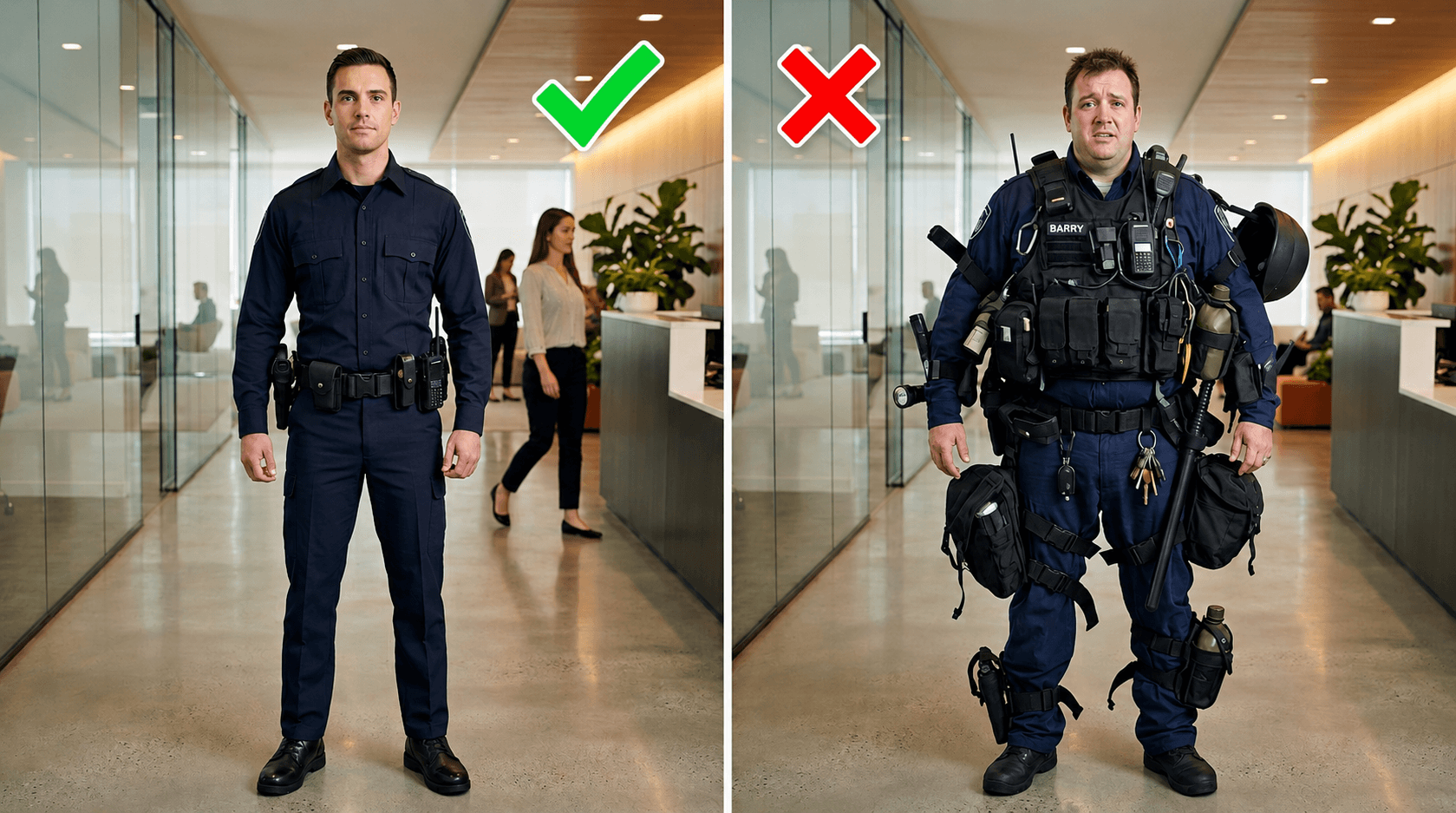
I find myself explaining this idea to people all the time. It applies whether you're an armed professional on duty or a prepared citizen going about your day. The principle is the same: Carry Everything You Need, and Nothing You Don't.
It sounds simple. It isn't.
New security guards are often enamored with kit. New concealed carriers get carried away and start lugging around more gadgetry than a special operator on a twelve-hour patrol. It's understandable. When you're new to the responsibility of being armed, gear feels like preparation. More gear feels like more preparation.
It's not.
Too much kit becomes a detriment. It weighs you down and slows you down. It leads to fatigue and, over time, chronic injury. When you need something fast, you can't find it. In a professional context, it looks exactly like what it is: someone who hasn't figured out what the mission actually requires.
I've seen this play out in training more than once. A new guard shows up with everything on his belt: extra mags, flashlight, fighting knife, multi-tool, taser, pepper spray, restraints, medical gear, radio, dump pouch, chem lights, gloves -- all things he thinks he might need. We put him through a simple movement and response drill. Within seconds, the problems show up. He's adjusting gear instead of moving. His draw is slower because something is in the way. He bangs into doorways on room entries. When we add a second task, communication or movement with another person, he starts losing track of what's where. Nothing failed mechanically. The setup failed him.
Over-carrying isn't a discipline problem. It's a feedback problem.
But here's what most people miss: over-carrying isn't a discipline problem. It's a feedback problem.
Most people don't over-carry because they want to. They do it because they don't have a reliable way to measure what actually matters under pressure. In the absence of real feedback -- training that replicates stress, environment, and task demand -- gear becomes the substitute for certainty. If you don't know what you'll need, you carry everything. That's not irresponsible. That's what happens when training doesn't close the loop.
The fix isn't subtraction. It's clarity. And clarity comes from training that gives you honest information about what you actually used, what slowed you down, and what never left the belt and pouches.
That kind of clarity doesn't come from guessing. It comes from running your setup in conditions that force decisions. Timed drills. Movement. Working one-handed. Managing another person while accessing gear. When you train that way consistently, patterns show up fast. You see what you actually reach for. You see what gets in the way. You see what never gets used at all. That's where the load gets refined, not by opinion, but by repetition under constraint.
Mission Drives the Load
The right question isn't what could I possibly need. It's what do I reasonably expect to need for this mission. Whether you're running a corporate security shift, volunteering at a house of worship, or going about your day as a responsibly armed citizen, you should be able to answer that before you walk out the door.
On duty: Have everything you reasonably expect to need within arm's reach. Generally speaking, that will be a duty firearm, two spare magazines, a handheld light, a non-/less-lethal option, an IFAK consisting only of items you’re trained to use, a means of communication, and any tools specific to the assignment. Not more. Not less.
Off duty: The calculus shifts. You're a private citizen, or an off-duty professional, not an operator running a mission. Concealment, comfort, and accessibility matter more. A compact pistol in a quality holster with a spare magazine will serve you far better than a full-size duty gun and three mag carriers that print through your shirt and slow your draw. Other than a daily utility knife, a task light, and tourniquet if that’s your thing, leave the rest at home.
A tool you can't access quickly is not a tool. It's weight. This applies to your firearm, your medical kit, your phone, and every piece of equipment on your body or in your bag.
Ask yourself: Can I access this one-handed? With my non-dominant hand? While moving? While managing another person? If the answer to any of those is no, the placement or the item needs to change.
This is especially true for medical gear. A tourniquet buried at the bottom of a bag is a tourniquet that will cost you time you may not have. It belongs on your body, staged where you can get to it with either hand.
There's a progression here that most people skip. Early on, you don't know what matters, so you compensate with volume. That's normal. The problem is staying there. Without structured training, people build habits around that early uncertainty. The gear stays, even as skill improves. What should have been a temporary phase becomes a permanent setup.
Experienced operators don't start lean. They become lean by removing what they've proven they don't need. That process doesn't happen automatically. It happens through training that creates enough repetition under pressure to show you what's working and what's just taking up space.
Experienced operators don't start lean. They become lean by removing what they've proven they don't need.
The Professional Standard
There's a reason experienced operators run lean. It's not because they care less about being prepared. It's because they've done the honest work of figuring out what preparation actually looks like. They trained with their gear, identified what slowed them down, and stripped it away. What's left is exactly what the mission requires.
That’s the standard. Not carrying as much as possible. Not carrying as little as possible. Carry what the mission requires, staged where you can use it, and nothing else.
If you can't justify it under pressure, it doesn't belong on your body. Most people never test their setup hard enough to find that out.